
Introduction: WhatsApp VBScript Campaign — Why It Matters
The WhatsApp VBScript Campaign is a newly identified malware operation that uses deceptive business and financial documents to infect users through WhatsApp Desktop and WhatsApp Web. According to research published by Kaspersky, the campaign has been observed targeting users across multiple countries, including India, Brazil, Malaysia, Singapore, the United Kingdom, Australia, and several others.
The WhatsApp VBScript Campaign is particularly concerning because it abuses legitimate software rather than deploying traditional malware alone. Victims who open malicious VBScript files may unknowingly install ManageEngine RMM Central, a legitimate remote management tool that can provide attackers with remote access to compromised systems.
Security researchers warn that the campaign could enable cybercriminals to conduct additional malicious activities after gaining access to infected devices.
What is WhatsApp?
WhatsApp is one of the world’s most widely used messaging platforms, owned by Meta. It supports personal and business communication through mobile devices, WhatsApp Desktop, and WhatsApp Web.
Due to its massive global user base and trusted reputation, WhatsApp has become an attractive target for cybercriminals seeking to distribute malware, phishing links, and social engineering attacks.
As threat actors increasingly exploit trusted communication channels, organizations are being forced to strengthen awareness training and endpoint security measures. Security experts warn that the WhatsApp VBScript Campaign demonstrates how trusted messaging platforms can be abused to distribute malware at scale.
What Caused the Incident?
The campaign relies heavily on social engineering techniques rather than exploiting a software vulnerability.
Attackers reportedly send malicious files disguised as legitimate business documents, financial reports, invoices, or account statements. Because these files appear relevant to workplace communication, victims may be more likely to open them without suspicion.
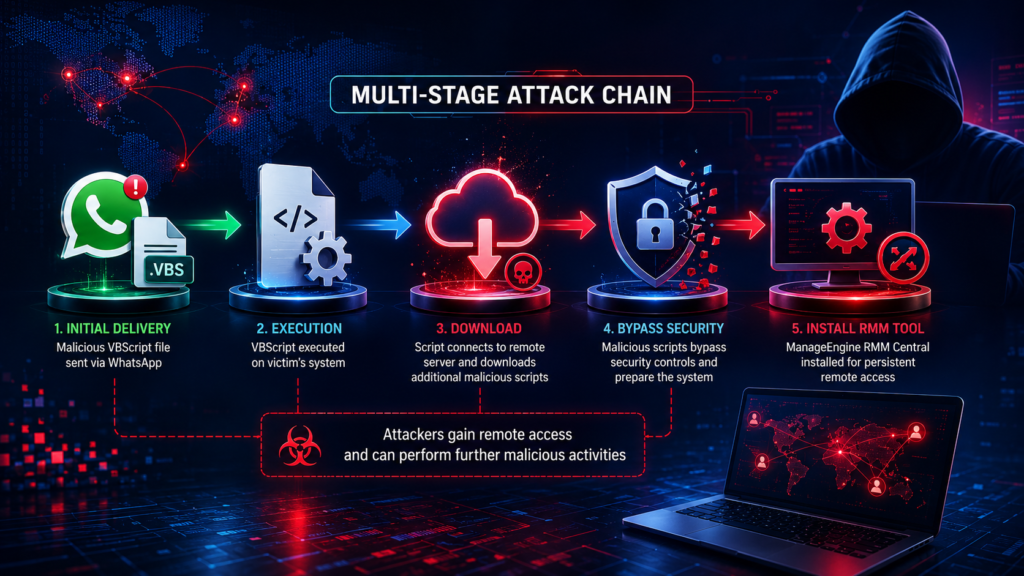
Researchers found that the attack chain uses VBScript files that initiate a multi-stage infection process designed to evade detection and install additional components. The success of the WhatsApp VBScript Campaign relies heavily on social engineering tactics that convince users to open malicious VBScript attachments.
WhatsApp VBScript Campaign: Full Technical/Factual Breakdown
Timeline of Events
- Security researchers at Kaspersky identified the campaign during ongoing malware investigations.
- Attackers distributed malicious VBScript files through WhatsApp messages.
- Victims opened files masquerading as financial or business documents.
- The scripts downloaded additional payloads from attacker-controlled infrastructure.
- Security controls were reportedly bypassed through multiple script stages.
- ManageEngine RMM Central was installed on compromised devices.
- Researchers identified possible infrastructure overlaps with previous Gh0st RAT and ValleyRAT-related operations.
What Data/Systems Were Allegedly Affected
Although researchers have not disclosed specific victim numbers, compromised systems may face exposure to various risks.
Potentially affected assets include:
- Windows endpoints
- Business workstations
- Corporate networks
- User credentials
- Sensitive documents
- Financial records
- Internal communications
The exact number of affected organizations and users has not been publicly disclosed.
Potential Risks & Impact
Identity and Financial Risk
Once attackers obtain remote access to a device, they may be able to monitor user activity, collect credentials, and access sensitive information. Organizations affected by the WhatsApp VBScript Campaign could face credential theft, unauthorized remote access, and potential data exposure.
Potential risks include:
- Credential theft
- Financial fraud
- Unauthorized account access
- Data exfiltration
- Banking information exposure
Business and Reputational Risk
Organizations whose employees unknowingly execute malicious scripts could face significant operational consequences.
Potential business impacts include:
- Network compromise
- Lateral movement within corporate environments
- Business interruption
- Loss of customer trust
- Incident response costs
Businesses can review additional cyberattack coverage in CyberNexora’s Cyber Incidents section.
Regulatory and Compliance Risk
Organizations handling customer or regulated data may face compliance concerns if attackers gain access to protected information.
Possible implications include:
- Data protection investigations
- Regulatory reporting requirements
- Contractual obligations
- Security audit findings
Companies operating in regulated sectors should maintain incident response procedures aligned with frameworks published by the Cybersecurity and Infrastructure Security Agency (CISA).
Official Response / Statement
Kaspersky researchers disclosed details of the campaign and highlighted its abuse of legitimate remote management software.
According to the researchers, attackers leveraged VBScript files disguised as documents such as:
- Financial Reports.vbs
- Account Statement.vbs
The researchers also noted possible infrastructure connections to activity previously associated with Gh0st RAT and ValleyRAT campaigns.
At the time of writing, no public statement has been released by the operators behind the campaign, and attribution remains unconfirmed.
Industry Context: Why This Type of Attack is Increasing
Threat actors are increasingly using legitimate software to avoid detection by traditional security tools.
This tactic, often referred to as “living off the land,” allows attackers to blend malicious activity with normal administrative operations. Remote Monitoring and Management (RMM) software has become particularly attractive because it is commonly used by IT teams and may not immediately trigger security alerts.
Recent cybercrime trends show growing abuse of:
- Remote management tools
- Legitimate cloud services
- AI-assisted phishing campaigns
- Multi-stage malware loaders
The WhatsApp VBScript Campaign reflects a broader trend in which threat actors increasingly abuse legitimate software and communication platforms to evade detection. Readers interested in similar threat trends can explore CyberNexora’s Learn & Protect resources and Resources section.
How to Protect Yourself / Your Organization
Organizations and individuals can reduce their exposure by following these security practices:
- Never open unexpected VBScript (.vbs) attachments received through messaging platforms.
- Verify document authenticity with the sender through a separate communication channel.
- Disable unnecessary script execution where possible.
- Deploy endpoint detection and response (EDR) solutions capable of monitoring script activity.
- Restrict installation of unauthorized remote management tools.
- Maintain updated antivirus and endpoint protection software.
- Implement application allowlisting policies.
- Conduct regular cybersecurity awareness training for employees.
- Monitor outbound network connections for suspicious activity.
- Review security guidance from the National Institute of Standards and Technology (NIST).
Organizations can also review practical security recommendations within CyberNexora’s Learn & Protect category. Defending against the WhatsApp VBScript Campaign requires a combination of user awareness, endpoint protection, and strict application control policies.
Indicators of Compromise (IoCs)
The following indicators may help security teams identify suspicious activity associated with the campaign:
- Unexpected .vbs files received through WhatsApp
- Files named:
- Financial Reports.vbs
- Account Statement.vbs
- Unusual PowerShell activity
- Unauthorized installation of ManageEngine RMM Central
- Suspicious outbound connections
- Unexpected remote access sessions
- New scheduled tasks created without authorization
Organizations should investigate any unusual remote management software installations that were not approved by IT administrators.
Key Takeaways
- Cybercriminals are using WhatsApp to distribute malicious VBScript files.
- The campaign targets WhatsApp Desktop and WhatsApp Web users globally, including India.
- Attackers abuse ManageEngine RMM Central to gain remote access.
- Researchers identified possible links to infrastructure associated with previous Gh0st RAT and ValleyRAT operations.
- Users should avoid opening unexpected script-based attachments, even when sent by known contacts.
Conclusion: WhatsApp VBScript Campaign and What Happens Next
The WhatsApp VBScript Campaign highlights how threat actors continue to combine social engineering with legitimate administrative tools to bypass traditional security defenses.
As investigations continue, organizations should monitor for suspicious script execution, unauthorized remote management software installations, and unusual network activity. As investigations continue, the WhatsApp VBScript Campaign serves as a reminder that even trusted messaging platforms can become effective malware delivery channels when users are not vigilant. Cybersecurity teams should also stay informed through CyberNexora’s Cyber Incidents coverage to track emerging threats and evolving attack techniques.