
Introduction: Showboat Malware 2026 — Why It Matters
Showboat Malware 2026 has emerged as one of the most stealthy cyber espionage threats uncovered this year. Security researchers report that the malware quietly targeted telecommunications companies across the Middle East for nearly four years while remaining invisible to traditional antivirus solutions.
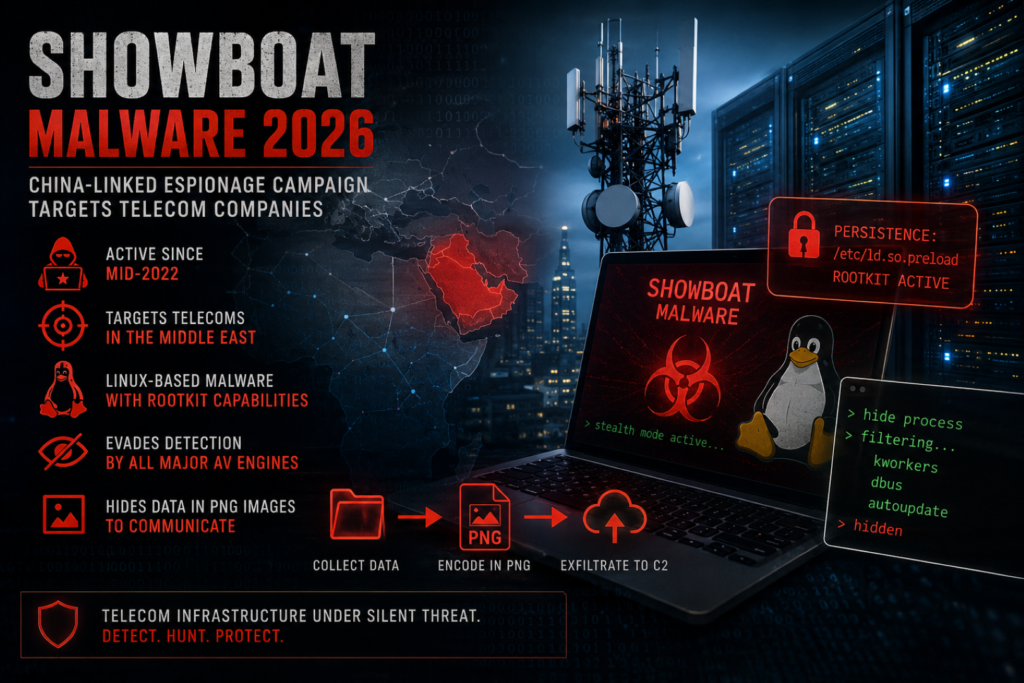
According to research disclosed by Picus and shared with Cyber Security News (CSN), Showboat Malware 2026 has reportedly been active since mid-2022. The Linux-based malware framework allegedly evaded detection by all 65 antivirus engines on VirusTotal during testing conducted in May 2025.
The campaign appears highly targeted rather than financially motivated. Instead of encrypting systems or demanding ransom payments, the malware provides long-term remote access, allowing threat actors to maintain persistent visibility into critical telecommunications infrastructure.
What is Showboat Malware?
Showboat is a sophisticated Linux-based malware framework designed for long-term cyber espionage operations. It specifically targets AMD x86-64 Linux environments commonly used within enterprise and telecommunications infrastructure.
Unlike ransomware or destructive malware, Showboat focuses on stealth, persistence, and intelligence collection. The framework enables attackers to gather system information, monitor network activity, transfer files, and maintain remote access without attracting attention.
Researchers believe the malware was specifically engineered to operate inside critical communication networks where uninterrupted access can provide significant intelligence value over extended periods.
Who is Behind the Incident?
Researchers attribute the activity to China-linked threat actors with moderate-to-high confidence.
The attribution reportedly stems from:
- Command-and-control infrastructure linked to Chengdu, China
- Operational similarities to previously documented Chinese advanced persistent threat (APT) campaigns
- Exclusive targeting of Middle Eastern telecommunications providers
- Long-term intelligence collection objectives consistent with nation-state espionage
While no public attribution has been officially confirmed by government agencies, analysts note that the tactics, techniques, and procedures closely resemble those observed in other Chinese cyber espionage operations.
Showboat Malware 2026: Full Technical/Factual Breakdown
Timeline of Events
- Mid-2022: Researchers believe the campaign first became active.
- 2022–2025: Malware allegedly remained undetected within targeted telecom environments.
- May 2025: VirusTotal testing reportedly showed zero detections across 65 antivirus engines.
- April 2026: Public detection and analysis of Showboat begins.
- June 2026: Researchers publish technical findings documenting the framework.
The timeline suggests that Showboat Malware 2026 operated as a long-term espionage platform, allowing attackers to maintain access for years before public detection.
What Data/Systems Were Allegedly Affected
Researchers indicate that Showboat collects extensive host and operational information, including:
- Hostname and system identification details
- Linux operating system information
- Running process information
- Network-related configuration data
- Screenshots captured from infected systems
- File system information
- Command execution results
The malware primarily targets:
- Linux servers
- Telecommunications infrastructure
- Network management systems
- Critical communications environments
How Showboat Operates
Once executed, Showboat retrieves an encrypted configuration file from its command-and-control (C2) server.
The configuration contains:
- C2 server addresses
- Communication ports
- Sleep intervals
- Operational instructions
Researchers found that the configuration is protected using a hardcoded XOR key:
look me, AV!
After decrypting the configuration, the malware begins communicating with attacker-controlled infrastructure using randomized beacon intervals. This behavior helps avoid detection by security monitoring tools that often look for predictable communication patterns.
Collected data is encrypted, Base64 encoded, and embedded within PNG image fields before transmission. This technique makes malicious traffic appear similar to normal image-related communications.
Linux Persistence and Rootkit Functionality
One of the most concerning capabilities involves Showboat’s “hide” command.
When activated, the malware:
- Downloads a C source file from an attacker-controlled Pastebin page.
- Compiles the code directly on the victim system.
- Creates a shared object library.
- Uses Linux’s
ld.so.preloadmechanism to hook system calls.
This process enables rootkit-like behavior that conceals malware processes from standard Linux administration tools such as:
- ps
- top
- process monitoring utilities
As a result, administrators may be unable to see malicious processes even while actively investigating a compromised server.
Showboat Malware 2026: Potential Risks & Impact
Identity and Intelligence Collection Risk
Telecommunications providers manage enormous volumes of sensitive communications data.
If attackers maintain long-term access, they may potentially:
- Monitor communication patterns
- Gather subscriber-related information
- Conduct intelligence collection activities
- Map critical infrastructure environments
Business and Reputational Risk
Successful compromises of telecom operators can lead to:
- Loss of customer trust
- Service disruptions
- Increased incident response costs
- Operational security concerns
For telecom companies, even the perception of unauthorized network access can create significant reputational challenges.
Regulatory and Compliance Risk
Organizations operating critical infrastructure face growing regulatory obligations.
Potential consequences may include:
- Regulatory investigations
- Security audits
- Compliance reviews
- Mandatory reporting requirements
Businesses can review broader cybersecurity compliance developments through CyberNexora’s Laws & Government coverage.
Official Response / Statement
At the time of reporting, no public statement has been released by any identified telecom victim organization.
The technical findings originate from research conducted by Picus and subsequently shared through Cyber Security News. Researchers continue to analyze the malware’s capabilities and operational history.Security researchers continue monitoring Showboat Malware 2026 to determine the full scope of the campaign and whether additional telecom providers may have been affected.
No government advisory specifically naming Showboat has been publicly issued at the time of writing.
Industry Context: Why This Type of Attack Is Increasing
Nation-state cyber espionage campaigns increasingly focus on telecommunications providers because they sit at the center of digital communications ecosystems.
Several factors are driving this trend:
- Growing geopolitical tensions
- Increased reliance on digital communications
- Expansion of critical infrastructure networks
- Sophisticated stealth techniques that bypass traditional defenses
Advanced persistent threats (APTs) increasingly prioritize long-term access rather than immediate disruption. Similar trends can be observed across numerous incidents documented within CyberNexora’s Cyber Incidents section.
Organizations are also seeing more Linux-focused threats as enterprise workloads continue migrating to cloud and hybrid environments. Additional defensive guidance can be found in CyberNexora’s Learn & Protect resources.
The discovery of Showboat Malware 2026 highlights the growing sophistication of modern cyber espionage operations targeting critical infrastructure.
For broader threat-hunting guidance, security teams can also reference recommendations from the Cybersecurity and Infrastructure Security Agency (CISA) and the MITRE ATT&CK framework.
How to Protect Yourself / Your Organization
Organizations should take the following defensive measures:
- Audit Linux systems for unauthorized modifications to
/etc/ld.so.preload. - Monitor outbound traffic for suspicious communications disguised as image transfers.
- Deploy behavioral detection tools rather than relying solely on antivirus signatures.
- Implement network segmentation for critical telecom infrastructure.
- Conduct regular threat-hunting exercises focused on persistence mechanisms.
- Monitor process creation and compilation activity on production servers.
- Review Pastebin access logs for unusual retrieval activity.
- Simulate advanced persistent threat scenarios to identify detection gaps.
Security teams can also leverage practical guidance available in CyberNexora’s Resources section.
Organizations should evaluate whether their existing security controls can detect threats exhibiting behaviors similar to Showboat Malware 2026.
Indicators of Compromise (IoCs)
- Domain:
telecom.webredirect[.]org - File Name:
ukpkmkk.c - File Name:
ukpkmkk.so - File Path:
/etc/ld.so.preload - XOR Key:
look me, AV! - Process Filters:
- kworkers
- dbus
- autoupdate
Note: These indicators are intentionally defanged. Security teams should only re-fang and investigate them within controlled threat intelligence or security monitoring platforms.
Key Takeaways
- Showboat Malware 2026 reportedly remained hidden inside telecom environments for nearly four years.
- Researchers attribute the malware to China-linked threat actors with moderate-to-high confidence.
- The framework uses advanced Linux persistence and rootkit techniques.
- Telecommunications companies in the Middle East appear to be the primary targets.
- PNG-based data smuggling and randomized beaconing contribute significantly to its stealth capabilities.
Conclusion: Showboat Malware 2026 and What Happens Next
Showboat Malware 2026 highlights how advanced espionage-focused malware continues evolving beyond the capabilities of traditional signature-based security tools. The campaign demonstrates how sophisticated threat actors can maintain long-term access through layered stealth techniques and persistence mechanisms.
As researchers continue analyzing the malware, organizations operating critical infrastructure should closely review their Linux environments and threat detection capabilities.Security teams should closely monitor future intelligence reports on Showboat Malware 2026, as additional indicators, victim disclosures, or government advisories may emerge in the coming months. Businesses can stay informed about future developments through CyberNexora’s ongoing Cyber Incidents coverage.