
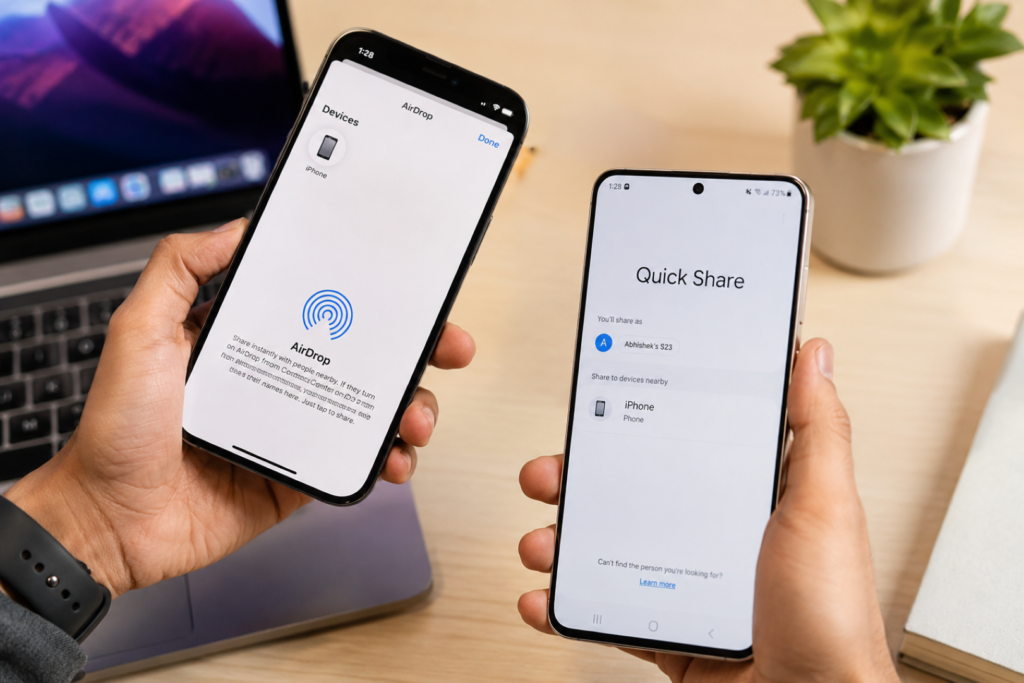
AirDrop Quick Share Flaws: Why It Matters
Security researchers have disclosed AirDrop Quick Share Flaws, revealing multiple vulnerabilities affecting Apple’s AirDrop and Samsung/Google Quick Share technologies. While no evidence of active exploitation has been reported, the flaws demonstrate that attackers located within wireless range may be able to crash services, bypass security checks, or manipulate file-sharing sessions under certain conditions.
The vulnerabilities were discovered by researchers Arash Ale Ebrahim and Nils Ole Tippenhauer from the CISPA Helmholtz Center for Information Security. Their findings show that several modern wireless sharing features—including AirDrop, AirPlay, Handoff, Universal Clipboard, Continuity Camera, NameDrop, and Quick Share—could become targets if users are nearby and vulnerable devices have not been updated.
Although the attacks require physical proximity—typically within approximately 10–30 meters or on the same local network—the research highlights how trusted convenience features can introduce unexpected security risks when protocol validation or memory safety protections fail.
What Are AirDrop and Quick Share?
Apple AirDrop is Apple’s wireless file-sharing feature that allows users to transfer photos, documents, videos, and other files between nearby Apple devices without requiring cables or internet connectivity. AirDrop is deeply integrated with Apple’s Continuity ecosystem, enabling additional features such as:
- AirPlay
- Handoff
- Universal Clipboard
- Continuity Camera
- NameDrop
Similarly, Samsung and Google offer Quick Share, enabling Android and Windows devices to exchange files over Bluetooth and Wi-Fi.
Because these services continuously advertise nearby devices, they must securely validate incoming requests before establishing trusted communication sessions. The newly disclosed research suggests weaknesses exist within that validation process.
What Caused the Vulnerabilities?
According to the researchers, six separate vulnerabilities were identified across Apple’s AirDrop implementation and Samsung/Google Quick Share.
The issues fall into multiple categories, including:
- Improper request validation
- Session authentication bypass
- Memory corruption
- Stack overflow
- Use-after-free memory handling
- Dencryption/session management weaknesses
None of the vulnerabilities require prior pairing between the attacker and victim device. Instead, an attacker only needs to be within wireless communication range.
Researchers emphasized that these attacks exploit weaknesses in wireless discovery and session establishment rather than traditional internet-based attack vectors.
AirDrop Quick Share Flaws: Full Technical Breakdown
Timeline of Events
- Security researchers identified six vulnerabilities during protocol analysis.
- Responsible disclosure was coordinated with Apple, Google, and Samsung.
- Apple patched one AirDrop vulnerability.
- Google released a fix for the Windows Quick Share issue and awarded a security bounty.
- Samsung continues investigating the remaining Quick Share vulnerabilities.
- At the time of disclosure, researchers reported no evidence of attacks occurring in the wild.
Apple AirDrop Vulnerabilities
Researchers discovered three separate issues affecting Apple’s wireless sharing infrastructure.
1. AirDrop Denial-of-Service Attack
One vulnerability allows an attacker to repeatedly send malformed discovery requests toward devices configured to receive AirDrop requests from Everyone.
Potential impact includes:
- Crash of the sharingd process
- Continuous denial-of-service
- Temporary loss of wireless sharing functionality
Affected Continuity services include:
- AirDrop
- AirPlay
- Universal Clipboard
- Handoff
- Continuity Camera
- NameDrop
Because the service automatically restarts, attackers may repeatedly trigger crashes until the device leaves wireless range.
2. Foundation XML Parser Stack Overflow
Researchers also identified a stack overflow inside Apple’s Foundation XML parser.
The flaw affects several Apple operating systems, including:
- macOS
- iOS
- iPadOS
- watchOS
- tvOS
- visionOS
Although no public exploitation has been reported, stack overflow vulnerabilities may introduce application instability and could potentially enable more severe attacks depending on future exploit development.
3. Additional AirDrop Security Weakness
Researchers disclosed a third AirDrop-related issue that remains under coordinated disclosure.
Apple has reportedly assigned a CVE identifier to one vulnerability, while advisory details for the remaining issues are expected following the responsible disclosure process.
Samsung Quick Share Vulnerabilities
Two vulnerabilities affect Samsung’s implementation of Quick Share.
According to the researchers, attackers may bypass session validation mechanisms both before and after encrypted communication begins.
Possible consequences include:
- Unauthorized session manipulation
- Circumvention of expected authentication checks
- Unexpected interaction with nearby Quick Share sessions
Samsung is currently investigating these findings.
Google Quick Share for Windows Vulnerability
Researchers also discovered a use-after-free memory vulnerability affecting Quick Share for Windows.
The flaw exists because memory can be accessed after it has already been released, potentially resulting in:
- Application crashes
- Memory corruption
- Possible code execution under certain conditions
Researchers additionally observed that Control Flow Guard (CFG)—a Windows exploit mitigation designed to prevent control-flow hijacking—was disabled in the affected application, potentially increasing exploitability.
Google has released a security update addressing the issue and rewarded the researchers through its vulnerability reward program. A CVE identifier is expected to be assigned.
What Systems Could Be Affected?
Depending on the vulnerability, affected platforms include:
Apple Ecosystem
- macOS
- iOS
- iPadOS
- watchOS
- tvOS
- visionOS
Affected features include:
- AirDrop
- AirPlay
- Handoff
- Universal Clipboard
- Continuity Camera
- NameDrop
Android and Windows Ecosystem
- Samsung Quick Share
- Google Quick Share
- Quick Share for Windows
Potential Risks & Impact
Identity and Privacy Risk
While the disclosed vulnerabilities are not known to expose personal data directly, successful exploitation could interrupt trusted communication between nearby devices or enable unauthorized interaction with wireless sharing sessions.
Since many users rely on AirDrop and Quick Share for exchanging confidential documents, repeated service disruptions may also affect productivity and trust in wireless file-sharing technologies.
Business and Enterprise Risk
Organizations that allow employees to use wireless sharing features may face temporary operational disruption if attackers exploit denial-of-service vulnerabilities in crowded environments such as offices, conferences, airports, or public venues.
Enterprises managing fleets of Apple or Samsung devices should prioritize timely deployment of available security updates and review device-sharing policies to reduce unnecessary exposure.
Official Response
Apple has addressed one of the reported AirDrop vulnerabilities through Apple Security Updates.
Google has patched the Quick Share for Windows vulnerability, awarded a security bounty to the researchers, and is expected to publish a CVE identifier.
Samsung has acknowledged the reported Quick Share issues and continues investigating the findings.
The researchers stated that they found no evidence of active exploitation at the time of disclosure. Nevertheless, users are encouraged to install the latest software updates as they become available and avoid leaving wireless sharing features unnecessarily exposed in public environments.
Industry Context: Why Wireless File-Sharing Attacks Are Increasing
Wireless file-sharing technologies have become a standard feature across smartphones, tablets, and computers, allowing users to exchange files quickly without cables or cloud services. However, as these services become more integrated into operating systems, they also expand the attack surface available to threat actors.
Researchers have increasingly identified vulnerabilities in proximity-based communication protocols such as Bluetooth, Wi-Fi Direct, Near Field Communication (NFC), and proprietary file-sharing services. Unlike traditional internet-based attacks, these exploits require attackers to be physically nearby, making them particularly concerning in crowded public spaces such as airports, offices, conferences, universities, and shopping malls.
The latest findings involving AirDrop and Quick Share reinforce the importance of secure protocol design, robust input validation, and memory-safe programming practices. Even though these vulnerabilities require close physical proximity, organizations should not underestimate their potential impact, especially in environments where sensitive information is routinely exchanged between devices.
For readers interested in similar security incidents, explore CyberNexora News’ Cyber Incidents category.
To learn best practices for protecting devices from emerging threats, visit the Learn & Protect section.
How to Protect Yourself and Your Organization
Although there is currently no evidence that these vulnerabilities are being actively exploited, users should take proactive steps to reduce their exposure.
- Install security updates immediately. Keep Apple, Samsung, Google, and Windows devices updated with the latest security patches.
- Disable AirDrop or Quick Share when not in use. Turning off wireless sharing significantly reduces the attack surface.
- Avoid using “Everyone” mode. Configure AirDrop to Contacts Only whenever possible.
- Limit wireless sharing in public places. Avoid enabling discoverable file-sharing modes in airports, hotels, cafes, and conferences.
- Keep endpoint protection enabled. Enterprise environments should ensure endpoint detection and response (EDR) solutions remain active and updated.
- Monitor vendor security advisories. Follow official announcements from Apple, Google, Samsung, and enterprise IT teams regarding newly released patches.
- Educate employees about wireless risks. Security awareness training should include proximity-based attacks alongside phishing and malware threats.
- Review enterprise device policies. Organizations should evaluate whether unrestricted wireless sharing is necessary on corporate-managed devices.
Key Takeaways
- Researchers disclosed six vulnerabilities affecting Apple AirDrop and Samsung/Google Quick Share.
- The flaws can enable denial-of-service attacks, session manipulation, and memory-related vulnerabilities under specific conditions.
- Attacks require attackers to be within approximately 10–30 meters or on the same local network.
- Apple has patched one AirDrop vulnerability, while Google has fixed the Windows Quick Share issue.
- Samsung continues investigating the reported Quick Share vulnerabilities.
- No evidence of active exploitation has been reported.
Conclusion: AirDrop Quick Share Flaws and What Happens Next
The disclosure of AirDrop Quick Share Flaws demonstrates that even trusted convenience features can become attractive attack vectors when protocol validation or memory handling weaknesses exist. Although these vulnerabilities require attackers to be physically nearby and there is currently no indication of active exploitation, the findings highlight the importance of timely patch management and secure software development.
As coordinated disclosure continues, additional technical details, CVE identifiers, and vendor advisories are expected to become available. Users and organizations should continue monitoring official security updates from Apple, Google, and Samsung, apply patches promptly, and follow security best practices when using wireless file-sharing features.
For additional cybersecurity guidance and the latest vulnerability news, explore CyberNexora News’ Cyber Incidents, Learn & Protect, and Resources sections.
Frequently Asked Questions(FAQs)
AirDrop Quick Share Flaws refer to six security vulnerabilities disclosed by researchers that affect Apple’s AirDrop and Samsung/Google Quick Share technologies. The flaws could allow nearby attackers to crash services, bypass session validation, or exploit memory-handling weaknesses under certain conditions.
No. At the time of disclosure, researchers reported no evidence that these vulnerabilities have been exploited in real-world attacks. However, users should still install available security updates as a precaution.
The vulnerabilities may impact devices running macOS, iOS, iPadOS, watchOS, tvOS, and visionOS, depending on the specific flaw. Features such as AirDrop, AirPlay, Handoff, Universal Clipboard, Continuity Camera, and NameDrop may also be affected.
Yes. Apple has patched one of the reported AirDrop vulnerabilities, while details regarding the remaining issues are still under coordinated disclosure. Users should regularly check for the latest software updates.
Users can reduce their risk by installing security updates promptly, limiting AirDrop to Contacts Only, disabling AirDrop or Quick Share when not needed, and avoiding discoverable wireless sharing modes in public places.
These vulnerabilities target wireless communication protocols such as Bluetooth and Wi-Fi Direct, which operate over short distances. As a result, attackers generally need to be within approximately 10–30 meters or connected to the same local network to attempt exploitation.