
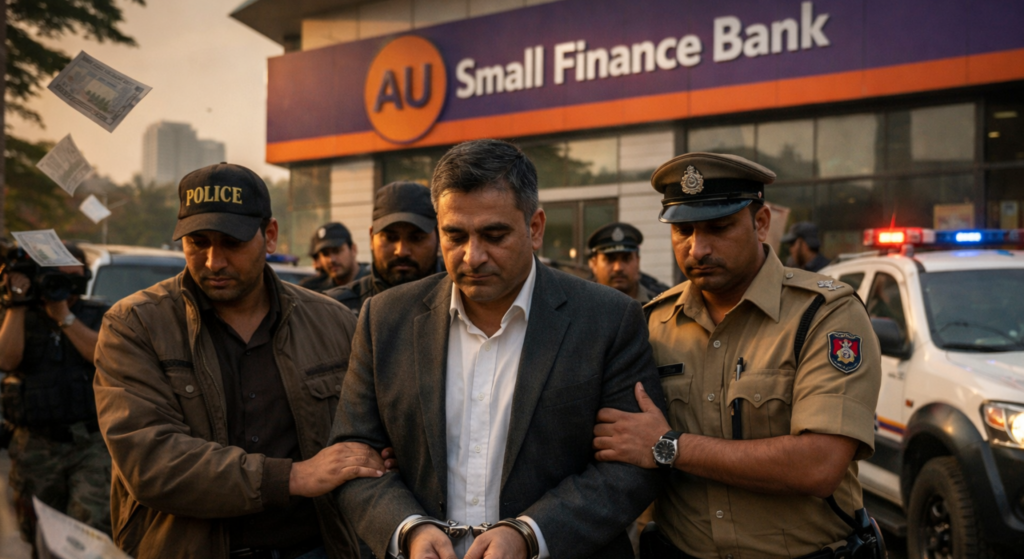
The ongoing investigation into the ₹590 crore bank fraud linked to AU Small Finance Bank has taken a significant turn, with former regional head Arun Sharma now emerging as a key figure in the case. Authorities allege that Sharma received approximately ₹10 crore in exchange for facilitating fraudulent activities connected to the wider network.
According to submissions made by investigating agencies before the court, Sharma is suspected of playing an active role in enabling the fraud by leveraging his position within the bank. Officials claim that his knowledge of internal banking systems and procedures was used to bypass standard checks and controls, allowing irregular transactions to pass undetected.
So far, 15 individuals have been arrested in connection with the case. These include bank officials as well as government employees, indicating that the fraud was not limited to external actors but involved coordination across multiple levels. All accused have been remanded to judicial custody as the probe continues.
Investigators believe the fraud was carried out through a structured and well-organized network. The primary method allegedly involved securing loan approvals and processing financial transactions using forged documents and misleading information. In several instances, due diligence processes were either manipulated or ignored, raising serious questions about internal compliance mechanisms.
Sources familiar with the investigation suggest that suspicious accounts and transactions were cleared despite clear warning signals. Over time, this enabled large sums of money to be siphoned out without immediate detection. Authorities are now examining whether systemic gaps were exploited deliberately or whether internal oversight failed at critical stages.
Sharma’s alleged involvement is said to extend beyond procedural lapses. Investigators have indicated that he may have directly influenced or approved transactions that would typically be flagged under standard risk assessment protocols. He is also believed to have worked in coordination with key accused individuals, including Ribhav Rishi and Abhay Kumar, to facilitate the movement of funds.
The case has further revealed signs of a multi-layered conspiracy involving document forgery, account manipulation, and weakening of internal control systems. Experts point out that such large-scale financial frauds often rely on insider access, making internal accountability a critical factor in both prevention and investigation.
Arun Sharma was arrested earlier this month, on March 6, and remains in custody. Investigating agencies have told the court that they possess evidence suggesting he received financial benefits in return for aiding незаконные transactions. However, officials have clarified that the investigation is still ongoing, and additional findings may emerge in the coming weeks.
The developments have sparked renewed debate around governance and transparency in the banking sector. Questions are being raised about how such a large fraud could persist over time without being detected by internal audits or regulatory checks. Industry observers are calling for stronger compliance frameworks, improved monitoring systems, and stricter accountability for individuals in positions of authority.
Authorities are now expanding the scope of the investigation to identify other possible links within the network. With financial trails still being analyzed and digital evidence under review, more arrests and disclosures are expected as the case progresses.
The ₹590 crore fraud case serves as a stark reminder of the vulnerabilities that can arise when internal controls are compromised. As the investigation unfolds, it is likely to have broader implications for banking practices and regulatory oversight across the sector.