
Introduction: FortiBleed Attack 2026 — Why It Matters
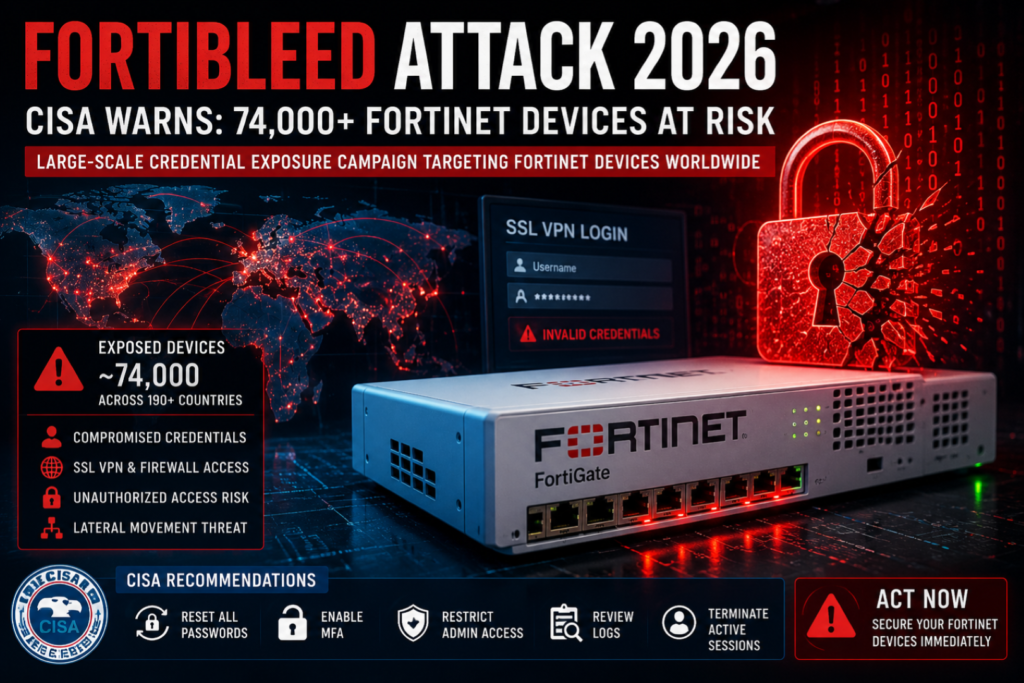
The FortiBleed Attack 2026 has prompted an urgent warning from the U.S. Cybersecurity and Infrastructure Security Agency (CISA) after reports emerged that compromised credentials linked to approximately 74,000 internet-facing Fortinet devices were exposed.
The FortiBleed Attack 2026 reportedly affects organizations across more than 190 countries, including government agencies and private-sector entities. According to threat intelligence researchers and CISA advisories, attackers may be leveraging leaked credentials to gain unauthorized access to FortiGate firewalls and SSL VPN gateways.
Unlike traditional cyberattacks that exploit software vulnerabilities, this campaign highlights the growing danger of credential-based attacks, where valid login credentials become the primary attack vector.
What is Fortinet?
Fortinet is a global cybersecurity company known for its network security solutions, including:
- FortiGate Next-Generation Firewalls (NGFWs)
- FortiClient endpoint security
- FortiAnalyzer monitoring tools
- FortiManager administration platforms
- SSL VPN remote access solutions
Organizations worldwide rely on Fortinet products to secure critical infrastructure, enterprise networks, government systems, and remote work environments.
Because these devices often sit at the network perimeter, they are highly attractive targets for cybercriminals seeking initial access into corporate environments.
What Caused the Incident?
Current reports indicate that the campaign revolves around exposed or compromised credentials associated with Fortinet systems rather than a newly discovered software vulnerability.
Security researchers from multiple threat intelligence organizations, including SOCRadar, Hudson Rock, and Arctic Wolf, have reportedly identified large datasets containing credentials linked to Fortinet deployments.
Attackers can use these credentials to:
- Authenticate using legitimate accounts
- Bypass certain security controls
- Establish persistent access
- Move laterally across networks
- Escalate privileges
- Access sensitive corporate resources
While no specific Common Vulnerabilities and Exposures (CVE) identifier has been directly associated with the campaign, the exposure demonstrates how credential leaks can create severe security risks.
FortiBleed Attack 2026: Full Technical/Factual Breakdown
Timeline of Events
- Threat intelligence firms reportedly identified large-scale Fortinet credential exposures.
- Researchers observed credentials linked to tens of thousands of internet-facing devices.
- Reports indicated affected systems spanning over 190 countries.
- CISA issued an urgent advisory urging organizations to secure Fortinet deployments.
- Security teams were advised to rotate passwords, review logs, and strengthen authentication controls.
What Data/Systems Were Allegedly Affected
According to available reports, affected assets may include:
- FortiGate firewalls
- Fortinet SSL VPN gateways
- Administrative management interfaces
- Remote access infrastructure
- Enterprise authentication systems
Potentially exposed elements include:
- Administrative credentials
- User authentication credentials
- VPN access accounts
- Remote management accounts
- Security appliance configurations
The exact number of impacted organizations and affected users has not been publicly disclosed.
Potential Risks & Impact of FortiBleed Attack 2026
Identity/Financial Risk
Credential-based attacks can provide threat actors with direct access to sensitive systems.
Potential consequences include:
- Unauthorized access to internal resources
- Theft of sensitive information
- Business email compromise
- Financial fraud
- Credential reuse attacks against other services
Organizations using the same passwords across multiple systems face elevated risk levels.
Business/Reputational Risk
Successful compromise of perimeter security devices can significantly impact business operations.
Potential business consequences include:
- Service disruptions
- Operational downtime
- Customer trust erosion
- Incident response costs
- Increased cybersecurity spending
For enterprises handling customer data, a credential-based intrusion could trigger broader investigations into network security controls.
Regulatory/Compliance Risk
Organizations operating in regulated industries may face compliance challenges if unauthorized access leads to data exposure.
Potential implications include:
- Regulatory investigations
- Breach notification obligations
- Security audit requirements
- Compliance remediation costs
Businesses should review applicable regulations and reporting requirements if evidence of compromise is discovered.
Official Response / Statement
Following the discovery of the FortiBleed Attack 2026, CISA has strongly encouraged organizations using Fortinet products to implement immediate mitigation measures.
Recommended actions include:
- Terminating all active SSL VPN sessions
- Resetting passwords associated with exposed devices
- Enforcing stronger password policies
- Reviewing logs for suspicious activity
- Enabling phishing-resistant MFA
- Restricting management interfaces from public internet exposure
Additionally, organizations are advised to verify that credentials are protected using Password-Based Key Derivation Function 2 (PBKDF2), a stronger password hashing mechanism recommended by Fortinet.
At the time of writing, no publicly reported evidence confirms that every exposed credential has been actively exploited. However, security authorities stress that organizations should assume exposure and act accordingly.
Industry Context: Why This Type of Attack is Increasing
The FortiBleed campaign reflects a broader shift in cybercriminal tactics.
Instead of focusing exclusively on software vulnerabilities, attackers increasingly exploit:
- Stolen credentials
- Information-stealer malware logs
- Password reuse practices
- Weak authentication controls
- Exposed administrative interfaces
Recent trends documented across the cybersecurity industry show that credential theft remains one of the most effective methods of gaining initial access.
Organizations seeking insights into similar incidents can review CyberNexora’s coverage of recent cyber incidents and ongoing developments in cybersecurity resources and threat intelligence.
The growing popularity of remote work and VPN-based access has expanded the attack surface available to threat actors, making identity security a critical component of modern cyber defense.
Security experts believe the FortiBleed Attack 2026 reflects a broader trend of attackers relying on stolen credentials rather than exploiting software vulnerabilities.
How to Protect Yourself / Your Organization
Organizations using Fortinet products should take the following actions immediately:
- Reset all Fortinet administrative and VPN passwords.
- Terminate active SSL VPN and management sessions.
- Enable phishing-resistant multi-factor authentication (MFA).
- Restrict administrative interfaces to trusted internal networks.
- Remove inactive, unnecessary, or unauthorized accounts.
- Review firewall, VPN, authentication, and domain controller logs.
- Monitor for unusual login activity and privilege escalation attempts.
- Verify that credentials are protected using PBKDF2 hashing.
- Conduct threat hunting for signs of unauthorized access.
- Develop and regularly test an incident response plan.
Additional security best practices can be found in CyberNexora’s Learn & Protect cybersecurity awareness section.
Organizations should also review guidance from the official CISA cybersecurity advisories and Fortinet security recommendations.
Organizations concerned about exposure from the FortiBleed Attack 2026 should prioritize credential rotation and multi-factor authentication deployment.
Indicators of Compromise (IoCs)
Security teams should investigate for the following indicators:
- Unusual VPN logins
- Login attempts from unfamiliar geographic locations
- Unexpected administrator account creation
- Privilege escalation events
- Unauthorized firewall configuration changes
- Suspicious remote access sessions
- Unusual authentication failures
- Unexpected outbound network connections
- New scheduled tasks or persistence mechanisms
- Changes to VPN or security appliance settings
These indicators do not confirm compromise on their own but should trigger further investigation.
Key Takeaways
- The FortiBleed campaign reportedly involves credentials linked to approximately 74,000 Fortinet devices.
- Affected systems span more than 190 countries.
- CISA has issued an urgent advisory urging immediate defensive actions.
- The campaign appears focused on credential exposure rather than a newly disclosed software vulnerability.
- Organizations should reset passwords, enable MFA, and review logs immediately.
Conclusion: FortiBleed Attack 2026 and What Happens Next
The FortiBleed Attack 2026 serves as another reminder that compromised credentials can be just as dangerous as critical software vulnerabilities. Even well-secured environments may be exposed if attackers obtain valid authentication credentials.
As investigations into the FortiBleed Attack 2026 continue, additional threat intelligence may reveal the full scope of the credential exposure campaign.Organizations using Fortinet products should promptly assess their exposure, follow CISA recommendations, and strengthen identity security controls. Readers can stay updated on emerging threats through CyberNexora’s coverage of cyber incidents and threat investigations and evolving cybersecurity regulations and guidance.