
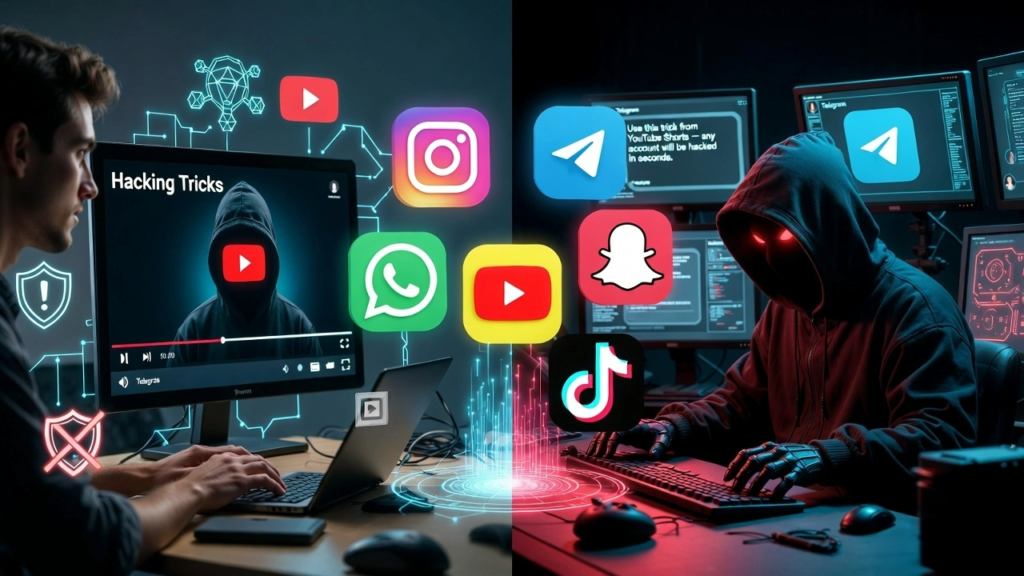
The Viral Illusion of “Instant Hacking”
Across Instagram Reels, YouTube Shorts, TikTok, and similar platforms, short videos claiming to reveal “secret hacking tricks” have become extremely common.
These videos often promise dramatic outcomes. Some claim that anyone can access an Instagram account in seconds. Others claim it is possible to read someone’s WhatsApp messages secretly, bypass Snapchat passwords, or gain control of a Facebook account without knowing the login credentials.
For viewers with limited cybersecurity knowledge, these demonstrations can appear convincing. A short clip shows a few steps, a tool is opened, a username is entered, and suddenly an account appears to be compromised.
In reality, most of these demonstrations are staged or manipulated. The account shown in the video is often controlled by the creator, or the footage has been edited to create the illusion of a successful attack.
The purpose of these videos is rarely cybersecurity education. Instead, they are designed to attract attention. The word “hack” generates curiosity, which increases views, shares, and engagement. As a result, social media algorithms promote this type of content widely, helping it spread rapidly.
The Growth of Telegram “Hack-for-Hire” Channels
Alongside viral videos, another ecosystem has emerged on platforms such as Telegram. Numerous channels claim to offer professional hacking services for a price.
These groups advertise services including:
• Instagram account takeovers
• WhatsApp message access
• Snapchat account monitoring
• Facebook password recovery
• Email account hacking
Many of these channels publish detailed price lists and claim they can compromise accounts within hours. Screenshots of supposed successful hacks are often shared to create credibility.
However, cybersecurity investigations and scam reports indicate that a large portion of these services are fraudulent.
Payments are typically requested through cryptocurrency, prepaid cards, or digital wallets. Once payment is sent, the operator may disappear entirely or provide fake screenshots as “proof.”
In many cases, individuals attempting to hire hackers become victims themselves. Their money is lost, and sometimes their personal information is also collected and misused.
How Fake Hacking Tutorials Create the Illusion of Access
Despite appearing technical, most viral hacking videos rely on simple tricks designed to look impressive on screen.
One common technique is staged access. The creator already knows the password or controls the account being “hacked,” making the demonstration appear successful.
Another technique involves edited screen recordings. Through simple editing, a login screen can be manipulated to appear as though a password has been bypassed.
Some videos promote websites claiming to generate passwords automatically. These websites rarely perform any real hacking. Instead, they often display advertisements, collect user information, or redirect visitors to other pages.
Other tutorials encourage viewers to download “hacking tools” or software. In many cases these programs either do nothing or are used to distribute malware.
Because these demonstrations are short and visually convincing, viewers may not realize that what they are watching is staged.
Why People Fall for These Tricks
Curiosity plays a major role in the popularity of hacking tutorials.
Many users are not necessarily trying to commit cybercrime. Instead, they may simply be curious about whether such tricks really work.
In other cases, personal motivations are involved. Some individuals search for hacking methods because they want to monitor a partner’s social media account or read someone’s private messages.
Search queries related to hacking frequently involve attempts to access a girlfriend’s, boyfriend’s, or spouse’s account. This curiosity creates an opportunity for scammers to exploit emotional motivations.
Creators who produce fake hacking content understand this psychology. By promising quick and secret access to another person’s account, they attract viewers who are curious, suspicious, or emotionally motivated.
When Curiosity Turns Into a Cybersecurity Risk
Ironically, many people who attempt to follow hacking tutorials end up compromising their own security.
Videos often instruct viewers to click on external links, install software, or enter usernames and passwords on unknown websites. These steps can expose users to phishing attacks or malicious software.
A phishing page may look like a legitimate login screen but is designed to capture credentials. Malware disguised as a hacking tool may collect personal data, monitor activity, or provide attackers with access to the device.
As a result, someone trying to hack another account can unknowingly expose their own data instead.
This pattern is increasingly common in cybercrime campaigns that exploit curiosity about hacking.
Modern Social Media Security Is Designed to Prevent This
Major technology companies invest heavily in protecting user accounts. Platforms such as Instagram, WhatsApp, Snapchat, Facebook, and Google implement multiple layers of security.
These include encrypted communications, suspicious login detection, device verification, and multi-factor authentication.
Security teams continuously monitor account activity, investigate unusual login attempts, and patch vulnerabilities when they are discovered.
Because of these protections, compromising accounts typically requires sophisticated techniques such as social engineering or targeted phishing campaigns.
The simple tricks shown in viral hacking videos rarely resemble the real methods used by professional threat actors.
The Difference Between Cybersecurity and Internet Myths
Professional cybersecurity operates under strict ethical and legal guidelines.
Ethical hackers and security researchers work with organizations to identify vulnerabilities before attackers can exploit them. Their work involves penetration testing, vulnerability assessments, and responsible disclosure.
These activities require permission, technical expertise, and structured methodologies.
The simplified narrative presented in viral hacking videos bears little resemblance to real cybersecurity practice.
Understanding this distinction is essential for anyone interested in technology, digital privacy, or online security.
Why Cybersecurity Awareness Matters
The rapid spread of fake hacking tutorials demonstrates how easily misinformation can circulate online.
When users believe that accounts can be hacked instantly, they may underestimate real threats such as phishing, social engineering, and malware.
Education and awareness play a crucial role in helping users recognize scams and avoid risky behavior online.
Recognizing how fake hacking content operates can prevent individuals from becoming victims of cybercrime.
Final Perspective
Across Instagram, YouTube Shorts, TikTok, and Telegram, a growing ecosystem of content claims that social media accounts can be hacked instantly using simple tricks or inexpensive paid services.
These claims attract millions of viewers and create the impression that compromising accounts is trivial.
However, analysis from a cybersecurity perspective shows that most of these demonstrations rely on misleading techniques, staged demonstrations, phishing operations, or outright scams.
Understanding how these schemes work is essential for protecting users in an online environment where misinformation spreads faster than facts.