
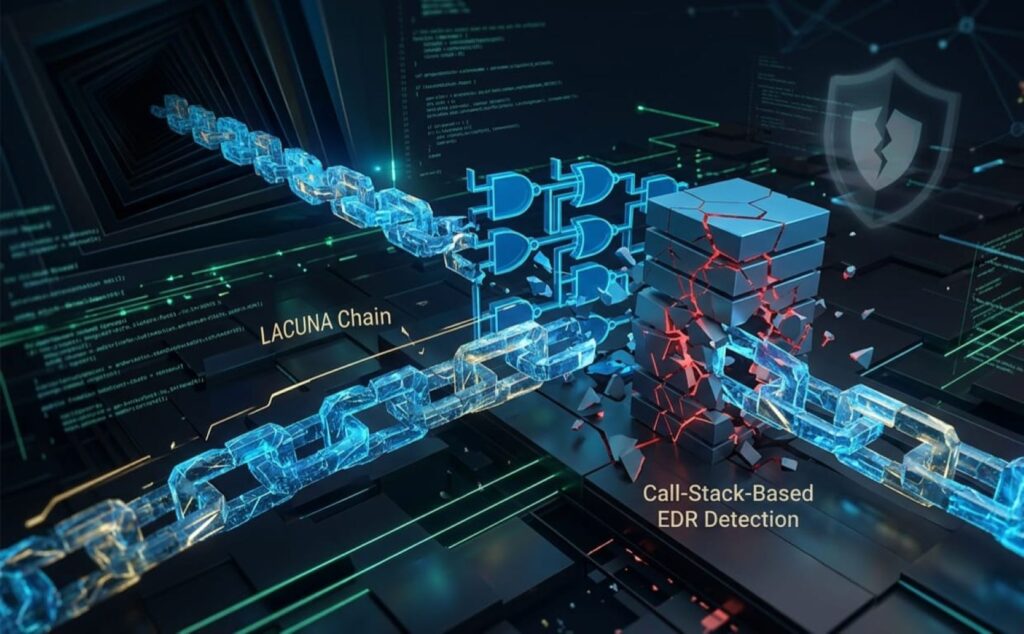
Introduction: LACUNA Chain EDR Bypass — Why It Matters
The cybersecurity community is closely examining the newly disclosed LACUNA Chain EDR Bypass framework after security researcher Mohamed Alzhrani unveiled a technique capable of defeating multiple layers of modern endpoint detection and response (EDR) monitoring. The framework reportedly exploits hidden execution gaps within Windows DLLs that are invisible to traditional stack unwinders, allowing malicious activity to evade detection mechanisms that rely heavily on call-stack analysis.
The LACUNA Chain EDR Bypass disclosure has raised concerns among enterprise defenders because it reportedly works against several widely used security products and monitoring technologies. According to the research, the technique was successfully tested on Windows 11 systems against multiple commercial EDR solutions, highlighting potential blind spots in modern endpoint protection strategies.
For security teams, the discovery underscores a growing challenge: attackers continue to innovate faster than signature-based and telemetry-dependent detection systems can adapt.
What is LACUNA Chain?
LACUNA Chain is a newly disclosed EDR evasion framework designed to exploit “lacunae”—hidden gaps inside Windows dynamic-link libraries (DLLs) that are not properly visible during stack unwinding operations.
Modern EDR products frequently analyze process call stacks to determine whether system calls originate from legitimate software components or suspicious code. By manipulating execution paths through these hidden DLL gaps, LACUNA Chain reportedly creates call stacks that appear benign or incomplete, reducing the likelihood of triggering security alerts.
The framework specifically targets security technologies that depend on:
- Call-stack inspection
- Stack unwinding mechanisms
- ETW-Ti STACKWALK telemetry
- User-mode monitoring techniques
- Endpoint behavior attribution models
What Caused the Incident?
Unlike a traditional breach or malware outbreak, this story centers on a newly published security research framework.
According to the researcher, the root issue lies within how Windows stack unwinding mechanisms interpret execution flow. Certain code regions inside DLLs create visibility gaps that stack walkers cannot properly reconstruct, creating opportunities for attackers to conceal malicious activity.
The framework chains together multiple evasion techniques to exploit these weaknesses and reportedly bypass detection logic that depends on stack visibility.
LACUNA Chain EDR Bypass: Full Technical/Factual Breakdown
Timeline of Events
- Security researcher Mohamed Alzhrani developed and tested the framework.
- Research findings were publicly disclosed on June 20.
- A proof-of-concept (PoC) implementation was released on GitHub.
- Security researchers and defenders began evaluating the implications for modern EDR platforms.
- Industry discussions intensified regarding the future reliability of stack-based detection methods.
What Data/Systems Were Allegedly Affected
The research does not describe a data breach or compromise of a specific organization. Instead, it demonstrates the ability to evade detection mechanisms across several security platforms.
Reportedly affected security monitoring capabilities include:
- Call-stack-based EDR detections
- ETW-Ti STACKWALK telemetry
- User-mode monitoring systems
- Process attribution mechanisms
- Security analytics relying on stack reconstruction
The framework reportedly demonstrated bypass capabilities against:
- Elastic EDR
- Bitdefender Endpoint Security
- Kaspersky Endpoint Security
- Windows 11 security monitoring environments
Key techniques disclosed include:
- BYOUD-Gap methodology
- Win32u NOP Gap Chain
- ETW-Ti APC Window Attack
- Encrypted syscall parameter delivery
- Stack visibility manipulation
Potential Risks & Impact
Identity/Financial Risk
At present, LACUNA Chain is a research framework rather than a documented criminal campaign. However, threat actors could potentially adapt similar concepts to conceal malware execution, credential theft tools, ransomware payloads, or post-exploitation activity.
Security analysts warn that the LACUNA Chain EDR Bypass framework could inspire future malware developers to adopt similar evasion methods against enterprise security products. If adopted by attackers, organizations may face increased difficulty identifying malicious behavior before damage occurs.
Business/Reputational Risk
Organizations increasingly depend on EDR platforms as a core cybersecurity defense layer. A successful bypass technique could reduce visibility into:
- Insider threats
- Malware execution
- Privilege escalation
- Lateral movement
- Post-compromise activity
This creates operational risk because security teams may falsely assume endpoints remain secure while malicious activity continues undetected.
Regulatory/Compliance Risk
Many compliance frameworks require organizations to maintain effective monitoring and threat detection capabilities.
Potential impacts could include:
- Delayed incident response
- Reduced audit visibility
- Monitoring gaps during investigations
- Challenges in demonstrating security effectiveness
Organizations operating under regulated environments may need to review whether reliance on a single detection methodology creates unacceptable risk.
Official Response / Statement
At the time of writing, no broad industry-wide mitigation has been publicly announced regarding the techniques described in the research.
While vendors continue analyzing the research, the implications of LACUNA Chain EDR Bypass are likely to influence future improvements in endpoint detection and telemetry correlation technologies. The researcher stated that stack-based detection mechanisms can be bypassed by exploiting hidden DLL execution gaps. Testing reportedly demonstrated successful evasion against multiple commercial endpoint security products.
Security vendors are expected to analyze the findings and evaluate potential detection improvements. The exact defensive responses may vary depending on each vendor’s architecture and monitoring capabilities.
Industry Context: Why This Type of Attack is Increasing
EDR bypass research has become increasingly sophisticated as endpoint security technologies evolve. Attackers and researchers alike continue searching for weaknesses in defensive assumptions. The emergence of LACUNA Chain EDR Bypass demonstrates how attackers and researchers continue to challenge long-standing assumptions about endpoint visibility and detection reliability.
Recent years have seen increased focus on:
- Direct syscall abuse
- Bring Your Own Vulnerable Driver (BYOVD) attacks
- Memory-only malware
- Kernel exploitation
- Telemetry manipulation
Many modern security products shifted toward behavioral analytics and call-stack inspection to detect advanced threats. The LACUNA Chain research suggests that stack-based visibility alone may no longer provide sufficient assurance.
Organizations following trends in advanced cyber threats can review CyberNexora’s coverage of major cyber incidents and related security resources for additional context on evolving attacker techniques.
Security teams may also benefit from guidance published by the Cybersecurity and Infrastructure Security Agency (CISA) and the MITRE ATT&CK framework for threat detection strategies and adversary behavior analysis.
How to Protect Yourself / Your Organization
Organizations assessing defenses against LACUNA Chain EDR Bypass should prioritize layered detection strategies that combine endpoint, network, and behavioral telemetry. Organizations concerned about advanced EDR evasion should consider the following defensive measures:
- Implement layered security controls
- Avoid relying solely on endpoint detection platforms.
- Increase behavioral analytics
- Monitor process behavior rather than individual telemetry signals.
- Deploy kernel-level visibility
- Use security controls capable of correlating activity beyond user-mode execution.
- Strengthen threat hunting programs
- Proactively investigate anomalies and suspicious execution chains.
- Monitor unusual syscall patterns
- Look for behavior inconsistent with normal application activity.
- Correlate multiple telemetry sources
- Combine EDR, SIEM, network, and identity data for broader visibility.
- Regularly test security controls
- Conduct adversary emulation exercises to identify blind spots.
- Stay informed about emerging bypass techniques
- Follow trusted cybersecurity research and Learn & Protect resources to understand evolving threats.
Indicators of Compromise (IoCs)
Because LACUNA Chain is a detection-evasion framework rather than a malware family, traditional IoCs are limited. However, defenders may watch for:
- Abnormal syscall execution patterns
- Unusual DLL execution flows
- Suspicious APC activity
- Inconsistent stack traces
- Telemetry gaps during sensitive operations
- Unexpected behavior without corresponding stack evidence
- Signs of encrypted syscall parameter usage
Key Takeaways
- LACUNA Chain introduces a new approach to EDR evasion.
- The framework exploits hidden gaps within Windows DLLs.
- Multiple commercial endpoint security products reportedly failed to detect the demonstrated techniques.
- Behavioral analysis and kernel-level correlation remained more effective defensive approaches.
- Public release of a proof-of-concept increases urgency for defenders to assess monitoring strategies.
Conclusion: LACUNA Chain EDR Bypass and What Happens Next
The disclosure of LACUNA Chain EDR Bypass highlights a significant challenge facing modern endpoint security solutions. As attackers and researchers continue identifying weaknesses in existing detection methodologies, defenders must avoid overreliance on any single telemetry source.
Going forward, security vendors are expected to evaluate the findings and strengthen detection capabilities where possible. Organizations should monitor developments closely, review their endpoint visibility strategies, and follow evolving guidance from the cybersecurity community through CyberNexora’s Cyber Incidents and Resources sections.
Frequently Asked Questions (FAQs)
LACUNA Chain EDR Bypass is a newly disclosed security research framework designed to evade call-stack-based endpoint detection systems. It reportedly exploits hidden execution gaps inside Windows DLLs that are not visible to stack unwinders.
The framework reportedly manipulates execution flow through hidden DLL regions to create misleading or incomplete call stacks. This can reduce the effectiveness of security tools that depend on stack analysis.
According to the research, tests were conducted against Elastic EDR, Bitdefender Endpoint Security, and Kaspersky Endpoint Security. The findings suggest the framework successfully bypassed several stack-based detection mechanisms.
No, LACUNA Chain is not described as malware. It is a research framework demonstrating advanced detection-evasion techniques that attackers could potentially adapt for malicious operations.
Call-stack-based detections help security products determine the origin and legitimacy of system calls. They are commonly used to identify suspicious behavior that traditional signatures may miss.
Organizations should use layered security strategies combining behavioral analytics, kernel-level visibility, threat hunting, and telemetry correlation. Relying solely on stack-based detection may create blind spots against advanced threats.