

A few years ago, most people rarely heard the word cybersecurity.
Today, it is everywhere — news headlines, job portals, company policies, government laws, and even daily conversations.
This is not a trend.
This is a response to a real problem.
Let’s understand what cybersecurity actually is, why it suddenly matters so much, and why its demand has increased worldwide — clearly, honestly, and without technical confusion.
What Cybersecurity Really Means (No Complicated Definitions)
Cybersecurity means protecting digital systems and digital data from misuse, theft, damage, and unauthorized access.
That’s it.
It is about protecting:
- Computers and servers
- Mobile phones and apps
- Websites and networks
- Personal, business, and government data
Whenever information is stored, processed, or transferred using technology, cybersecurity is involved.
Why Cybersecurity Exists in the First Place
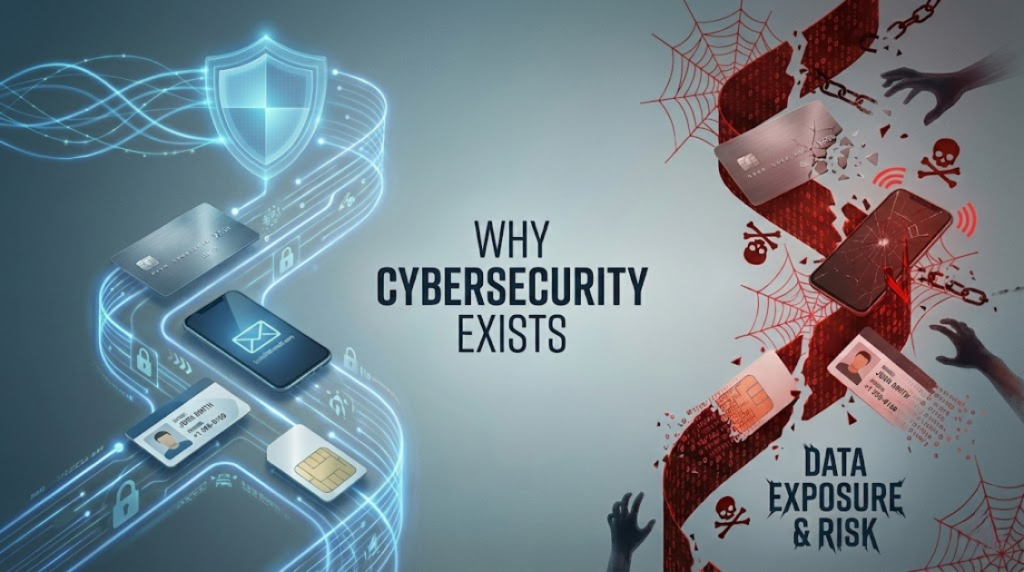
Cybersecurity exists because data became valuable.
Earlier, data was just information.
Today, data represents:
- Money
- Identity
- Access
- Power
- Trust
Your name, phone number, email, Aadhaar, PAN, photos, location, login credentials, and bank details are all digital assets now.
Cybersecurity exists to answer one basic question:
Who is allowed to access this data — and who is not?
Why the Word “Cybersecurity” Is Heard So Often Today

The reason is simple:
Our lives have moved online faster than security could keep up.
Look at daily life today:
- Payments are digital
- Documents are online
- Communication is online
- Work is online
- Education is online
- Healthcare is digital
- Government services are online
Every shift to digital creates new entry points for misuse.
Cybersecurity is discussed more today because:
- Digital usage increased rapidly
- Cybercrime increased faster
- Laws and awareness are catching up late
What Changed in Recent Years (The Real Reason for High Demand)
Cybersecurity demand did not increase randomly.
It increased because of four major changes:
1. Massive Data Collection
Companies collect more data than ever before — often without proper protection.
2. Online Payments Became Normal
UPI, cards, wallets, and digital banking made money accessible through technology.
3. Work From Anywhere
Remote work expanded attack surfaces beyond office networks.
4. Cybercrime Became Organized
Cybercrime is no longer random hacking. It is:
- Professional
- Automated
- Financially motivated
- Global
This forced companies and governments to invest seriously in cybersecurity.
What Happens When Cybersecurity Fails

When cybersecurity fails, the impact is real — not theoretical.
- Bank accounts get drained
- Identities are misused
- Fake loans are issued
- Companies lose customer trust
- Businesses shut down
- Governments impose penalties
- Legal actions follow
This is why cybersecurity is no longer optional.
Is Cybersecurity Only About Hackers and Tools?

No — and this misunderstanding causes most confusion.
Cybersecurity includes:
- Technical protection (systems, networks, applications)
- Monitoring and detection
- Rules and policies
- Risk management
- Legal compliance
- Incident response
- User awareness
Hacking is only one part of a much larger system.
Who Needs Cybersecurity Today?
The correct answer is: everyone.
- Individuals need it to protect identity and money
- Companies need it to protect data and operations
- Banks need it to protect financial systems
- Hospitals need it to protect patient records
- Governments need it to protect national infrastructure
If something is connected to the internet, cybersecurity is required.
Why Cybersecurity Became a Serious Career Field

Cybersecurity jobs exist because damage prevention is cheaper than damage recovery.
A single incident can cost:
- Millions in losses
- Legal penalties
- Reputation damage
- Long-term trust loss
That is why organizations hire:
- Security analysts
- Monitoring teams
- Incident responders
- Risk and compliance professionals
Cybersecurity is not a “hot career” — it is a necessary function.
One Important Truth Most People Miss
Cybersecurity is not about:
- Learning tools first
- Memorizing commands
- Shortcuts
- Hype
Real cybersecurity starts with:
- Understanding how systems work
- Understanding how data flows
- Understanding where mistakes happen
- Understanding human behavior
Without this foundation, tools are useless.
If You Understand This, You Are Not Confused Anymore
After reading this, one thing should be clear:
Cybersecurity exists because digital life created digital risk.
It became important because that risk became real.
Its demand increased because damage became unavoidable without it.
Cybersecurity is not a mystery, not a trend, and not fear-based marketing.
It is simply digital safety in a digital world.