
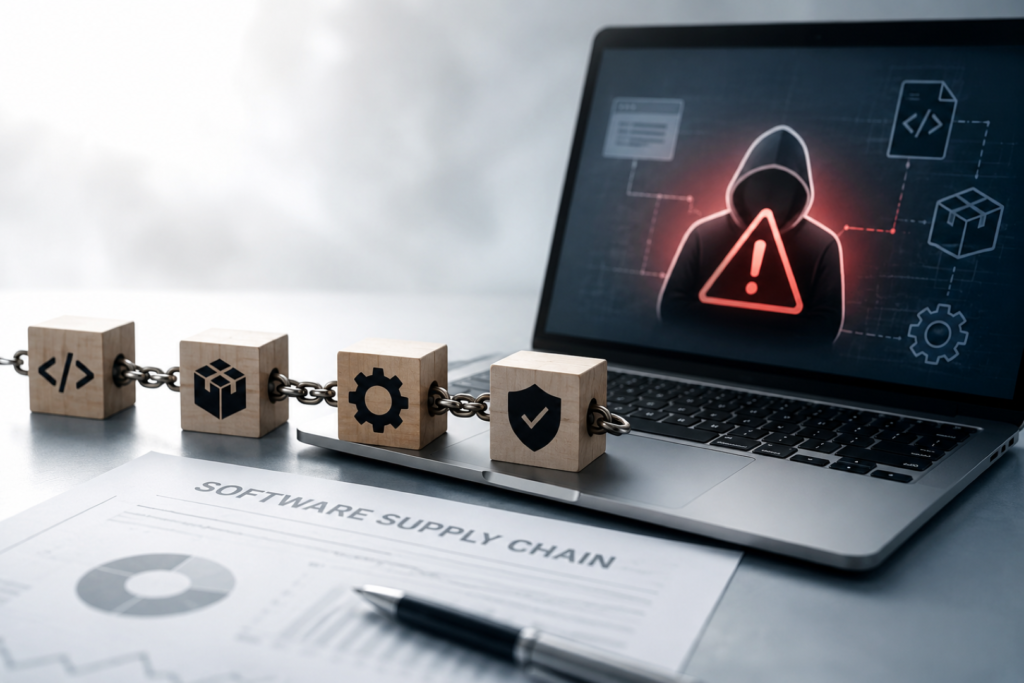
Introduction: Supply Chain Attacks — Why It Matters
Supply Chain Attacks continue to emerge as one of the most dangerous cybersecurity threats affecting organizations worldwide. Rather than directly targeting businesses or individuals, attackers compromise trusted software vendors, open-source libraries, development tools, or update mechanisms to silently distribute malicious code to thousands—or even millions—of users.
Unlike conventional cyberattacks, supply chain compromises exploit the trust organizations place in legitimate software. Once malicious code enters the software development or distribution process, every customer installing the affected application may unknowingly become a victim.
Security researchers have observed increasing abuse of package repositories, CI/CD pipelines, software build environments, and developer credentials. These attacks demonstrate that even organizations with strong security controls can be compromised if a trusted supplier becomes infected.
As businesses become increasingly dependent on third-party software and cloud-based development environments, strengthening software supply chain security has become a top priority for governments, enterprises, and cybersecurity professionals worldwide.
What is a Supply Chain Attack?
A software supply chain attack occurs when threat actors compromise the software development, build, or distribution process instead of attacking the final victim directly.
Rather than exploiting individual organizations one by one, attackers infiltrate trusted software vendors or components that are widely used across multiple industries. Once malicious code is inserted into legitimate software, it is delivered to customers through official updates or software installations.
Common targets include:
- Software vendors
- Open-source packages
- Third-party libraries
- Developer accounts
- Build servers
- CI/CD pipelines
- Package repositories
- Code-signing infrastructure
- Software update mechanisms
Because users trust software obtained from legitimate sources, malicious updates often bypass traditional security checks and remain undetected for extended periods.
What Caused the Rise of Supply Chain Attacks?
Several factors have contributed to the rapid increase in software supply chain attacks.
Modern applications are rarely developed entirely in-house. Instead, they rely heavily on thousands of external components, open-source libraries, cloud services, APIs, and automated deployment pipelines. Every dependency introduces another potential attack surface.
Threat actors increasingly target:
- Weakly protected developer accounts
- Compromised package repositories
- Vulnerable build servers
- Stolen code-signing certificates
- Misconfigured CI/CD pipelines
- Third-party software vendors
If attackers successfully compromise just one trusted supplier, they can distribute malware to every downstream customer using that software.
This indirect approach enables cybercriminals to maximize impact while reducing the effort required to compromise individual organizations.
Supply Chain Attacks: Full Technical Breakdown
Modern supply chain attacks typically follow a structured sequence that allows attackers to compromise software before it reaches end users.
Timeline of a Typical Supply Chain Attack
- Attackers identify a trusted software vendor or open-source project.
- Developer credentials are stolen or exploited.
- Attackers gain access to the software development environment.
- Malicious code is inserted into the application or dependency.
- The compromised software is compiled and digitally signed.
- Legitimate software updates are released.
- Customers download and install the malicious update.
- Malware executes automatically inside victim environments.
- Attackers establish persistence and begin stealing sensitive information or deploying additional payloads.
Unlike phishing or ransomware attacks that require individual victims to make mistakes, supply chain attacks leverage trust to spread silently across multiple organizations.
What Systems Are Commonly Targeted?
Cybersecurity investigations have shown that attackers frequently target critical components of the software ecosystem, including:
- Open-source package repositories
- Software update servers
- Continuous Integration/Continuous Deployment (CI/CD) pipelines
- Build automation platforms
- Developer workstations
- Code-signing certificates
- Software development environments
- Cloud-based repositories
- Enterprise software vendors
- Third-party application dependencies
These components are attractive because compromising a single trusted element can affect thousands of organizations simultaneously.
Recent Techniques Used by Threat Actors
Recent campaigns have demonstrated increasingly sophisticated methods for compromising software supply chains.
Researchers have observed attackers abusing:
- Package managers by uploading malicious packages that closely resemble legitimate software.
- Developer tools and plugins to execute unauthorized code during software builds.
- CI/CD pipelines to inject malware automatically into compiled applications.
- Code-signing mechanisms to make malicious software appear authentic.
- Third-party dependencies that organizations install without comprehensive security validation.
Because these attacks exploit trusted infrastructure, many traditional antivirus and endpoint security solutions may initially fail to detect malicious activity.
Why Supply Chain Attacks Are So Dangerous
Supply chain attacks present unique risks compared to traditional cyberattacks.
Instead of compromising one organization at a time, attackers can infect thousands—or even millions—of devices through a single trusted software update.
These attacks are particularly effective because:
- Software updates are generally trusted by users.
- Digitally signed applications appear legitimate.
- Malicious code is distributed through official channels.
- Security teams may not immediately suspect trusted vendors.
- Organizations often share the same third-party software dependencies.
- Detection can take weeks or even months after deployment.
As digital supply chains become increasingly interconnected, even a relatively small compromise within a software ecosystem can have global consequences.
Potential Risks & Impact
Software supply chain attacks can have widespread consequences because a single compromised application may be installed across thousands of organizations before malicious activity is detected. The financial, operational, and reputational damage often extends beyond the initial victim, affecting customers, partners, and the broader software ecosystem.
Identity and Data Security Risks
Compromised software may provide attackers with unauthorized access to sensitive systems and confidential information.
Potential risks include:
- Theft of usernames and passwords
- Exposure of personally identifiable information (PII)
- Credential harvesting
- API key and authentication token theft
- Intellectual property theft
- Customer database compromise
- Cloud environment access
- Installation of ransomware or backdoors
If attackers obtain privileged credentials, they may laterally move across enterprise networks, increasing the scope of the compromise.
Business and Operational Risks
Organizations affected by supply chain attacks may experience significant operational disruption.
Possible impacts include:
- Business downtime
- Production interruptions
- Loss of customer trust
- Increased cybersecurity recovery costs
- Delayed software deployments
- Incident response expenses
- Contractual penalties
- Long-term reputational damage
For software vendors, the consequences can be particularly severe, as a single compromised update may impact every customer using their products.
Regulatory and Compliance Risks
Organizations operating under cybersecurity and data protection regulations may face compliance challenges following a supply chain compromise.
Potential regulatory concerns include:
- Data protection investigations
- Mandatory breach notification requirements
- Industry compliance violations
- Third-party risk management failures
- Increased security audits
- Legal liabilities if customer data is exposed
Many cybersecurity frameworks now emphasize software supply chain security as a critical component of enterprise risk management.
Official Response / Statement
At the time of writing, this article highlights the broader cybersecurity risks associated with software supply chain attacks rather than a specific confirmed incident.
However, cybersecurity agencies and industry leaders continue to encourage organizations to strengthen software development security through practices such as secure coding, dependency verification, Software Bill of Materials (SBOM), continuous monitoring, and multi-factor authentication for developer accounts.
Governments worldwide are also introducing stronger software security guidance aimed at improving transparency across the software supply chain and reducing the risk of large-scale compromise.
Industry Context: Why This Type of Attack Is Increasing
Software supply chain attacks have become increasingly common because organizations rely heavily on third-party software, open-source components, cloud services, and automated development pipelines.
Modern software often includes hundreds—or even thousands—of external libraries. While these dependencies accelerate development, they also expand the potential attack surface.
Cybercriminals recognize that compromising a trusted supplier provides a much greater return than attacking individual organizations separately.
Recent trends driving supply chain attacks include:
- Rapid adoption of open-source software
- Growth of cloud-native development
- Increasing reliance on CI/CD automation
- Expansion of third-party integrations
- Remote software development environments
- Growing software complexity
To stay informed about the latest cybersecurity developments, readers can explore our Cyber Incidents section for coverage of emerging threats, ransomware campaigns, data breaches, and vulnerability disclosures. Organizations looking to strengthen their cyber defenses can also visit our Learn & Protect section, which features practical security guides, best practices, and awareness articles. For additional checklists, reference materials, and cybersecurity tools, browse our Resources section to access valuable information that helps improve your organization’s overall security posture.
These resources provide additional insights into emerging threats, vulnerabilities, and defensive strategies relevant to software supply chain security.
How to Protect Yourself and Your Organization
Reducing supply chain risk requires continuous monitoring and proactive security practices throughout the software development lifecycle.
1. Maintain a Software Bill of Materials (SBOM)
Create and regularly update an SBOM to identify every software component, dependency, and third-party library used within applications. This improves visibility and accelerates vulnerability response.
2. Verify Code Signing
Always validate digital signatures before deploying software updates. Code-signing verification helps ensure that software originates from trusted publishers and has not been modified.
3. Secure Developer Accounts
Developer accounts should be protected using:
- Multi-factor authentication (MFA)
- Strong password policies
- Hardware security keys
- Least privilege access
- Continuous login monitoring
Compromised developer credentials remain one of the most common entry points for supply chain attacks.
4. Continuously Scan Dependencies
Organizations should regularly scan:
- Open-source libraries
- Third-party packages
- Containers
- Build dependencies
- Software repositories
Dependency scanning tools help identify vulnerable or malicious packages before deployment.
5. Secure CI/CD Pipelines
Protect software build environments by:
- Restricting administrative access
- Encrypting secrets
- Monitoring build activities
- Auditing deployment logs
- Separating development and production environments
A compromised CI/CD pipeline can distribute malware to every downstream customer.
6. Apply Software Updates Promptly
Install verified security updates as soon as vendors release them.
Organizations should also:
- Test updates in isolated environments
- Verify update authenticity
- Monitor vendor security advisories
- Maintain rollback procedures
7. Continuously Monitor for Suspicious Activity
Continuous monitoring enables organizations to detect unusual behavior before attackers establish persistence.
Recommended monitoring includes:
- Endpoint Detection and Response (EDR)
- Security Information and Event Management (SIEM)
- Threat intelligence feeds
- Network traffic analysis
- File integrity monitoring
8. Evaluate Third-Party Vendors
Vendor risk assessments should become part of every procurement process.
Organizations should review:
- Security certifications
- Vulnerability disclosure programs
- Incident response capabilities
- Secure development practices
- Patch management policies
Selecting security-conscious vendors reduces overall supply chain risk.
Indicators of Compromise (IoCs)
While supply chain attacks vary significantly, organizations should investigate the following indicators:
- Unexpected software behavior after updates
- Unknown processes executing from trusted applications
- Unauthorized outbound network connections
- Suspicious PowerShell or command-line activity
- Modified application files
- Unexpected scheduled tasks
- New administrator accounts
- Credential theft attempts
- Connections to unfamiliar external servers
- Unusual authentication events
Prompt investigation of these indicators may help contain attacks before widespread damage occurs.
Key Takeaways
- Software supply chain attacks target trusted vendors instead of individual victims.
- Compromised software updates can infect thousands or even millions of devices.
- Open-source packages, CI/CD pipelines, and developer accounts remain common attack targets.
- Implementing SBOM, dependency scanning, MFA, and continuous monitoring significantly reduces risk.
- Organizations should treat software supply chain security as a core component of their overall cybersecurity strategy.
Conclusion: Supply Chain Attacks and What Happens Next
Supply Chain Attacks highlight how modern cybercriminals increasingly exploit trust rather than technical vulnerabilities alone. By compromising software vendors, development pipelines, or trusted dependencies, attackers can extend their reach across entire industries with a single successful breach.
As software ecosystems continue to grow more interconnected, organizations must adopt a proactive approach to software supply chain security. Strengthening developer security, verifying software integrity, continuously monitoring third-party dependencies, and implementing industry best practices such as SBOM will play a critical role in reducing future risks. Staying informed through trusted cybersecurity resources and adopting a defense-in-depth strategy will remain essential as supply chain threats continue to evolve.
Frequently Asked Questions(FAQs)
Supply Chain Attacks refer to cyberattacks in which threat actors compromise trusted software vendors, third-party dependencies, or software development environments instead of attacking victims directly. By injecting malicious code into legitimate software, attackers can distribute malware through official updates to thousands or even millions of users.
Software supply chain attacks are dangerous because they exploit trust. Since malicious code is delivered through legitimate software updates or trusted applications, users and security systems may unknowingly install compromised software, allowing attackers to gain unauthorized access without triggering immediate suspicion.
Attackers frequently target software vendors, developer accounts, open-source package repositories, CI/CD pipelines, code-signing infrastructure, cloud development environments, and third-party software dependencies. Compromising any of these components can enable attackers to affect numerous downstream organizations.
Organizations can reduce risks by implementing Software Bill of Materials (SBOM), enabling multi-factor authentication for developer accounts, verifying code signatures, regularly scanning dependencies, continuously monitoring software environments, and promptly applying verified security updates. Strong third-party risk management is also essential.
A Software Bill of Materials (SBOM) is a detailed inventory of all software components, libraries, dependencies, and modules used within an application. It improves software transparency and helps organizations quickly identify affected components when new vulnerabilities are disclosed.
Yes. As organizations increasingly rely on open-source software, cloud services, and automated development pipelines, software supply chain attacks have become more frequent and sophisticated. Security experts recommend strengthening software development security practices to reduce the risk of large-scale compromise.