
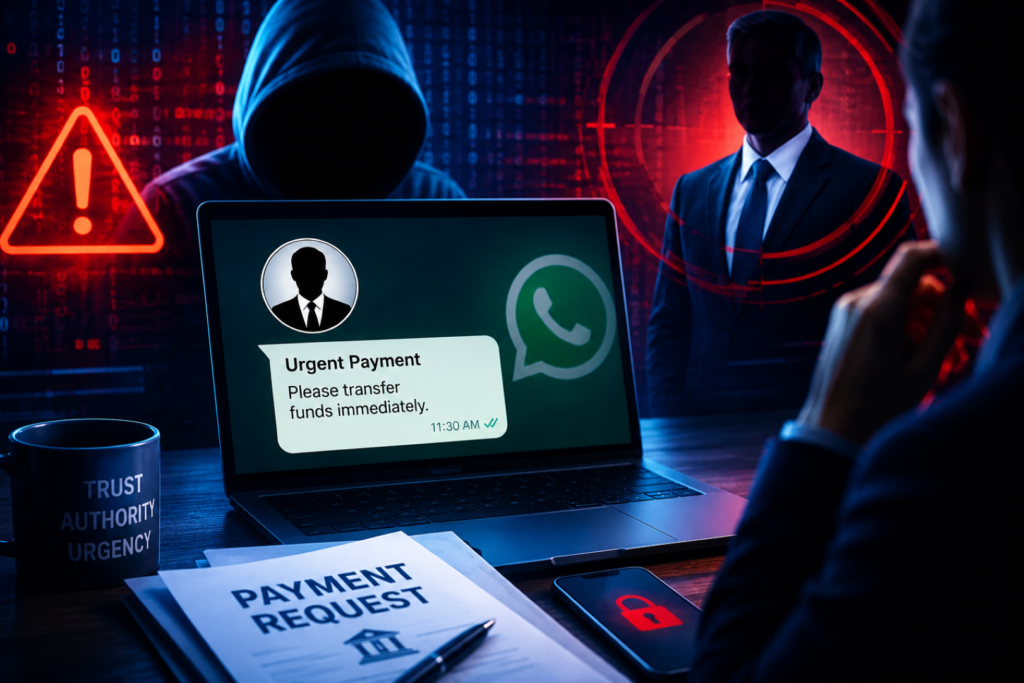
Introduction: Boss Scam Warning — Why It Matters
India’s Boss Scam Warning has put organizations on high alert after the Ministry of Home Affairs (MHA), through the Indian Cyber Crime Coordination Centre (I4C), warned businesses about a growing wave of CEO impersonation attacks targeting finance teams. The advisory highlights how cybercriminals exploit trust and urgency to trick employees into transferring company funds to fraudulent accounts.
According to I4C, attackers increasingly combine phishing emails, WhatsApp messages, and malware to compromise employee communications before sending fake payment instructions that appear to come from senior executives. The campaign primarily targets organizations that process large financial transactions and depend on digital communication for approvals. The Boss Scam Warning also emphasizes that organizations should treat executive impersonation attacks as a critical business risk rather than isolated phishing incidents.
Unlike traditional phishing campaigns that rely solely on deceptive emails, the latest scams leverage compromised messaging accounts, making fraudulent requests appear highly convincing. As businesses continue to adopt remote and hybrid work environments, the opportunity for attackers to exploit digital trust has grown significantly.
The latest advisory serves as a reminder that cybercriminals no longer rely only on technical exploits—they increasingly manipulate human behavior. Even organizations with strong cybersecurity infrastructure remain vulnerable if employees fail to verify urgent financial requests through independent channels.
What is the Indian Cyber Crime Coordination Centre (I4C)?
The Indian Cyber Crime Coordination Centre (I4C) is a specialized initiative established by the Ministry of Home Affairs (MHA) to strengthen India’s response to cybercrime. The organization coordinates intelligence sharing, cybercrime investigations, digital forensics, public awareness campaigns, and incident reporting across central and state law enforcement agencies. More information about the Indian Cyber Crime Coordination Centre (I4C) and its cybercrime awareness initiatives is available on the official I4C website.
I4C also manages the National Cyber Crime Reporting Portal and supports the 1930 Cyber Helpline, enabling individuals and organizations to report cyber frauds quickly. Through periodic advisories, threat intelligence, and awareness campaigns, the agency helps businesses prepare against emerging cyber threats ranging from phishing and ransomware to online financial fraud.
The latest Boss Scam advisory reflects I4C’s broader efforts to reduce financial cybercrime affecting Indian businesses by encouraging stronger verification procedures and cybersecurity awareness. The Boss Scam Warning is one of the latest public advisories issued by I4C to help businesses strengthen their defenses against financial cyber fraud.
What Caused the Incident?
The recent warning follows an increase in social engineering attacks where cybercriminals impersonate senior executives to manipulate employees responsible for company finances.
Rather than exploiting software vulnerabilities, attackers exploit organizational trust, authority, and urgency. Their objective is simple: convince an employee that an urgent payment or bank account modification has been approved by senior management. According to security experts, the Boss Scam Warning demonstrates how attackers increasingly combine malware with social engineering to maximize the success of financial fraud.
The attacks often begin with carefully crafted phishing emails or WhatsApp messages carrying malicious ZIP archives or attachments. Once opened, the malware infects the victim’s Windows system and may compromise communication platforms such as WhatsApp Web, enabling attackers to observe conversations or send convincing fraudulent payment requests from legitimate accounts.
Because the messages originate from trusted executive accounts—or appear nearly identical to legitimate communications—employees may process transactions without performing standard verification checks.
Boss Scam Warning: Full Technical Breakdown
Timeline of Events
- The Ministry of Home Affairs, through I4C, observed increasing reports of CEO impersonation scams targeting businesses.
- Authorities identified phishing emails and malicious WhatsApp messages as common initial attack vectors.
- Malware delivered through malicious ZIP files compromises Windows devices and messaging platforms.
- Attackers use compromised executive communication channels to issue fake payment requests.
- I4C released an advisory urging organizations to strengthen payment verification procedures and employee awareness.
The timeline outlined in the Boss Scam Warning shows how attackers gradually establish trust before initiating fraudulent payment requests.
How the Boss Scam Works
The attack chain typically follows several coordinated stages:
- Attackers identify employees working in finance, accounting, payroll, or treasury departments.
- Phishing emails or WhatsApp messages containing malicious attachments are delivered to selected employees.
- Victims open the attachment, allowing malware to execute on the Windows system.
- Malware compromises communication platforms, including WhatsApp Web.
- Attackers impersonate senior executives using legitimate or spoofed accounts.
- Employees receive urgent requests for confidential financial transactions.
- Funds are transferred before independent verification takes place.
This combination of malware and social engineering significantly increases the credibility of fraudulent payment requests compared to traditional phishing attacks. Organizations reviewing the Boss Scam Warning should evaluate whether similar attack paths exist within their own payment approval processes.
What Systems Were Potentially Affected
According to the advisory, attackers may target:
- Windows workstations
- Corporate email accounts
- WhatsApp Web sessions
- Business messaging platforms
- Finance department communication channels
- Internal payment approval workflows
- Banking transaction processes
- Employee credentials used for communication systems
Although the advisory does not disclose specific victim organizations or financial losses, the described techniques closely resemble Business Email Compromise (BEC) operations that have caused significant financial damage worldwide.
Potential Risks & Impact
Identity and Financial Risk
The primary objective of Boss Scam attacks is financial theft. Once attackers successfully impersonate executives, employees may unknowingly authorize large payments to attacker-controlled bank accounts. The Boss Scam Warning highlights that even organizations with mature cybersecurity programs remain vulnerable when financial verification processes are weak.
Additional financial risks include:
- Unauthorized wire transfers
- Fraudulent vendor payments
- Payroll diversion
- Bank account modification fraud
- Recovery costs following financial theft
Organizations may also incur investigation expenses, legal costs, and operational disruptions while responding to the incident.
Business and Reputational Risk
A successful CEO impersonation attack can significantly damage organizational trust.
Potential consequences include:
- Loss of employee confidence
- Damaged supplier relationships
- Delayed business operations
- Increased audit requirements
- Public reputation damage if incidents become known
For regulated industries such as banking, healthcare, manufacturing, and government services, such incidents may also attract increased regulatory scrutiny.
Regulatory and Compliance Risk
Organizations experiencing financial fraud may face compliance obligations depending on applicable regulations and contractual requirements.
Businesses may need to:
- Conduct internal investigations.
- Notify affected financial institutions.
- Preserve forensic evidence.
- Review payment authorization policies.
- Cooperate with law enforcement agencies investigating cyber fraud.
The latest advisory underscores the importance of implementing robust internal controls alongside technical cybersecurity measures to reduce organizational exposure to CEO impersonation scams.
Official Response / Statement
The Ministry of Home Affairs, through the Indian Cyber Crime Coordination Centre (I4C), has urged organizations to strengthen payment verification procedures before approving any request involving urgent fund transfers or changes to beneficiary bank account details. Businesses are advised to independently verify such instructions through direct phone calls or face-to-face confirmation rather than relying solely on emails or messaging platforms.
Additionally, I4C recommends that organizations avoid opening suspicious attachments, regularly review linked WhatsApp devices, maintain updated anti-malware solutions, and reinforce employee awareness programs to reduce the risk of successful social engineering attacks. Victims or suspected targets are encouraged to report incidents immediately through the National Cyber Crime Reporting Portal or by calling the 1930 Cyber Helpline for immediate assistance.
Industry Context: Why CEO Impersonation Attacks Are Increasing
Business Email Compromise (BEC) and CEO impersonation scams have become one of the fastest-growing forms of cyber-enabled financial fraud. Unlike ransomware attacks, these scams often do not rely on exploiting software vulnerabilities. Instead, attackers manipulate human trust, urgency, and authority to convince employees to approve fraudulent financial transactions.
The growing adoption of remote work, cloud-based collaboration platforms, and messaging applications such as WhatsApp has expanded the attack surface for cybercriminals. Once an attacker compromises a communication channel, fraudulent payment requests become significantly more convincing.
Organizations should also monitor emerging cyber fraud techniques by following CyberNexora’s Cyber Incidents section, where similar phishing campaigns, malware attacks, and financial fraud incidents are regularly analyzed.
Businesses can also stay updated on evolving cyber regulations through CyberNexora’s Laws & Government section, which covers advisories issued by agencies such as CERT-In, MHA, RBI, and other government bodies.
Industry experts continue to emphasize that employee awareness, strong verification procedures, and multi-layered security controls remain the most effective defenses against social engineering attacks.
How to Protect Your Organization
Organizations can significantly reduce the risk of CEO impersonation attacks by implementing the following security measures:
- Verify every urgent payment request through a phone call or face-to-face confirmation before processing financial transactions.
- Never rely solely on email or WhatsApp messages when receiving requests involving bank account changes or large fund transfers.
- Avoid opening suspicious attachments or ZIP files, especially those received unexpectedly from unknown or unusual sources.
- Review linked WhatsApp Web devices regularly and immediately remove unauthorized sessions.
- Deploy updated anti-malware and endpoint security solutions across all employee workstations.
- Enable Multi-Factor Authentication (MFA) for email, messaging platforms, and financial systems.
- Conduct regular phishing awareness training for finance, payroll, HR, procurement, and executive assistants.
- Implement dual approval workflows for high-value financial transactions.
- Monitor executive accounts for unusual login attempts or suspicious communication activity.
- Develop an incident response plan specifically addressing Business Email Compromise (BEC) and executive impersonation attacks.
For additional security best practices, readers can explore CyberNexora’s Learn & Protect section, which provides practical guidance for defending against phishing, malware, and financial cybercrime.
Indicators of Compromise (IoCs)
Organizations should investigate immediately if they observe any of the following indicators:
- Unexpected emails requesting urgent payments.
- WhatsApp messages claiming immediate financial action is required.
- Requests to change beneficiary bank account details without prior notice.
- Unknown ZIP files or attachments sent by executives.
- Newly linked or unfamiliar WhatsApp Web sessions.
- Unauthorized logins to executive communication accounts.
- Unusual outbound financial transactions.
- Employees being pressured to bypass established approval procedures.
While these indicators alone do not confirm a compromise, they warrant immediate investigation and verification.
Key Takeaways
- The Ministry of Home Affairs and I4C have warned businesses about a growing Boss Scam targeting finance departments.
- Attackers impersonate CEOs and senior executives to trick employees into transferring funds.
- Malware delivered through phishing emails and WhatsApp attachments can compromise communication platforms.
- Independent verification of payment requests is one of the most effective defenses.
- Organizations should strengthen cybersecurity awareness, payment approval procedures, and endpoint protection.
Conclusion: Boss Scam Warning and What Happens Next
The Boss Scam Warning highlights how cybercriminals continue to shift from purely technical attacks toward highly sophisticated social engineering campaigns. By exploiting authority, urgency, and trusted communication channels, attackers can bypass even mature cybersecurity defenses if proper financial verification processes are absent.
As organizations increasingly rely on digital collaboration tools, businesses should treat executive impersonation as a critical cyber risk rather than merely an email fraud issue. Implementing strong payment verification procedures, employee awareness training, endpoint protection, and communication security will remain essential to defending against future attacks.
Readers can also explore CyberNexora’s Resources section for additional cybersecurity guides, checklists, and security awareness materials.
Frequently Asked Questions(FAQs)
The Boss Scam Warning refers to an advisory issued by India’s Ministry of Home Affairs through I4C warning businesses about CEO impersonation scams. These attacks trick employees into making fraudulent financial transfers by pretending to be senior executives.
Attackers impersonate CEOs or company directors using email, WhatsApp, or compromised messaging accounts. They create a sense of urgency to convince finance employees to transfer funds or update banking information without proper verification.
Finance, accounts, payroll, procurement, and treasury departments are the most common targets because they have authority to approve financial transactions. Executive assistants may also be targeted.
Organizations should verify payment requests through independent communication channels, enable multi-factor authentication, deploy anti-malware solutions, train employees to recognize phishing attempts, and implement dual approval processes for financial transactions.
Organizations should immediately stop pending transactions, disconnect affected systems if malware is suspected, preserve evidence, report the incident through the National Cyber Crime Reporting Portal, and contact the 1930 Cyber Helpline as soon as possible.
BEC attacks continue to increase because they rely on social engineering rather than software vulnerabilities. Attackers exploit human trust, remote work environments, and digital communication platforms, making these scams highly effective even against organizations with strong technical security.