
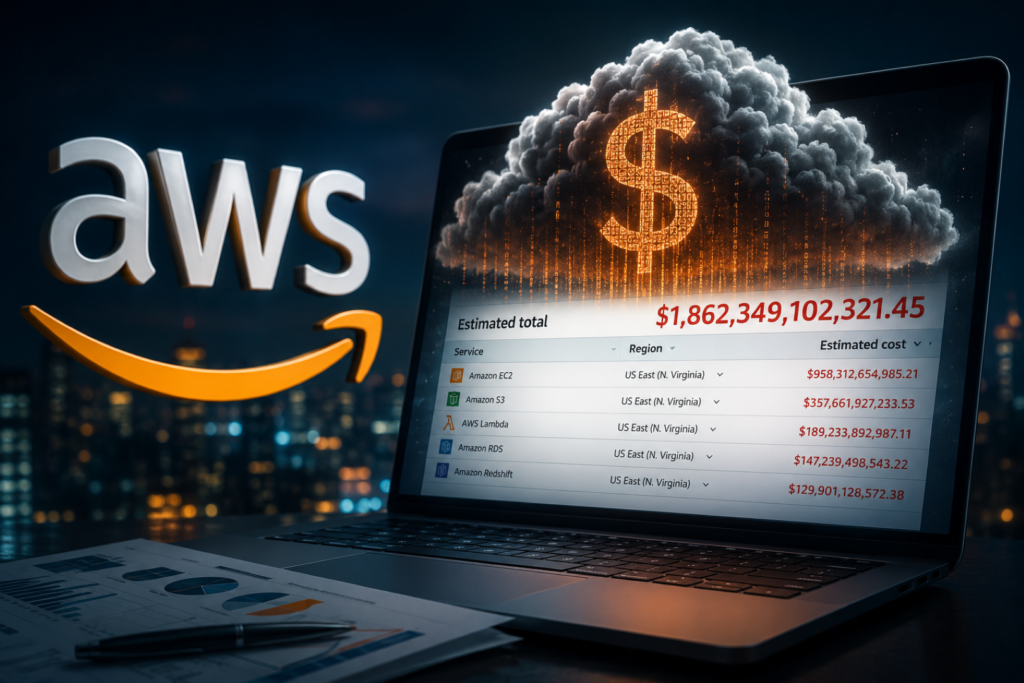
Introduction: AWS Cost Explorer Bug — Why It Matters
AWS Cost Explorer Bug briefly caused panic among cloud customers after the AWS Billing and Cost Management Console displayed projected cloud bills reaching billions and even trillions of dollars. While the enormous estimates immediately raised concerns across the cloud community, Amazon Web Services (AWS) confirmed that the issue was limited to estimated billing calculations and did not affect customers’ actual invoices or account charges.
The AWS Cost Explorer Bug began around 7:38 PM PDT on July 16, when customers started reporting abnormal projected costs and automated budget alerts. Screenshots quickly spread across X (formerly Twitter), showing impossible cloud spending estimates that sparked confusion among developers, IT administrators, and enterprises relying on AWS for critical workloads.
AWS later identified the root cause as an issue within the unit pricing component of its estimated billing computation subsystem. According to the company, billing records, actual service usage, invoices, and payment processing remained accurate throughout the incident. Engineers are currently recomputing estimated billing data, and AWS expects full recovery after the recalculation process is completed.
Although the incident was not a cybersecurity breach or financial compromise, it highlights the importance of reliable cloud billing systems and demonstrates how even temporary platform errors can disrupt business operations, trigger unnecessary alerts, and create uncertainty for organizations managing cloud infrastructure. The AWS Cost Explorer Bug quickly became one of the most discussed cloud platform incidents after unrealistic billing estimates appeared across customer dashboards.
What is AWS Cost Explorer?
AWS Cost Explorer is a cloud cost analysis service provided by Amazon Web Services (AWS) that enables organizations to visualize, monitor, and forecast their cloud spending. It plays a critical role in cloud financial management by helping businesses understand resource consumption, optimize costs, and identify unusual spending trends.
The service is commonly used by:
- Cloud administrators
- DevOps teams
- Security Operations Centers (SOCs)
- Finance and procurement teams
- Cloud architects
- Managed Service Providers (MSPs)
Key capabilities include:
- Historical cloud spending analysis
- Cost forecasting
- Budget tracking
- Resource utilization reporting
- Service-level cost breakdowns
- Cost optimization recommendations
Because many organizations integrate Cost Explorer with automated budget notifications, procurement systems, and financial dashboards, inaccurate estimates can immediately generate false alarms across multiple departments. During the AWS Cost Explorer Bug, many organizations relied on official AWS updates to verify that the displayed estimates did not reflect actual charges.
What Caused the Incident?
According to AWS, the incident was not caused by a cyberattack, unauthorized account activity, ransomware, or data breach. Instead, the company traced the issue to an error affecting the unit pricing logic within the estimated billing computation subsystem.
As a result, the platform generated dramatically inflated projected cloud costs while continuing to calculate actual usage correctly behind the scenes.
AWS confirmed that the following services remained unaffected:
- Actual customer invoices
- Service usage records
- Billing transactions
- Payment processing
- Cost & Usage Reports
- Customer account balances
The issue was isolated specifically to estimated billing data displayed within:
- AWS Billing and Cost Management Console
- AWS Cost Explorer dashboards
- Estimated budget calculations
- Forecasted spending metrics
AWS engineers initiated remediation efforts shortly after identifying the problem and began recomputing estimated billing information to restore accurate forecasts. AWS confirmed that the AWS Cost Explorer Bug was caused by an internal billing estimation issue rather than malicious activity.
AWS Cost Explorer Bug: Full Technical Breakdown
The billing anomaly first became visible when AWS customers noticed extraordinary projected cloud costs that bore no resemblance to their normal spending patterns. Some organizations received automated budget alerts indicating projected bills in the billions or trillions of dollars, despite no corresponding increase in resource utilization.
Because many enterprises rely on automated cost monitoring, the erroneous estimates triggered immediate internal investigations. Engineering teams checked running workloads, reviewed infrastructure deployments, and searched for signs of compromised credentials before AWS publicly confirmed the platform issue.
The incident remained confined to the presentation and computation of estimated billing values rather than actual financial transactions. This distinction proved critical because it meant customer invoices, payment processing, and recorded service usage continued to function normally despite the alarming dashboard figures.
AWS has stated that recalculating estimated billing information requires processing large volumes of billing data, meaning some customers may continue to observe inconsistent estimates until the recomputation process is fully completed.
Timeline of Events
- July 16, 2026 – 7:38 PM PDT: AWS begins experiencing issues affecting estimated billing calculations.
- Customers start reporting unrealistic projected cloud bills through the AWS Billing Console and Cost Explorer.
- Screenshots showing trillion-dollar estimated charges rapidly circulate on X (formerly Twitter).
- AWS investigates the issue and identifies a fault in the estimated billing computation subsystem.
- July 17, 2026 – 3:03 AM PDT: AWS publishes a root cause update confirming the problem is related to unit pricing calculations.
- AWS begins recomputing estimated billing data across affected customer accounts.
- AWS confirms that actual usage, invoices, and customer charges remain unaffected, while full recovery is expected to take several hours.
The AWS Cost Explorer Bug spread rapidly across social media as users shared screenshots of unusually high projected cloud bills.
What Systems Were Affected?
The issue impacted estimated billing information displayed through AWS billing interfaces, including:
- AWS Billing and Cost Management Console
- AWS Cost Explorer
- Estimated billing calculations
- Budget forecasting dashboards
- Automated budget alerts
- Cost projection metrics
The following systems were not affected:
- Actual cloud resource usage
- Customer invoices
- Payment processing
- AWS account balances
- Cost & Usage Reports (CUR)
- Cloud service availability
- Running workloads
- Customer data and cloud infrastructure
Potential Risks & Impact
Although the AWS Cost Explorer Bug did not compromise customer data or alter actual invoices, the incident demonstrated how inaccurate billing estimates can disrupt business operations and trigger unnecessary investigations. Many organizations rely on automated cost-monitoring tools to detect unexpected cloud spending, making even temporary estimation errors a significant operational concern. Although the AWS Cost Explorer Bug was not a security breach, it highlighted the operational importance of accurate cloud billing systems.
Identity & Financial Risk
AWS confirmed that the billing anomaly was not the result of compromised accounts or unauthorized cloud activity. However, organizations should remain cautious if unusually high billing estimates continue after AWS completes its remediation process.
If billing anomalies persist, security teams should investigate for:
- Compromised AWS credentials
- Unauthorized IAM user activity
- Exposed Access Keys
- Cryptomining malware running on EC2 instances
- Unexpected resource deployments
- Misconfigured Auto Scaling Groups
- Forgotten development environments consuming resources
In this incident, AWS emphasized that actual customer invoices and payment processing remained accurate, reducing the likelihood of direct financial losses caused by the platform issue itself.
Business & Operational Risk
For enterprises operating large cloud environments, inaccurate cost forecasts can create unnecessary operational disruptions.
Potential business impacts include:
- False budget threshold alerts
- Emergency incident response activation
- Time-consuming investigations by cloud teams
- Delays in planned infrastructure deployments
- Temporary suspension of cloud provisioning while costs are reviewed
- Increased workload for finance and procurement departments
Organizations with automated governance workflows linked to AWS budgets may also experience interruptions if cost thresholds are used to trigger deployment approvals or spending restrictions.
Regulatory & Compliance Risk
While the incident was not a cybersecurity breach, regulated industries still have obligations to investigate unusual financial or operational anomalies.
Organizations operating under compliance frameworks such as:
- ISO/IEC 27001
- SOC 2
- PCI DSS
- HIPAA
- GDPR
- India’s Digital Personal Data Protection (DPDP) Act
may need to document the incident internally to demonstrate appropriate monitoring and response procedures during audits.
Because AWS confirmed that no customer data or billing records were compromised, the event does not currently indicate a reportable security incident. However, maintaining incident documentation remains a good governance practice.
Official Response / Statement
AWS acknowledged the issue through its service communications and confirmed that engineers had identified the root cause within the unit pricing component of the estimated billing computation subsystem.
According to AWS:
- Actual service usage remained accurate.
- Customer invoices were unaffected.
- Payment processing continued normally.
- Cost & Usage Reports remained accurate.
- Only estimated billing calculations displayed incorrect values.
- Engineers are recomputing billing estimates.
- Full recovery may require several hours.
- No customer action is currently required.
AWS also advised customers to continue monitoring their cloud environments using existing security and operational tools while the recalculation process is completed. AWS stated that engineers are continuing recovery efforts until the AWS Cost Explorer Bug no longer affects estimated billing calculations.
Industry Context: Why Cloud Billing Accuracy Matters
Cloud cost management has become a critical component of enterprise cybersecurity and operational resilience. Organizations increasingly depend on automated billing analytics to identify compromised cloud accounts, unauthorized resource creation, and unexpected infrastructure changes.
Modern FinOps (Financial Operations) practices integrate billing data with security monitoring, allowing teams to detect abnormal spending patterns that may indicate:
- Cryptojacking attacks
- Compromised IAM accounts
- Misconfigured cloud services
- Insider misuse
- Resource provisioning errors
Because billing anomalies are often one of the earliest indicators of unauthorized cloud activity, even temporary inaccuracies can create significant uncertainty for security operations teams. Incidents like the AWS Cost Explorer Bug demonstrate why organizations should continuously validate unexpected billing changes before assuming unauthorized cloud activity.
Organizations looking to strengthen their cloud security posture can also explore CyberNexora’s guides on Cloud Security Best Practices and follow the latest Cyber Incidents affecting major cloud providers.
How to Protect Yourself / Your Organization
Although AWS has confirmed that this incident was caused by an internal billing computation issue, organizations should always verify unusual cloud costs before assuming they are harmless.
- Review AWS CloudTrail logs for unusual API calls or unauthorized account activity.
- Monitor AWS Config to identify unexpected infrastructure changes.
- Compare Cost Explorer estimates with Cost & Usage Reports (CUR) to verify actual resource consumption.
- Inspect IAM users, roles, and access keys for unauthorized logins or recently created credentials.
- Check EC2 instances and container workloads for signs of cryptomining or unexplained compute usage.
- Review Auto Scaling Groups and Lambda functions to ensure resources have not expanded unexpectedly.
- Enable Multi-Factor Authentication (MFA) for all privileged AWS accounts and rotate access keys regularly.
- Continue monitoring the AWS Health Dashboard and official service announcements until AWS confirms complete recovery of estimated billing calculations.
Taking these precautions helps distinguish between platform-related issues and genuine security incidents that require immediate remediation. Organizations affected by the AWS Cost Explorer Bug should compare estimated costs with actual usage reports before initiating emergency response procedures.
Indicators to Investigate (If Billing Still Appears Abnormal)
If estimated costs remain unusually high after AWS announces full recovery, organizations should investigate the following indicators:
- Unexpected EC2 instances running continuously
- Large increases in compute or storage usage
- New IAM users or roles without authorization
- Unrecognized API calls in CloudTrail
- Suspicious outbound network traffic
- Recently generated Access Keys
- Unexpected S3 bucket activity
- Cryptomining software detected on workloads
- Budget alerts continuing after AWS resolves the incident
- Unauthorized deployments through Infrastructure-as-Code pipelines
These indicators may suggest a genuine cloud security issue rather than a temporary billing estimation error.
Key Takeaways
- AWS confirmed the incident affected estimated billing calculations only.
- Actual customer invoices, charges, and resource usage remained accurate.
- The root cause was identified within the unit pricing calculation subsystem.
- AWS is recomputing estimated billing data, with full recovery expected after processing completes.
- Customers do not need to take immediate action, but should continue monitoring their cloud environments.
- Persistent billing anomalies after the fix should be investigated as potential indicators of compromised credentials, cryptomining, or cloud misconfigurations.
Conclusion: AWS Cost Explorer Bug and What Happens Next
The AWS Cost Explorer Bug serves as a reminder that cloud billing platforms are essential operational tools whose accuracy directly influences financial planning, security monitoring, and incident response. Although the incident generated widespread concern after customers observed trillion-dollar projected bills, AWS has confirmed that the issue was limited to estimated billing calculations and did not affect actual invoices or customer charges.
As AWS completes the recomputation of estimated billing data, organizations should continue monitoring CloudTrail logs, AWS Config, Cost & Usage Reports, and official AWS service updates. If abnormal billing estimates persist after the platform has fully recovered, security teams should promptly investigate for compromised credentials, unauthorized resource provisioning, cryptomining activity, or configuration errors. Staying proactive helps ensure that genuine cloud security incidents are identified quickly while avoiding unnecessary panic caused by temporary platform anomalies.
Frequently Asked Questions(FAQs)
The AWS Cost Explorer Bug was a billing estimation issue that caused AWS Cost Explorer and the AWS Billing Console to display extremely inflated projected cloud costs for some customers. AWS confirmed that the problem affected only estimated billing calculations, while actual usage, invoices, and customer charges remained accurate.
No. AWS stated that the incident did not impact actual customer invoices, billing transactions, payment processing, or recorded cloud resource usage. The issue was limited to estimated billing values displayed in Cost Explorer and related dashboards.
According to AWS, the root cause was an issue within the unit pricing component of the estimated billing computation subsystem. This resulted in incorrect projected billing estimates without affecting the underlying billing records or customer charges.
AWS has indicated that no immediate customer action is required. However, organizations should continue monitoring AWS CloudTrail, AWS Config, Cost & Usage Reports (CUR), and the AWS Health Dashboard. If abnormal billing estimates continue after AWS completes its recovery, customers should investigate for compromised credentials, unauthorized cloud activity, cryptomining, or configuration errors.
Not necessarily. AWS confirmed there is no evidence that the incident resulted from a cyberattack or data breach. Nevertheless, if unusually high costs persist after AWS resolves the issue, organizations should verify their environments for unauthorized resource creation or suspicious account activity.
Organizations should implement continuous cloud monitoring using CloudTrail, AWS Config, Cost & Usage Reports, AWS Budgets, and Security Hub. Combining these tools with regular IAM reviews and multi-factor authentication (MFA) can help distinguish genuine security incidents from temporary platform issues.