
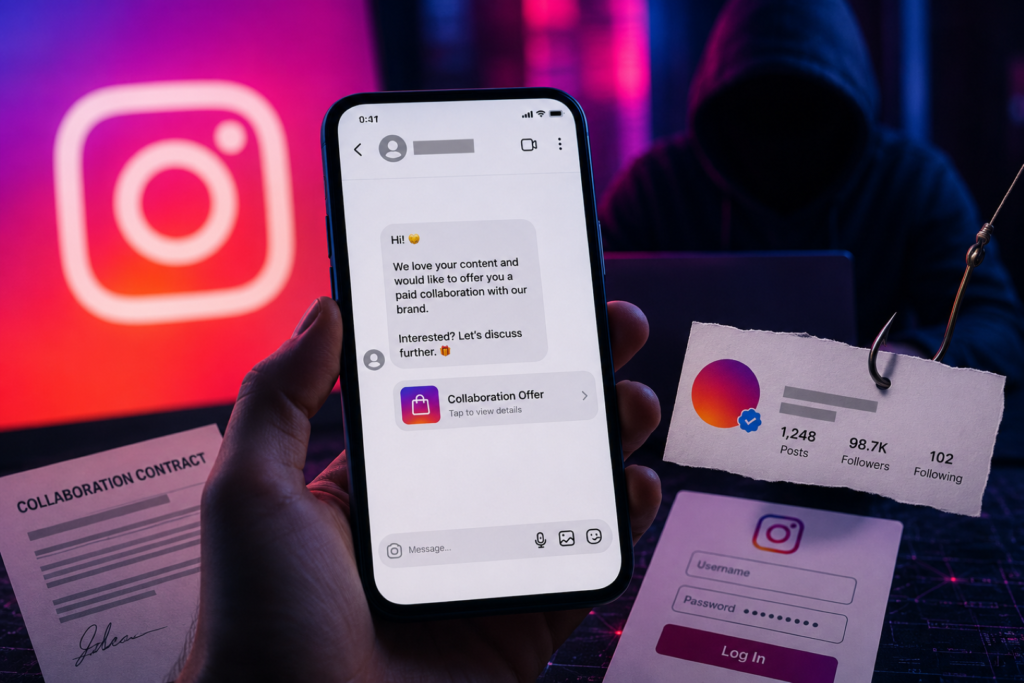
Introduction: Instagram DM Scams — Why It Matters
Cybercriminals are increasingly exploiting social media to target individuals seeking brand collaborations and sponsorship opportunities. One of the latest campaigns involves Instagram DM Scams, where attackers impersonate legitimate companies to deceive influencers, creators, and small businesses into revealing sensitive information or making fraudulent payments.
The scam is reportedly affecting users across India, with nano and micro influencers appearing to be the primary targets. Fraudsters create convincing Instagram profiles using stolen logos, copied branding, and professional-looking messages to make fake collaboration offers appear genuine. Victims are then directed to phishing websites or asked to pay fabricated registration or verification fees before supposedly receiving sponsorship opportunities.
As influencer marketing continues to grow in India, these scams pose a significant risk to content creators, entrepreneurs, and digital marketers who rely on social media for business partnerships. Beyond financial losses, compromised Instagram accounts can also be used to spread additional scams, steal personal data, and damage professional reputations.
What are Instagram DM Scams?
Instagram DM scams are phishing campaigns conducted through Instagram’s Direct Messaging feature. Instead of sending random spam messages, cybercriminals carefully target creators, influencers, freelancers, photographers, artists, and small businesses that regularly engage with brands online.
These attacks typically begin with what appears to be a legitimate collaboration request from a well-known company. The message often includes:
- Paid partnership offers
- Product promotion opportunities
- Ambassador program invitations
- Sponsored content requests
- Verification or onboarding instructions
To increase credibility, attackers frequently:
- Create lookalike Instagram usernames
- Copy profile pictures and branding from official company pages
- Use professional language similar to genuine marketing agencies
- Mimic the communication style of legitimate brands
The ultimate objective is to convince victims to click malicious links, submit Instagram credentials, or transfer money under the guise of partnership-related fees.
What Caused the Incident?
Unlike traditional phishing emails, Instagram DM scams take advantage of the growing influencer economy and people’s willingness to collaborate with brands. The rapid increase in Instagram DM Scams reflects how attackers are exploiting the popularity of influencer marketing and trusted brand identities.
Several factors have contributed to the rapid increase of these scams:
Growth of Influencer Marketing
India has witnessed rapid growth in digital content creation across Instagram, YouTube, and other social platforms. Thousands of creators receive genuine partnership requests every day, making fake offers more believable.
Publicly Available Contact Information
Many creators display business email addresses and openly invite collaboration requests in their Instagram bios. While this helps attract legitimate brands, it also provides cybercriminals with an easy list of potential victims.
Ease of Creating Fake Accounts
Attackers can quickly create Instagram profiles that closely resemble genuine brand accounts by copying:
- Logos
- Profile descriptions
- Previous posts
- Highlight covers
- Brand colors
Some fake profiles even purchase followers to appear authentic.
Social Engineering Techniques
Rather than relying on malware, attackers manipulate human psychology.
Common tactics include:
- Creating urgency
- Offering unusually high payments
- Limited-time campaigns
- Exclusive partnership invitations
- Fake account verification requirements
These methods pressure victims into acting before verifying the legitimacy of the offer.
Instagram DM Scams: Full Technical Breakdown
Timeline of Events
Although no single coordinated campaign has been officially attributed to a specific threat actor, cybersecurity researchers and fraud investigators have observed an increasing number of reports involving fake Instagram collaboration messages targeting Indian users throughout 2026.
The attack typically follows this sequence:
- A fake Instagram account impersonating a popular brand is created.
- The attacker sends direct messages to influencers or business accounts.
- The victim receives an attractive collaboration proposal.
- The message contains a phishing link or downloadable document.
- The victim is asked to:
- Log into Instagram
- Complete account verification
- Fill out a partnership form
- Pay registration or shipping fees
- Credentials or payment information are captured.
- The compromised Instagram account may then be used to scam additional users by sending similar fraudulent collaboration requests.
Security researchers believe Instagram DM Scams continue to evolve, with attackers regularly changing fake brand identities and phishing techniques.
This attack chain relies almost entirely on social engineering rather than exploiting software vulnerabilities.
What Data or Systems Were Potentially Affected?
The exact number of affected users has not been officially disclosed. However, successful attacks may expose various types of sensitive information, including:
Potentially Compromised Data
- Instagram usernames
- Account passwords
- Two-factor authentication codes
- Email addresses
- Mobile phone numbers
- Personal identification details
- Banking or payment information
- Digital wallet details
- Brand collaboration communications
- Business contact databases
Potentially Affected Systems
- Instagram creator accounts
- Instagram business accounts
- Creator email accounts
- Mobile devices used for authentication
- Linked Meta Business accounts
- Payment applications connected to collaboration activities
If attackers gain control of an Instagram account, they may also impersonate the victim to launch additional phishing campaigns, request money from followers, or distribute malicious links.
Potential Risks & Impact
Identity and Financial Risk
Victims of Instagram DM Scams face more than just the loss of access to their Instagram accounts. Once attackers obtain login credentials or financial information, they can exploit the compromised data for identity theft, unauthorized transactions, and further phishing campaigns. Successful Instagram DM Scams can result in identity theft, financial fraud, and long-term loss of trust for both individuals and businesses.
Potential risks include:
- Unauthorized access to Instagram accounts
- Identity theft through stolen personal information
- Financial losses due to fake registration or verification fees
- Exposure of linked email accounts
- Theft of payment information
- Hijacking of Meta Business Suite accounts
- Loss of access to business pages and advertising accounts
For influencers whose income depends on social media, losing account control can also result in missed brand deals, reduced audience trust, and long-term reputational damage.
Business and Reputational Risk
Small businesses increasingly rely on Instagram for customer engagement, marketing, and sales. A compromised account can disrupt daily operations and damage customer confidence.
Organizations and creators may experience:
- Loss of customer trust
- Fake promotional posts published by attackers
- Fraudulent messages sent to followers
- Business impersonation
- Reduced engagement and brand credibility
- Revenue loss due to account suspension or recovery delays
Once an attacker controls a business account, they may use it to promote cryptocurrency scams, investment fraud, or additional phishing campaigns targeting the account’s followers.
Regulatory and Compliance Risk
Businesses that store customer information or conduct transactions through social media platforms may also face regulatory challenges if account compromises expose customer data.
Potential compliance concerns include:
- Violation of data protection obligations
- Customer privacy issues
- Reputational consequences from public disclosure
- Increased scrutiny following account compromise
- Incident reporting requirements depending on applicable regulations
Although these scams primarily target Instagram credentials, organizations should treat compromised social media accounts as legitimate cybersecurity incidents requiring investigation and remediation.
Official Response / Statement
At the time of writing, Meta has not issued a public statement specifically addressing this particular wave of fake brand collaboration scams targeting Indian influencers.
However, Meta has consistently advised users to:
- Verify business accounts before engaging with collaboration offers.
- Report suspicious profiles and phishing attempts through Instagram.
- Enable two-factor authentication (2FA) for account security.
- Review account activity and login alerts regularly.
- Avoid sharing login credentials through external websites.
Cybersecurity professionals also recommend verifying collaboration requests through official company websites or verified business email addresses rather than relying solely on Instagram Direct Messages. Users and organizations can also follow the CERT-In cybersecurity advisories for official guidance on protecting online accounts and responding to cyber threats.
Users who believe their accounts have been compromised should immediately change their passwords, revoke suspicious login sessions, enable multi-factor authentication, and report the incident to Instagram.
Industry Context: Why This Type of Attack Is Increasing
Social engineering attacks continue to evolve as cybercriminals shift away from traditional malware and instead exploit human trust.
The rapid growth of India’s creator economy has made influencers and small businesses attractive targets. Unlike large enterprises with dedicated security teams, independent creators often manage their own social media accounts, making them more vulnerable to impersonation and phishing attacks.
Several trends are contributing to the rise of these scams:
- Increasing popularity of influencer marketing
- Growing use of AI-generated phishing messages
- Availability of stolen brand assets online
- Low cost of creating convincing fake social media profiles
- Rising financial value of verified Instagram accounts
Threat actors increasingly understand that compromising a trusted influencer account can provide access to thousands—or even millions—of potential victims.
Readers interested in latest phishing attacks and cyber incidents can explore CyberNexora News for coverage of recent cybersecurity events.
Readers looking for cybersecurity awareness and online safety tips can also explore CyberNexora News’ educational resources.
How to Protect Yourself from Instagram DM Scams
Individuals and businesses can significantly reduce their risk by following these cybersecurity best practices:
1. Verify Brand Accounts
Always confirm that collaboration requests originate from verified Instagram profiles or official company websites before responding.
2. Never Click Unsolicited Links
Avoid clicking links received through unexpected Instagram DMs, especially those requesting account verification or login credentials.
3. Enable Multi-Factor Authentication (MFA)
Enable MFA on Instagram to add an additional security layer even if attackers obtain your password.
4. Never Pay Upfront Collaboration Fees
Legitimate brands generally do not ask influencers to pay registration, shipping, onboarding, or verification fees before beginning a partnership.
5. Inspect Usernames Carefully
Cybercriminals frequently use lookalike usernames that differ by only one or two characters.
For example:
- brand_official
- brand-official
- brandofficial_
- brand.support
Always compare usernames with the company’s verified profile.
6. Use Official Communication Channels
If you receive an unexpected collaboration offer, contact the company through its official website or verified business email to confirm authenticity.
7. Review Login Activity Regularly
Check Instagram’s Account Center for unfamiliar devices or login sessions and immediately remove unauthorized access.
8. Report Suspicious Accounts
Reporting fake accounts helps Instagram remove fraudulent profiles before they target additional users.
9. Keep Recovery Information Updated
Ensure your recovery email address and mobile number remain current so you can quickly regain access if your account is compromised. Users can also review Instagram’s official account recovery guide if they lose access to their accounts.
10. Educate Team Members
Businesses should train employees managing corporate social media accounts to recognize phishing attempts and verify collaboration requests before responding.
Indicators of Compromise (IoCs)
Users should immediately investigate their accounts if they notice any of the following indicators:
- Unexpected brand collaboration messages from unverified accounts
- Requests to log into external websites
- Fake Instagram verification pages
- Requests for shipping, onboarding, or registration fees
- Password reset notifications that were not initiated by the user
- Login alerts from unfamiliar devices or locations
- Unauthorized posts or stories appearing on the account
- Followers reporting suspicious messages sent from your profile
- Unexpected changes to account email address or phone number
- Disabled or altered two-factor authentication settings
Key Takeaways
- Instagram DM Scams are increasingly targeting Indian influencers, creators, and small businesses through fake brand collaboration offers.
- Cybercriminals use lookalike Instagram accounts, phishing websites, and social engineering techniques to steal credentials and financial information.
- Nano and micro influencers are particularly vulnerable due to their higher likelihood of accepting collaboration requests.
- Verifying brand identities, enabling multi-factor authentication, and avoiding unsolicited links remain the most effective defenses.
- Both creators and businesses should treat suspicious collaboration offers as potential phishing attempts and report fraudulent accounts promptly.
Conclusion: Instagram DM Scams and What Happens Next
The rise of Instagram DM Scams highlights how cybercriminals continue to exploit trust rather than technical vulnerabilities. By impersonating well-known brands and presenting convincing collaboration offers, attackers are successfully targeting influencers, content creators, freelancers, and small businesses that depend on Instagram for income and customer engagement.
As influencer marketing continues to expand across India and globally, these scams are expected to become increasingly sophisticated. Artificial intelligence, deepfake technology, and automated phishing tools could further enhance the realism of fraudulent messages, making it more difficult for users to distinguish legitimate brand partnerships from scams.
The best defense remains a combination of awareness, verification, and strong account security. Individuals should independently verify every collaboration request, avoid clicking unsolicited links, enable multi-factor authentication (MFA), and report suspicious accounts to Instagram immediately.
Readers interested in additional phishing campaigns can explore our Cyber Incidents coverage, while those looking for cybersecurity resources and best practices can browse our Resources section for practical guidance.
Frequently Asked Questions(FAQs)
Instagram DM Scams are phishing campaigns in which cybercriminals impersonate legitimate brands and send fake collaboration offers through Instagram Direct Messages. Their goal is to steal account credentials, personal information, or money by tricking users into clicking malicious links or paying fraudulent fees.
Indian influencers, especially nano and micro creators, are attractive targets because they frequently seek brand collaborations and may be more likely to trust unsolicited partnership offers. Attackers exploit this opportunity by sending convincing fake sponsorship messages.
Common warning signs include unverified Instagram accounts, suspicious usernames, requests to click external links, demands for upfront payments, poor grammar, unrealistic payment offers, and pressure to respond quickly. Always verify the collaboration through the brand’s official website or business email.
Yes. Users should immediately change their password if possible, revoke suspicious login sessions, enable multi-factor authentication, and use Instagram’s official account recovery process. Reporting the incident promptly increases the likelihood of successful account recovery.
Businesses should train employees managing social media accounts to recognize phishing attempts, enforce strong passwords and MFA, verify all collaboration requests independently, and regularly monitor account login activity for unauthorized access.
Unlike email phishing, Instagram DM Scams 2026 exploit social media interactions and influencer marketing. Attackers impersonate trusted brands through Instagram messages instead of email, making the scams appear more personal and convincing to potential victims.