
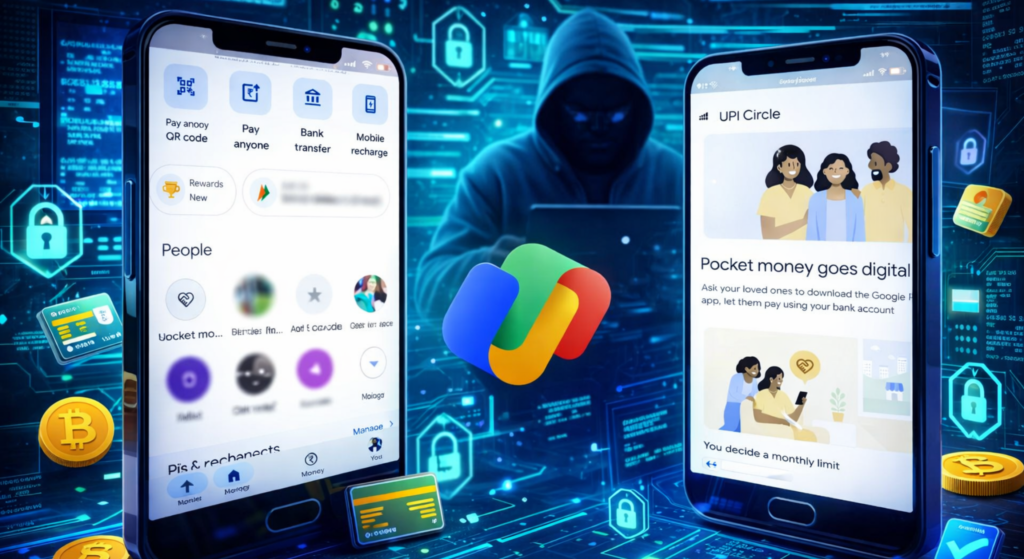
A new feature in Google Pay, often referred to as “Pocket Money” or “UPI Circle,” has recently triggered concern among users in India. Several posts circulating on social media claim that the feature is linked to unauthorized transactions or unexpected deductions.
These claims have led to confusion, with some users calling it a potential scam. However, a closer look shows that the issue is less about fraud and more about misunderstanding how the feature works.
What is the “Pocket Money” Feature?
The feature is part of Google Pay’s effort to expand controlled payment access within families or trusted groups. It allows a primary user to authorize another person to make payments using their linked bank account, within predefined limits.
The concept is similar to:
- Allowing controlled spending access
- Managing dependent expenses
- Setting monthly usage caps
This is not a new financial concept, but a digital adaptation within the UPI ecosystem.
How the Feature Works
The functionality is structured around two roles:
Primary User (Account Holder):
- Links their bank account
- Invites a trusted person
- Sets a fixed monthly spending limit
Secondary User (Authorized Person):
- Gains permission to make payments
- Uses Google Pay normally
- Cannot exceed the assigned limit
All transactions remain visible to the primary user, and access can be revoked at any time.
Importantly, no access is granted without user approval during setup.
Why Are Users Calling It a Scam?
The rise in “scam” claims appears to be driven by a mix of misinformation and user behavior rather than a flaw in the system itself.
1. Misinterpretation of Permissions
Some users may not fully read or understand the authorization process. Granting access without clarity can later appear suspicious when transactions occur.
2. Viral Social Media Claims
Unverified posts suggesting “money is disappearing” or “accounts are being accessed automatically” have amplified fear. In most cases, these claims lack technical evidence.
3. Confusion with Fraud Attempts
Cybercriminals often exploit trending features. Fake messages or links claiming to “activate” or “secure” the Pocket Money feature can trick users into sharing sensitive information.
4. Lack of Awareness About UPI Controls
Many users are unfamiliar with permission-based payment systems. As a result, legitimate transactions initiated by authorized users may be mistaken for unauthorized activity.
Is It Technically a Scam?
Based on current information, the feature itself is not a scam.
There is no indication that:
- Funds are deducted without user authorization
- Access is granted automatically
- Google Pay is enabling unauthorized transactions
The system relies on explicit user consent at every step. Without approval, no secondary access is created.
However, like any financial tool, it can be misused if users are careless with permissions or fall victim to social engineering attacks.
Where the Risk Actually Lies
The real risk is not in the feature, but in how it is used.
User-Level Risks:
- Approving requests without verifying the sender
- Misunderstanding access permissions
- Not monitoring transaction history
External Threats:
- Phishing links posing as Google Pay notifications
- Fraud calls asking users to “enable” or “fix” the feature
- Fake apps or cloned interfaces
In such cases, losses occur due to user action, not a system breach.
Can Money Be Deducted Without Permission?
No direct mechanism allows automatic deduction without user setup.
For money to be used:
- The primary user must approve access
- A spending limit must be defined
- Transactions must be initiated within that limit
If users observe unexpected deductions, the likely reasons include:
- Previously granted access
- Shared device or account misuse
- Falling for phishing or fraud
Who Should Use This Feature?
The feature is designed for controlled and transparent use cases:
- Parents managing children’s spending
- Supporting elderly family members
- Shared household expense management
- Budget-controlled financial access
When used correctly, it adds convenience without reducing control.
Key Safety Measures
Users can avoid confusion or misuse by following basic precautions:
- Review all permission requests carefully before approving
- Only authorize known and trusted individuals
- Avoid clicking links from unknown sources
- Never share UPI PIN, OTP, or login details
- Regularly check transaction history
- Revoke access immediately if anything seems unusual
The Google Pay “Pocket Money” feature is a legitimate addition to digital payments, aimed at improving controlled access and financial flexibility. The current wave of “scam” claims appears to be driven largely by misinformation and lack of awareness.
There is no verified evidence suggesting that the feature itself enables unauthorized transactions. However, as with any financial system, user awareness remains critical.
Understanding how the feature works — and using it responsibly — is the key to avoiding unnecessary risk.