
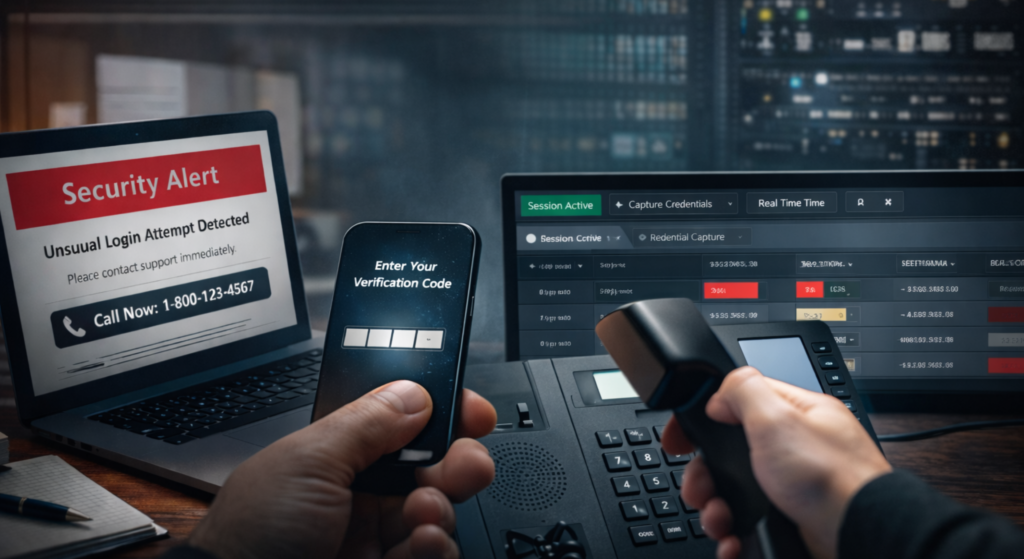
A new and highly advanced cybercrime platform is raising serious concerns across the cybersecurity community, as attackers shift from traditional phishing links to AI-powered voice scams. The platform, known as ATHR, represents a major evolution in how cybercriminals target individuals and organizations by combining email deception with real-time voice interaction.
Unlike conventional phishing attacks that rely on malicious links or attachments, this new method focuses on social engineering through phone calls. Victims receive a simple-looking email containing a support or security alert along with a phone number. At first glance, the message appears legitimate and does not trigger typical spam filters, making it far more effective in reaching targets.
The real attack begins when the recipient calls the number provided in the email. Instead of speaking to a human operator, the victim is connected to an AI-powered voice agent that mimics a professional customer support representative. The voice is designed to sound natural, calm, and authoritative, creating a high level of trust during the interaction.
During the call, the AI agent informs the victim about suspicious activity on their account and guides them through a fake verification or recovery process. This often includes confirming personal details and eventually requesting a one-time password (OTP) or login credentials. Since the interaction feels genuine and personalized, many victims comply without hesitation.
What makes this attack particularly dangerous is its ability to bypass traditional security measures. Since there are no malicious links or attachments in the initial email, standard email security systems often fail to detect the threat. The entire operation relies on convincing the victim to initiate contact, making it a highly effective form of social engineering.
Behind the scenes, the ATHR platform operates as a complete cybercrime toolkit. It integrates multiple components, including email delivery systems, AI-driven voice interaction, and real-time credential harvesting panels. Attackers can monitor live sessions, track victim activity, and capture sensitive data as it is entered during the call.
The platform also allows attackers to customize their campaigns with detailed personal information, such as location, login attempts, and account activity. This level of personalization significantly increases the credibility of the attack and makes it harder for victims to recognize the fraud.
Another concerning aspect is the accessibility of this technology. Previously, executing such complex attacks required significant technical expertise and infrastructure. However, ATHR simplifies the process by offering an all-in-one solution that can be deployed with minimal effort. This lowers the barrier for entry into cybercrime and increases the scale of potential attacks.
Cybersecurity experts warn that this marks a shift from traditional phishing to what is now being called “voice phishing” or “vishing,” powered by artificial intelligence. The use of realistic voice synthesis and automated scripts allows attackers to handle multiple victims simultaneously, making the operation both scalable and efficient.
Recent observations indicate that such campaigns are already targeting users of major platforms, including email services, financial accounts, and cryptocurrency platforms. The goal remains consistent: to gain access to sensitive accounts and extract financial or personal data.
Despite the advanced nature of these attacks, experts emphasize that awareness remains the most effective defense. Users should avoid calling phone numbers provided in unsolicited emails, especially those claiming urgent security issues. Instead, they should directly visit the official website of the service and use verified contact information.
It is also important to remember that no legitimate company will ask for one-time passwords or sensitive credentials over a phone call. Any such request should be treated as a clear warning sign. Enabling strong authentication methods, such as hardware-based security keys, can further reduce the risk of compromise.
Organizations are also advised to monitor for unusual patterns, such as multiple employees receiving similar emails with identical phone numbers. Such patterns may indicate an ongoing coordinated attack.
The emergence of platforms like ATHR highlights how cyber threats are evolving with technology. Attackers are no longer limited to technical exploits; they are now leveraging artificial intelligence to manipulate human behavior at scale.
As cybercrime continues to adapt, individuals and organizations must remain vigilant. The combination of AI, automation, and social engineering represents a powerful threat, but with the right awareness and precautions, these attacks can be effectively mitigated.
In today’s digital environment, the safest approach is simple: never trust unexpected security alerts without verification, and always use official channels to confirm any request. The cost of a single mistake can be far greater than the effort required to stay cautious.