
AI Is Changing How Developers Understand and Rebuild Software
Artificial intelligence is opening a new chapter in software development. Tasks that once required extensive manual analysis and experienced developers can increasingly be assisted by AI coding agents, creating new opportunities for software research and application development.
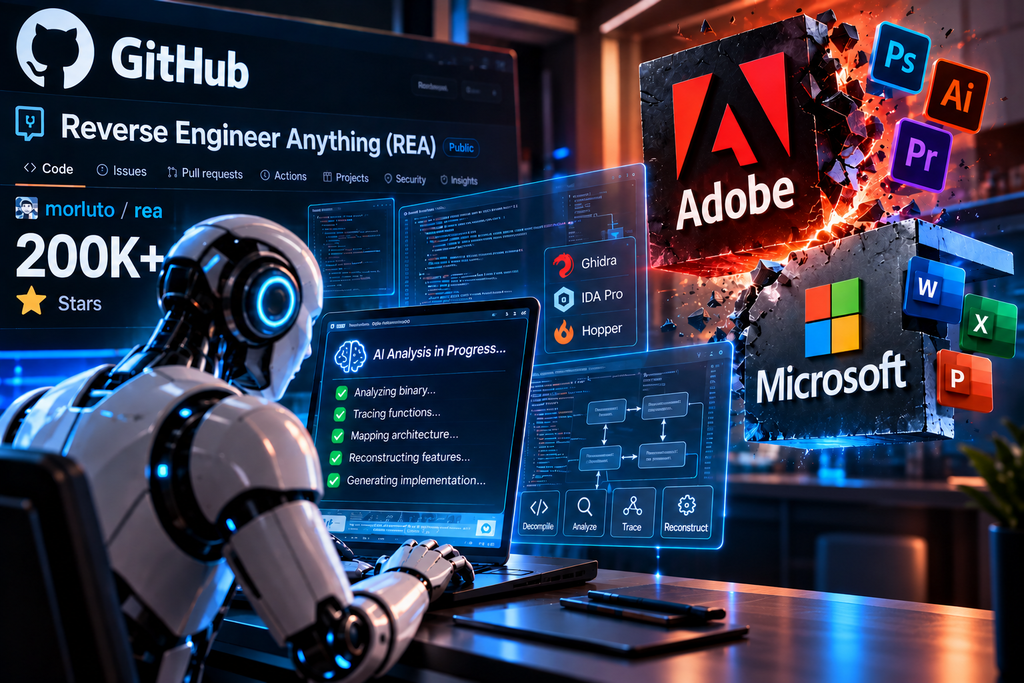
The trend has gained attention following the rise of Reverse Engineer Anything (REA), an open-source project that connects AI coding agents with specialized reverse-engineering tools. At the same time, developer Brandon Thomas has attracted attention for ArtCraft, a separate initiative creating applications with features similar to established commercial software.
Together, these developments have raised an important question: could AI make it easier for developers to build alternatives to software products that companies have spent years developing?
The answer is more complicated than simply copying an application. AI can accelerate analysis and implementation, but recreating a mature software product—with its reliability, advanced features, compatibility and ongoing support—remains a significant challenge.
What Is Reverse Engineer Anything (REA)?
Reverse Engineer Anything, commonly known as REA, is an open-source project available on GitHub. It connects AI coding agents, including Claude Code and Codex, with reverse-engineering tools used to inspect compiled software.
According to the project’s official GitHub repository, REA can help developers investigate how an application works, examine functions and references, and analyze programs even when their original source code is unavailable.
Traditional reverse engineering can be time-consuming. Developers may need to examine assembly instructions, trace function calls, inspect program behaviour and form hypotheses about how particular features work.
AI agents can help organize this process by examining evidence, answering targeted questions and assisting with follow-up analysis.
REA does not automatically recover an application’s complete original source code. Instead, it helps an AI agent investigate the available technical evidence and explain the program’s behaviour.
This distinction matters because understanding what a program does is not the same as recovering every design decision, internal implementation detail or development document behind it.
How AI-Assisted Reverse Engineering Works
The process combines conventional analysis tools with AI-assisted reasoning.
- Software inspection: A compatible analysis tool examines the target program and extracts information such as functions, references or assembly instructions.
- AI-assisted analysis: The coding agent uses the available evidence to investigate how a particular feature behaves.
- Targeted investigation: The agent requests additional information to test its assumptions and understand the relevant program logic.
- Implementation and testing: Developers can use their findings to build an independent implementation and test whether it behaves as intended.
REA supports integrations with tools such as Ghidra, Hopper and IDA, subject to the relevant installation and licensing requirements.
This approach can reduce the manual effort involved in understanding unfamiliar software. However, results depend on the application, available analysis tools, complexity of the code and quality of the evidence.
ArtCraft Brings the Debate Closer to Adobe and Microsoft
Another development attracting attention is ArtCraft, associated with developer Brandon Thomas.
Reporting by The Chosun describes AI-assisted applications developed to provide functionality similar to several established Adobe products, including Photoshop, Illustrator and Premiere Pro. The reporting also discusses applications inspired by Microsoft productivity software, including Word, Excel and PowerPoint.
The key distinction is that REA and ArtCraft serve different purposes. REA helps investigate software; ArtCraft develops alternative applications. Available reporting does not establish that REA was used to create ArtCraft.
The idea behind these applications is straightforward: rather than purchasing a large commercial software package, some users may prefer a smaller application that performs the particular tasks they need.
For example, a user who primarily edits images may not need every advanced feature available in a professional creative suite. An alternative focused on common editing tasks could be attractive if it is reliable, easy to use and affordable.
However, these projects should not yet be treated as complete replacements for established products. Independent testing has identified limitations in early-stage alternatives, including missing features, compatibility issues and differences in editing precision.
Sources: The Chosun’s reporting and Creative Bloq’s review.
Why the Software Industry Is Paying Attention
The growing use of AI in software analysis and development could affect the industry in several ways.
1. More competition for established products
If developers can build useful alternatives more quickly, some software categories may face increased competition. This could encourage established companies to improve their products, pricing and customer experience.
That does not mean established software businesses will disappear. Mature products often provide extensive integrations, professional workflows, technical support and dependable performance that are difficult to reproduce.
2. New questions about subscription models
Many commercial applications rely on recurring subscriptions. AI-assisted development could make it easier to create tools that address specific user needs without requiring a full subscription package.
The commercial impact will depend on whether these alternatives can deliver sufficient quality, security, support and compatibility for everyday use.
3. A lower barrier to software development
Independent developers, researchers and small teams may gain new ways to investigate technical problems and develop specialised applications.
This could increase experimentation and make some useful tools available to more people. It may also increase competition for developers building products in established markets.
4. Greater importance of intellectual property
Reverse engineering can have legitimate purposes, including security research, software preservation, education and interoperability. Its legality depends on the circumstances and applicable law.
There is an important difference between independently recreating functionality and unlawfully copying protected source code, confidential information or other protected material.
Developers must also consider software licences, contractual restrictions, copyright law and the permissions associated with the applications they examine.
Cybersecurity Implications: Opportunity and Risk
AI-assisted reverse engineering is relevant to cybersecurity because understanding a program’s behaviour can help researchers investigate vulnerabilities, examine suspicious software and assess how applications handle sensitive operations.
For authorised security teams, AI may help organise technical evidence and reduce the time required to investigate unfamiliar components.
However, the same general capabilities can also be misused. Attackers could attempt to understand proprietary applications, identify weaknesses or investigate how security controls work.
Potential risks include:
- Faster analysis of vulnerable software components.
- Greater pressure to fix and patch discovered weaknesses.
- Increased scrutiny of software licensing and intellectual property.
- New challenges in protecting proprietary code and sensitive implementation details.
The existence of these risks does not mean that every reverse-engineering project is malicious. Context, authorisation and the intended use of the findings are essential.
Organisations should continue to use secure development practices, maintain software updates, restrict access to sensitive systems and conduct authorised security assessments.
Could AI Replace Adobe and Microsoft?
At present, it would be premature to conclude that AI-generated alternatives can replace Adobe Creative Cloud or Microsoft 365.
Professional applications are more than collections of individual features. They include years of development, complex file-format support, integrations, accessibility features, collaboration capabilities and established user workflows.
An AI-assisted project may reproduce a particular feature quickly without matching the reliability or completeness of the original product.
Nevertheless, the wider direction is worth watching. AI is lowering some barriers to experimentation and making it easier for developers to explore how software works and build alternatives to selected features.
For established software companies, the challenge may be less about a single open-source project and more about responding to a growing number of specialised alternatives.
For users, the potential benefit is greater choice. For developers, the opportunity is faster experimentation. For the industry, the challenge is balancing innovation with security, quality and intellectual property rights.
What Happens Next?
The significance of AI-assisted reverse engineering will become clearer as projects mature and independent testing establishes what they can reliably accomplish.
REA demonstrates how AI agents can work alongside conventional software-analysis tools. ArtCraft illustrates a separate approach: using AI-assisted development to create applications that offer some functionality associated with established commercial products.
Neither development proves that commercial software is obsolete. Both highlight how AI is changing the cost and speed of certain software-development tasks.
For cybersecurity professionals and software developers, the practical priority is to understand these capabilities, evaluate their limitations and use them responsibly.
Frequently Asked Questions
What is AI reverse engineering?
AI reverse engineering uses AI-assisted tools to help analyse an existing program’s structure and behaviour. It can help developers understand how software functions, even when the original source code is unavailable.
What is Reverse Engineer Anything (REA)?
REA is an open-source project that connects AI coding agents with specialised reverse-engineering tools. It helps agents investigate programs and interpret technical evidence. It does not automatically recover an application’s complete original source code.
Is REA the same as ArtCraft?
No. REA helps analyse software, while ArtCraft is a separate initiative associated with developing alternative applications. The available reporting does not establish that REA was used to build ArtCraft.
Can AI completely replace Adobe Photoshop or Microsoft Office?
Not necessarily. AI can help developers reproduce selected functions, but mature commercial products also provide advanced features, compatibility, integrations, reliability and support. Early alternatives may not offer equivalent capabilities.
Is software reverse engineering legal?
It depends on the purpose, the software involved, the applicable law, licence terms and whether the person has appropriate authorisation. Security research and interoperability can have legitimate uses, but copying protected code or violating applicable restrictions can create legal risks.
About CyberNexora
CyberNexora covers cybersecurity news, emerging threats, technology developments and educational resources to help readers better understand the digital world.
For organisations seeking to improve their security posture, CyberNexora can also be approached to discuss web application security testing and Vulnerability Assessment and Penetration Testing (VAPT), subject to agreed scope and authorisation.
Explore our platform: CyberNexora
Read more cybersecurity news: CyberNexora News
Editorial note: This article is for informational purposes and does not constitute legal advice or a claim that any particular company has confirmed a specific response to these developments.