
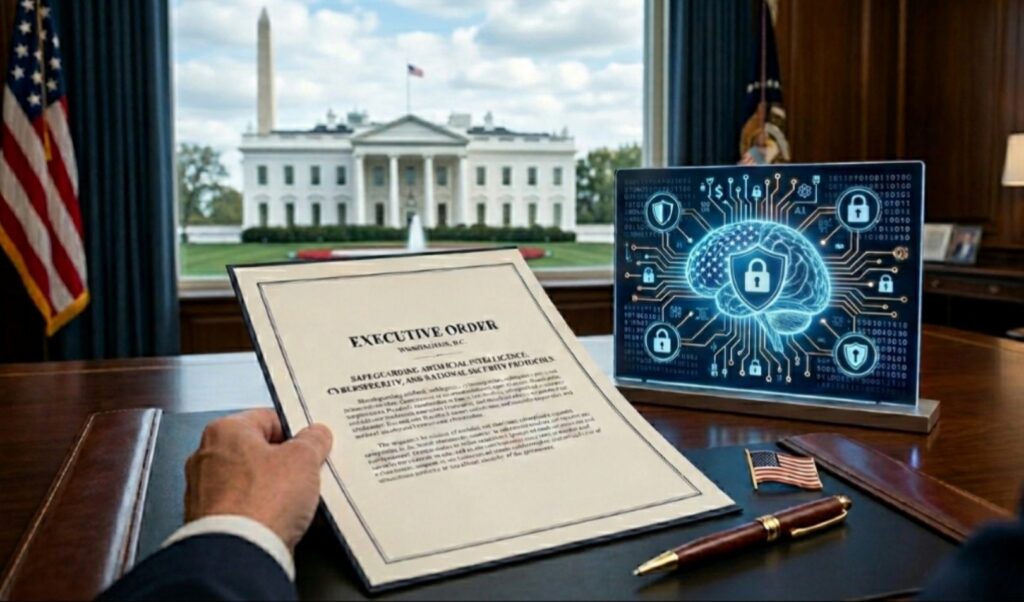
Introduction: AI Security Order — Why It Matters
The AI Security Order marks a significant shift in how governments and organizations approach cybersecurity in an era increasingly influenced by artificial intelligence. Signed by the U.S. Administration, the new framework aims to accelerate AI innovation while strengthening defenses against emerging cyber threats.
The AI Security Order directs federal agencies to expand the use of AI-powered security tools, establish a voluntary cybersecurity clearinghouse, and improve collaboration between government agencies, technology developers, and private-sector organizations.
For businesses, security teams, healthcare providers, financial institutions, and critical infrastructure operators worldwide, the initiative offers important insights into the future direction of cybersecurity strategy and AI governance.
What Is the AI Security Order?
The AI Security Order is a cybersecurity-focused executive initiative designed to encourage responsible AI adoption while strengthening national cyber resilience.
Key objectives include:
- Expanding AI-assisted cybersecurity capabilities across federal agencies.
- Improving software vulnerability identification and remediation.
- Strengthening protection for critical infrastructure sectors.
- Promoting collaboration between public and private organizations.
- Supporting innovation without imposing mandatory licensing requirements on AI models.
- Increasing enforcement efforts against cybercriminals using AI for malicious purposes.
According to the official White House fact sheet, the initiative forms part of a broader national effort to enhance cybersecurity readiness while maintaining technological competitiveness.
What Caused the Need for This Initiative?
Governments and organizations worldwide are facing an increasing number of AI-enabled cyber threats.
Threat actors are now using artificial intelligence to:
- Automate phishing campaigns.
- Generate highly convincing social engineering content.
- Accelerate malware development.
- Improve credential theft operations.
- Identify software vulnerabilities faster.
- Conduct large-scale reconnaissance against targets.
At the same time, defensive security teams are increasingly relying on AI to detect anomalies, automate incident response, and prioritize vulnerability remediation.
The new framework reflects a growing recognition that AI can be both a cybersecurity risk and a powerful defensive tool.
AI Security Order: Full Technical and Policy Breakdown
Timeline of Events
- The Administration released its broader AI strategy initiatives.
- Federal cybersecurity modernization efforts accelerated.
- The new executive framework was signed to advance AI innovation and security.
- Agencies were directed to increase adoption of AI-powered cybersecurity capabilities.
- Plans were announced for a voluntary AI cybersecurity clearinghouse.
Key Components of the Framework
The initiative introduces several notable cybersecurity measures:
AI-Powered Cyber Defense
Federal agencies are encouraged to deploy advanced AI technologies for:
- Threat detection
- Network monitoring
- Incident response
- Vulnerability management
- Risk assessment
Voluntary Cybersecurity Clearinghouse
A new clearinghouse will help participants:
- Identify software vulnerabilities.
- Share cybersecurity insights.
- Improve remediation processes.
- Enhance collaboration between stakeholders.
Critical Infrastructure Protection
The framework prioritizes security improvements across:
- Hospitals
- Financial institutions
- Energy providers
- Water utilities
- Transportation networks
- Government systems
Public-Private Collaboration
The initiative encourages cooperation among:
- Government agencies
- AI developers
- Security researchers
- Infrastructure operators
- Private enterprises
Potential Risks & Impact
Identity and Financial Risk
Organizations facing AI-enabled cyberattacks may experience:
- Increased phishing success rates.
- Credential theft incidents.
- Financial fraud attempts.
- Account takeover attacks.
AI-generated social engineering techniques continue to become more sophisticated, making employee awareness and technical controls increasingly important.
Business and Reputational Risk
Businesses that fail to prepare for AI-driven threats could face:
- Operational disruptions.
- Customer trust issues.
- Data exposure incidents.
- Increased recovery costs.
As AI capabilities become more accessible, the attack surface for many organizations is expanding rapidly.
Regulatory and Compliance Risk
Although the initiative does not create mandatory AI licensing requirements, organizations should expect:
- Greater scrutiny of cybersecurity practices.
- Enhanced reporting expectations.
- Stronger security governance requirements.
- Increased focus on critical infrastructure resilience.
Official Response / Statement
According to the White House fact sheet, the Administration stated that the initiative seeks to promote American leadership in artificial intelligence while improving cybersecurity protections across critical sectors.
Officials emphasized that the framework does not impose mandatory approval or licensing requirements for AI models. Instead, it focuses on innovation, voluntary collaboration, and stronger enforcement against criminals who misuse AI for cyberattacks, data theft, and related malicious activities.
Industry Context: Why AI-Driven Cyber Threats Are Increasing
The cybersecurity industry has witnessed a dramatic increase in AI-assisted attacks over recent years.
Several factors are contributing to this trend:
- Wider availability of generative AI tools.
- Lower barriers to entry for cybercriminals.
- Automated phishing and social engineering capabilities.
- Faster vulnerability discovery techniques.
- Growth of cybercrime-as-a-service ecosystems.
Security leaders can align their governance programs with the NIST AI Risk Management Framework to better manage emerging AI-related risks. Organizations can learn more about emerging cyberattack trends through CyberNexora’s coverage of cyber incidents.
Businesses reviewing governance and compliance implications should also explore developments in cybersecurity laws and government regulations.
The AI Security Order reflects a broader shift toward integrating artificial intelligence into national cybersecurity strategies and critical infrastructure protection.The broader trend indicates that AI will increasingly influence both offensive and defensive cybersecurity operations.
How to Protect Yourself and Your Organization
Organizations should take proactive measures to prepare for AI-driven threats.
- Deploy AI-Assisted Security Monitoring
- Utilize advanced threat detection tools capable of identifying anomalous behavior.
- Strengthen Employee Security Awareness
- Train employees to recognize AI-generated phishing and social engineering attacks.
- Improve Vulnerability Management
- Prioritize timely patching and remediation processes.
- Implement Multi-Factor Authentication
- Reduce the risk of credential compromise and account takeover.
- Enhance Incident Response Planning
- Develop response playbooks specifically addressing AI-enabled threats.
- Conduct Regular Security Assessments
- Evaluate security controls against evolving attack techniques.
- Protect Critical Assets
- Segment networks and secure high-value systems.
- Follow Trusted Cybersecurity Guidance
- Review educational resources from CyberNexora’s Learn & Protect section.
Security leaders should review the principles outlined in the AI Security Order when updating their cybersecurity roadmaps and AI governance programs.
Key Indicators Organizations Should Monitor
Although this is not a malware-specific incident, security teams should watch for:
- Unusual login activity.
- AI-generated phishing emails.
- Automated credential stuffing attempts.
- Abnormal network traffic patterns.
- Unauthorized access attempts.
- Unexpected system configuration changes.
- Large-scale data exfiltration indicators.
Key Takeaways
- The AI Security Order promotes greater use of AI-powered cybersecurity technologies.
- Critical infrastructure sectors are a major focus of the initiative.
- A voluntary cybersecurity clearinghouse will support vulnerability identification and remediation.
- The framework encourages collaboration between government and private organizations.
- Businesses should prepare for increasingly sophisticated AI-driven cyber threats.
Conclusion: AI Security Order and What Happens Next
The AI Security Order represents an important development in the evolution of cybersecurity strategy. By encouraging AI-powered defenses, public-private collaboration, and critical infrastructure protection, the framework reflects the growing role of artificial intelligence in national security and cyber resilience.
Organizations should closely monitor future implementation guidance, emerging security standards, and evolving threat intelligence. Businesses seeking additional cybersecurity resources can explore CyberNexora’s security resources library for ongoing updates and best practices.
Frequently Asked Questions(FAQs)
The AI Security Order is a government cybersecurity initiative focused on advancing AI innovation while improving cyber defense capabilities. It promotes AI-powered security tools, vulnerability management, and critical infrastructure protection.
The initiative provides guidance and strategic direction that may influence future cybersecurity practices. Businesses can use its principles to strengthen resilience against AI-driven threats.
No. According to official statements, the framework does not establish mandatory licensing or approval requirements for AI models.
Critical infrastructure sectors such as healthcare, banking, energy, and utilities are frequent targets for cyberattacks. Improving resilience in these sectors helps reduce national cybersecurity risk.
Threat actors increasingly use AI to automate phishing, create convincing social engineering content, identify vulnerabilities, and improve attack efficiency.
The AI Security Order highlights future cybersecurity priorities, including AI-assisted defense, vulnerability management, and collaboration between public and private organizations.