
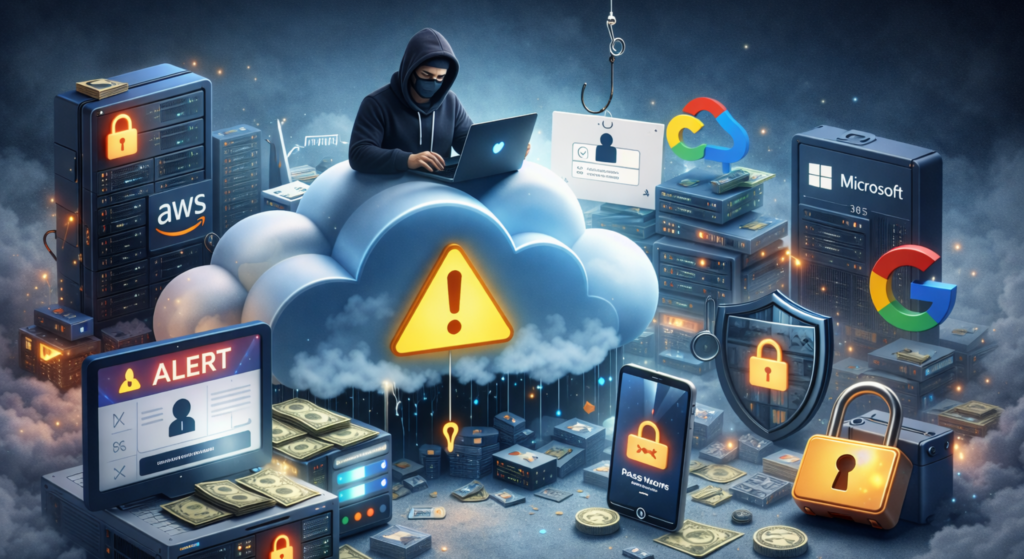
As organizations continue to shift their operations to the cloud, cybersecurity experts are warning of a sharp increase in attacks targeting cloud accounts and infrastructure. Recent investigations and threat intelligence reports indicate that attackers are actively exploiting weak configurations, stolen credentials, and session hijacking techniques to gain unauthorized access to cloud environments.
Cloud platforms such as Microsoft 365, AWS, and Google Cloud have become prime targets due to their widespread adoption across businesses, startups, and government organizations. While these platforms offer strong built-in security features, misconfigurations and poor access management practices are creating opportunities for attackers.
One of the most significant threats currently observed is account takeover through stolen credentials. In many recent cases, attackers have used phishing campaigns to trick users into revealing login details. Once access is gained, they move laterally within the cloud environment, accessing sensitive data, emails, and internal systems. This type of attack often goes undetected for extended periods, increasing the potential damage.
Another growing concern is the use of session hijacking techniques. Instead of directly stealing passwords, attackers capture session tokens or cookies, allowing them to bypass multi-factor authentication (MFA). This method has become increasingly popular because it avoids traditional security checks and enables seamless access to user accounts without raising immediate suspicion.
Security teams have also reported a rise in attacks targeting exposed cloud storage. Misconfigured storage buckets and publicly accessible databases continue to be a major issue. In several recent incidents, sensitive data such as customer records, internal documents, and API keys were exposed due to improper access settings. These exposures are not always the result of sophisticated attacks but rather simple configuration mistakes that leave critical data unprotected.
In addition to data exposure, attackers are increasingly exploiting cloud environments for financial gain. Compromised accounts are often used to deploy unauthorized resources such as virtual machines for cryptocurrency mining or to host malicious infrastructure. This not only leads to financial losses but also impacts system performance and availability.
Another trend gaining attention is the abuse of cloud APIs. Attackers are leveraging weak API security to extract data or manipulate services. Since APIs are essential for cloud communication, any vulnerability in their implementation can have widespread consequences. Improper authentication and lack of monitoring make these endpoints attractive targets.
Recent breach investigations also highlight the role of identity and access management (IAM) weaknesses. Overprivileged accounts, lack of role-based access control, and unused credentials increase the attack surface. Once an attacker gains access to a privileged account, they can control large parts of the infrastructure, making containment difficult.
The rapid adoption of cloud services has also outpaced security awareness in many organizations. Small and medium businesses, in particular, often prioritize deployment speed over security, leading to gaps in monitoring and protection. Without proper logging and threat detection, suspicious activities may go unnoticed until significant damage has already occurred.
Cybersecurity professionals emphasize that cloud security is not just the responsibility of service providers. While cloud companies operate under a shared responsibility model, organizations must ensure that their configurations, user access controls, and data protection measures are properly implemented.
To address these challenges, experts recommend a multi-layered security approach. Strong authentication practices, including phishing-resistant MFA, should be enforced across all accounts. Continuous monitoring of login activity and anomaly detection can help identify unauthorized access early. Regular audits of cloud configurations and permissions are also essential to prevent accidental exposure.
Encryption of sensitive data, both at rest and in transit, adds another layer of protection. Additionally, organizations should implement strict API security measures and ensure that all endpoints are properly authenticated and monitored.
Employee awareness remains a critical factor in preventing cloud-related attacks. Since many breaches begin with phishing, training users to recognize suspicious emails and login pages can significantly reduce risk. Security teams should also conduct regular simulations to test preparedness and improve response capabilities.
As cloud adoption continues to grow, so does the importance of robust security practices. The convenience and scalability of cloud services make them indispensable, but they also introduce new risks that cannot be ignored. Organizations must balance innovation with security to protect their data and maintain trust.
The current surge in cloud account attacks serves as a clear warning: without proper safeguards, even the most advanced platforms can become vulnerable. Strengthening cloud security is no longer optional—it is a necessity in today’s digital landscape.