
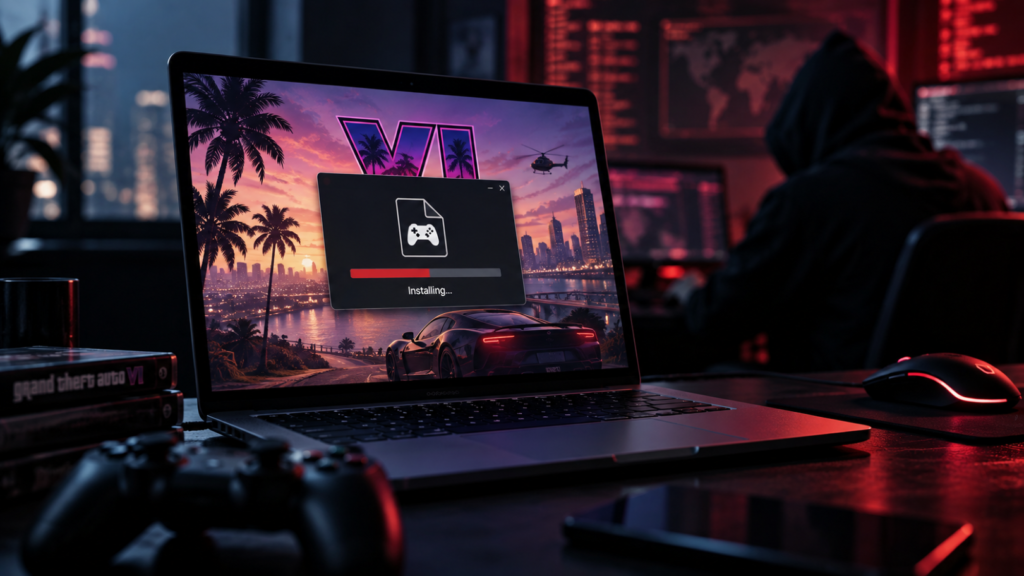
Introduction: Fake GTA 6 Downloads Malware — Why It Matters
Fake GTA 6 Downloads Malware is exploiting the huge anticipation surrounding Rockstar Games’ upcoming Grand Theft Auto VI. Security researchers at Huntress analyzed a malicious ISO presented as a leaked GTA 6 copy and found multiple malware components, including remote-access trojans, an information stealer and destructive ransomware.
The campaign reportedly uses poisoned search results, gaming forums, torrent sites and social media to lure users searching for leaked builds or unofficial versions. Huntress noted that there is no official GTA 6 demo or confirmed playable leaked copy being distributed online, making such downloads particularly risky.
What Caused the GTA 6 Malware Campaign?
The operation appears to rely on social engineering rather than a sophisticated new exploit. Attackers capitalize on users’ eagerness to obtain an unreleased game and disguise malware as a legitimate installation package.
Huntress found that some fake GTA 6 ISO files exceed 100GB. Much of that size is reportedly junk data intended to make the files look like genuine AAA-game images.
The analyzed package contained:
- NJRAT remote-access trojans
- DCRAT
- Mercurial Grabber infostealer
- Chaos ransomware used as a destructive wiper
- A fake GTA 6 installer
- Additional files designed to make the installation appear legitimate
Fake GTA 6 Downloads Malware: Technical Breakdown
Timeline of Events
The infection begins when a user downloads and mounts the supposed GTA 6 ISO. The fake installer then launches multiple malicious components while presenting messages intended to convince the victim that the game simply failed to activate.
After installation, the user may see a “license not found” error. According to Huntress, this creates a plausible explanation for why the unreleased game does not launch, while malware continues operating in the background.
What Systems and Data Are Affected?
The malware combination can expose or damage a broad range of information:
- Browser passwords and cookies
- Discord tokens and gaming-session data
- Clipboard contents
- Screenshots and system information
- Windows product keys
- Files and folders
- Saved games and personal documents
- OneDrive and other synchronized data
- Files stored on shared locations
NJRAT can provide remote control capabilities such as keystroke logging, screenshot capture, webcam access and file transfer. DCRAT can also capture screenshots, monitor windows and access clipboard data.
Mercurial Grabber reportedly targets browser credentials, cookies, Discord tokens, gaming information and other system details. The campaign also uses a Discord webhook to transmit stolen information.
Chaos Ransomware Becomes a Wiper
The most destructive component is Chaos ransomware. Huntress reported that the sample does not appear designed primarily to collect a ransom. Instead, it functions as a wiper by encrypting smaller files and overwriting files larger than 200MB with random data.
If administrator privileges are available, the malware can reportedly delete shadow copies and modify recovery settings. This can make restoration considerably more difficult.
Potential Risks & Impact
Identity and Financial Risk
Browser passwords, cookies, authentication tokens and other credentials could potentially allow attackers to access online accounts. Cryptocurrency-related information may also be exposed by NJRAT.
Personal and Business Data Loss
The destructive component can affect documents, photographs, downloads, saved games, shared folders and cloud-synchronized files. For users who store work information on gaming PCs, the consequences can extend beyond personal entertainment.
Security and Recovery Risk
DCRAT reportedly modifies the Windows hosts file to block selected security, telemetry and reporting services. This can interfere with security visibility and make malicious activity harder to identify.
Official Response / Research Findings
Huntress is the primary research source for the analyzed sample. Its investigation identified the malware components, infection behavior and associated indicators of compromise. Huntress also assessed that Russian-language prompts and the ransom note, along with the inclusion of Yandex Browser, could indicate a focus on Russian-speaking users.
For broader malware-awareness guidance, Indian organizations can also consult CERT-In’s cybersecurity advisories, which regularly publish malware and security mitigation recommendations.
Industry Context: Why Gaming Malware Keeps Growing
Gaming-related malware campaigns work because attackers can combine urgency, curiosity and piracy into a powerful social-engineering lure. Fake releases, cracks and leaked builds give criminals an opportunity to bypass users’ normal caution.
CERT-In has previously warned about malware distributed through pirated software and torrent-style sources, reinforcing the risk of obtaining software from untrusted channels.
Readers can follow CyberNexora’s Cyber Incidents coverage for more reports on malware, ransomware and emerging attacks.
How to Protect Yourself and Your Organization
- Avoid leaked GTA 6 builds: Do not download alleged demos, cracks or unreleased copies from unofficial websites.
- Use official sources: Obtain games and updates through legitimate publisher and platform channels.
- Do not disable security tools: Never turn off antivirus or endpoint protection because an unofficial installer requests it.
- Keep Windows updated: Security updates and current endpoint protection can block known malware families.
- Use MFA: Enable multi-factor authentication on email, gaming, social-media and financial accounts.
- Protect backups: Maintain offline or otherwise isolated backups that malware cannot easily delete.
- Treat unexpected errors cautiously: A “license not found” message does not prove that a download is legitimate.
- Isolate suspected systems: If a malicious installer was executed, disconnect the machine from networks and begin incident-response procedures.
Additional security guidance is available through CyberNexora’s Learn & Protect resources.
Indicators of Compromise (IoCs)
Huntress identified multiple indicators associated with the analyzed sample, including:
Gta6installer.exe— MD5:a15e280a3fd65dfaa243bbe2dbf45e97adminapp.exe— Mercurial Grabber componentgta6.exe— Chaos ransomware componentread_it.txt— ransomware notea0700877.xsph[.]ru— DCRAT infrastructure141.8.197[.]42— associated IP address35.157.111[.]131,3.68.56[.]232,3.67.15[.]169— NJRAT-related infrastructure
Organizations should review the complete Huntress analysis for the broader IOC list before using these indicators in detection systems.
Key Takeaways
- Fake GTA 6 downloads are being used as malware delivery mechanisms.
- The analyzed ISO combines RATs, an infostealer and destructive ransomware.
- NJRAT and DCRAT can provide attackers with extensive remote-access capabilities.
- Chaos can destroy data and interfere with Windows recovery mechanisms.
- Users should avoid alleged leaked GTA 6 copies and rely on legitimate distribution channels.
Conclusion: Fake GTA 6 Downloads Malware and What Happens Next
The Fake GTA 6 Downloads Malware campaign demonstrates how cybercriminals can turn excitement around a major game release into an effective malware lure. Rather than delivering an unreleased game, the analyzed package can reportedly expose credentials, enable remote access and destroy files.
Users who may have executed a suspicious GTA 6 installer should disconnect the affected device, change potentially exposed passwords from a clean system, enable MFA and consider a complete system reimage. Organizations should also review endpoint telemetry and the published IoCs for signs of compromise.
For additional cybersecurity awareness and incident coverage, readers can follow CyberNexora’s security resources.
Frequently Asked Questions(FAQs)
It is a malware campaign that disguises malicious files as leaked or unofficial GTA 6 downloads. Huntress found RATs, an infostealer and destructive ransomware in an analyzed sample.
Huntress reported that there was no official GTA 6 demo or confirmed playable leaked copy being distributed online at the time of its investigation. Users should treat alleged leaked downloads as suspicious.
The analyzed ISO contained NJRAT, DCRAT, Mercurial Grabber and Chaos ransomware, alongside a fake installer and supporting files.
Yes. Mercurial Grabber can reportedly collect browser passwords and cookies, while NJRAT can also steal credentials and other sensitive information.
Yes. The analyzed Chaos sample encrypted files up to 200MB and overwrote larger files with random data, effectively functioning as a wiper.
Disconnect the potentially infected system from the network, change exposed passwords using a clean device, enable MFA and consider completely reimaging the affected machine.