
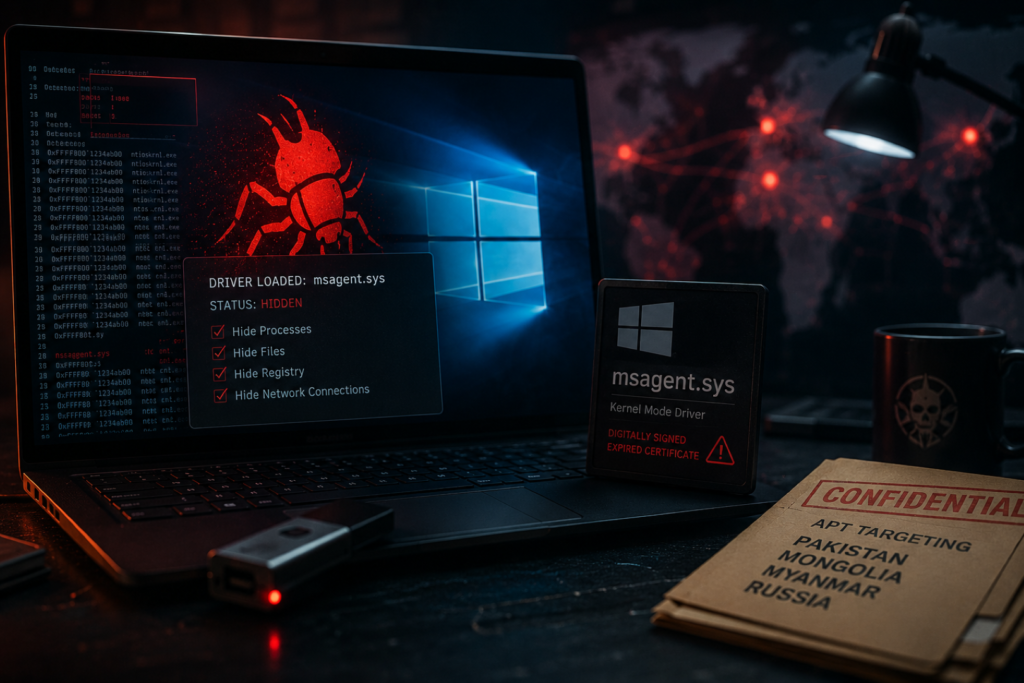
Introduction: HoneyMyte CoolClient Rootkit — Why It Matters
HoneyMyte CoolClient Rootkit highlights a significant change in the group’s Windows malware toolkit. The HoneyMyte CoolClient Rootkit reportedly uses a kernel-level rootkit to hide malicious processes, files, registry entries and command-and-control (C2) activity, making routine detection and forensic analysis harder.
The activity has targeted organizations in Pakistan, Mongolia, Myanmar and Russia, including government entities. Kaspersky has documented updated CoolClient campaigns and a related HoneyMyte kernel-mode rootkit used to strengthen stealth.
What is HoneyMyte?
HoneyMyte is a cyber-espionage threat actor associated with Mustang Panda and other tracking names. The HoneyMyte CoolClient Rootkit is one of its backdoor tools and has been observed alongside PlugX or LuminousMoth, with DLL sideloading used for execution.
HoneyMyte CoolClient Rootkit: Technical Breakdown
The major development is the addition of the HoneyMyte CoolClient Rootkit with Windows kernel-level capabilities. Kernel-mode malware operates with higher privileges than ordinary applications and can interfere with what endpoint tools see.
The supplied incident details identify the rootkit driver as msagent.sys, digitally signed with an expired certificate.
Kaspersky has separately documented a HoneyMyte kernel-mode rootkit signed with an old certificate and designed to protect malicious components from inspection.
Timeline of Events
- HoneyMyte used CoolClient in targeted cyber-espionage activity.
- In some Myanmar incidents, PlugX provided the initial foothold before CoolClient was deployed.
- A newer CoolClient variant introduced the rootkit component.
- The toolkit added stronger concealment and persistence.
Systems and Activity at Risk
Reported capabilities include:
- Hiding processes, files, registry entries and C2 connections.
- Keylogging and clipboard theft.
- Credential and system-information collection.
- File operations and remote activity.
- Persistence through DLL sideloading, scheduled tasks, AutoRun entries and Windows services.
Potential Risks & Impact
Detection and Forensic Risk
The HoneyMyte CoolClient Rootkit can reduce the reliability of normal user-mode investigation and complicate incident response.
Business and Government Risk
Government targeting creates risks involving espionage, credential theft and long-term access to sensitive documents, communications and internal system details.
Trust and Compliance Risk
Signed drivers require context-based validation. Security teams should examine certificate status, publisher, file location, installation method and behavior rather than relying on the presence of a signature alone.
Official Response / Research Findings
Kaspersky’s research provides the main public technical context for the CoolClient evolution and HoneyMyte’s kernel-mode tooling. Its reporting covers CoolClient activity in Myanmar, Mongolia, Malaysia and Russia, while its rootkit analysis documents a HoneyMyte-linked kernel driver using an old certificate.
No victim-specific official statement was included in the supplied incident information.
Industry Context: Why Kernel-Level Stealth Matters
Attackers increasingly abuse trusted software, signed binaries and legitimate execution paths to blend malicious activity into normal Windows operations. DLL sideloading is especially useful because a malicious DLL can be loaded by a legitimate executable.
Readers can follow CyberNexora’s Cyber Incidents coverage and Learn & Protect resources.
The case shows why endpoint defense needs layered application control, driver monitoring, reliable telemetry and network visibility.
How to Protect Your Organization
- Monitor kernel drivers: Alert on unexpected
.sysfiles and investigate publisher, certificate and installation path. - Audit persistence: Review scheduled tasks, services, AutoRun entries and unusual registry changes.
- Restrict driver loading: Apply enterprise application-control and Windows security policies to limit unauthorized kernel drivers.
- Investigate signed files: Treat expired, unusual or unexpected certificates as investigation triggers.
- Review Defender exclusions: Investigate exclusions that lack a clear administrative purpose.
- Hunt for fake security directories: Check folders that imitate legitimate security-product locations.
- Inspect DLL sideloading: Identify legitimate executables loading unexpected DLLs from unusual directories.
- Strengthen telemetry: Use independent or offline analysis when kernel tampering is suspected.
- Monitor C2 traffic: Investigate unusual outbound connections from unfamiliar services.
CyberNexora’s [Learn & Protect category] provides additional security-awareness guidance.
Indicators of Compromise (IoCs)
The supplied details identify these indicators:
msagent.sysrootkit driver.- A signed driver using an expired certificate.
- Unexpected kernel-driver installation or service creation.
- Suspicious DLL sideloading chains.
- Unusual scheduled tasks, AutoRun entries or Windows services.
- Unexplained Defender exclusions.
- Fake security-product directories or mismatched DLLs.
- Hidden or unexplained processes, files, registry entries or network connections.
Validate campaign-specific IoCs against trusted threat-intelligence sources before blocking.
Key Takeaways
- HoneyMyte has expanded CoolClient with kernel-level stealth.
- Rootkit-based hiding can undermine ordinary Windows investigation.
- Digital signatures do not automatically prove driver trustworthiness.
- DLL sideloading and multiple persistence methods increase resilience.
- Organizations should prioritize driver, persistence and endpoint-telemetry monitoring.
Conclusion: HoneyMyte CoolClient Rootkit and What Happens Next
HoneyMyte CoolClient Rootkit demonstrates how cyber-espionage malware is moving beyond conventional user-space backdoors. Kernel-level concealment can make detection, triage and evidence collection substantially more difficult.
Security teams should watch for suspicious drivers, unexpected persistence, signed-but-untrusted components and mismatched DLL loading.
Frequently Asked Questions(FAQs)
HoneyMyte CoolClient Rootkit refers to the reported evolution of CoolClient with a Windows kernel-level rootkit. It is designed to conceal malicious activity and reduce endpoint visibility.
The reported rootkit can hide processes, files, registry entries and C2 connections. This can interfere with routine monitoring and forensic investigation.
A digital signature does not automatically mean a driver is safe. The reported use of an expired certificate shows why certificate validity, provenance and behavior also need to be checked.
The supplied incident details identify Pakistan, Mongolia, Myanmar and Russia, including government organizations. Kaspersky has separately reported related HoneyMyte activity across several of these regions.
Organizations should monitor unexpected kernel drivers, DLL sideloading, scheduled tasks, services, AutoRun entries, Defender exclusions and unusual network connections.
Yes. The supplied incident details state that PlugX was used as an initial foothold before CoolClient in some Myanmar incidents, while Kaspersky has also reported CoolClient alongside PlugX.