

In recent days, multiple websites, social media posts, and shared links have claimed to provide access to so-called “Epstein Files” or “Epstein Emails.” Some of these claims specifically reference domains such as email.epstein, presenting them as official or government-released sources.
These claims are false and unverified.
From a cybersecurity and information-integrity perspective, the spread of such links represents a growing risk, as trending global topics are increasingly used to distribute misinformation, phishing content, and malicious files.
What Is Actually Verified
All legitimate information related to the case involving Jeffrey Epstein exists only through formal legal and government channels. There has been no official public release of an email database, bulk document archive, or online portal labeled as “Epstein Files” or “Epstein Emails.”
There is also no government-recognized website or service named email.epstein.
Any platform claiming to host such material is not endorsed or published by courts or government authorities.

Why These Links Are Dangerous
Cybercriminals frequently exploit high-interest news topics to increase engagement with malicious content. In the current wave, Epstein-related keywords are being used to lure users into clicking links that may:
- Deliver malware through fake PDFs or documents
- Redirect users to phishing pages designed to steal credentials
- Collect personal or device data without consent
- Spread false or manipulated information disguised as news
The professional appearance of these sites and documents often makes them appear credible, even when they are not.
Where Official Information Can Be Read Safely
Readers who want accurate and verifiable information should rely only on the following official and trusted sources:
U.S. Department of Justice (DOJ) — Official Government Source
https://www.justice.gov
Publishes official press releases, prosecutorial statements, and case-related updates.
U.S. Federal Court Records (PACER) — Official Judiciary System
https://pacer.uscourts.gov
The official system for accessing U.S. federal court filings, motions, and rulings.
(Note: Registration may be required.)
U.S. Attorney’s Office – Southern District of New York (SDNY)
https://www.justice.gov/usao-sdny
This office handled key proceedings and publishes verified legal updates and statements.
Reputed International Media (Court-Based Reporting Only)
These outlets report strictly on court-released and government-confirmed information:
- Reuters — https://www.reuters.com
- Associated Press — https://apnews.com
- BBC News — https://www.bbc.com/news
They do not publish leaked databases or email dumps.
What Does Not Have Official Status
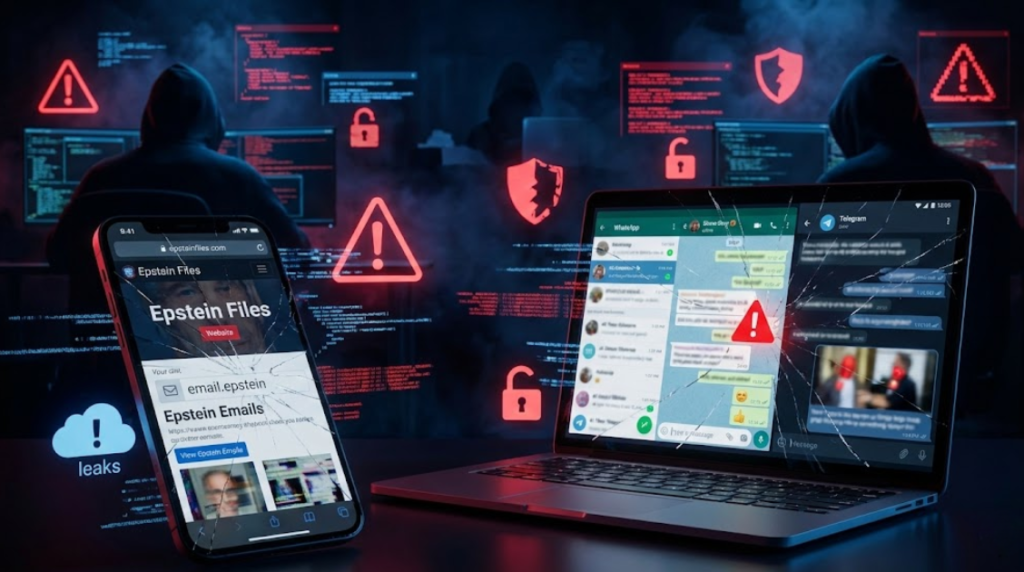
The following should be treated as unreliable and unsafe:
- Websites claiming to host “Epstein Files” or “Epstein Emails”
- Domains such as email.epstein
- Links shared through WhatsApp, Telegram, or private groups
- Google Drive or cloud folders labeled as “leaks”
- Viral lists or screenshots without court references
If a claim cannot be traced directly to a court, prosecutor, or recognized news organization, it should not be trusted
Why Verification Matters
This issue highlights a broader cybersecurity concern: modern threats increasingly rely on misinformation and psychological manipulation, not just technical exploits. When sensitive topics are mixed with fabricated sources and AI-generated content, public confusion becomes a security vulnerability.
Careful verification is essential before clicking, sharing, or downloading any content related to trending legal or political topics.
Editorial Disclaimer
This article is published for cybersecurity awareness and public information purposes only. It does not promote unverified allegations, fabricated documents, or misleading claims. Readers are advised to rely exclusively on official court records, government statements, and reputable journalistic sources.