
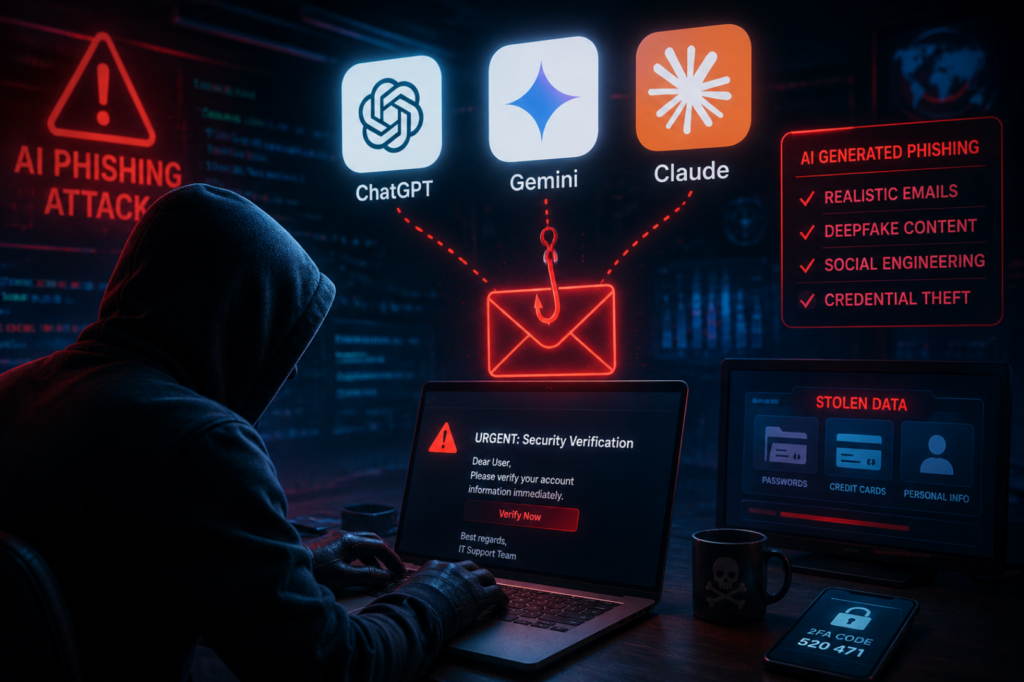
AI Phishing Attacks are becoming one of the fastest-growing cybersecurity threats in 2026. Cybercriminals are increasingly attempting to misuse AI tools like ChatGPT, Claude, and other generative AI platforms to create realistic phishing emails, deepfake scams, and advanced social engineering attacks. As artificial intelligence becomes more powerful, both individuals and organizations must understand how these AI-driven threats work and how to stay protected online.
Artificial intelligence has transformed the way people communicate, work, and manage digital tasks. AI platforms such as ChatGPT, Claude, Gemini, and other generative AI systems are now widely used for business automation, customer support, education, coding assistance, research, and content creation. These tools help organizations improve productivity and streamline operations across industries.
However, cybersecurity professionals are also seeing a growing trend where threat actors attempt to misuse AI technology to improve phishing attacks, online scams, and social engineering campaigns. While AI companies implement strict safeguards and security policies, cybercriminals continue looking for ways to exploit emerging technologies for malicious purposes.
In 2026, AI-powered phishing attacks are becoming more sophisticated, personalized, and difficult to identify. Instead of relying on poorly written scam emails, attackers can now generate highly convincing content that closely resembles legitimate communication. As a result, both individuals and businesses face increased risks from AI-assisted cybercrime.
The Rise of AI-Powered Phishing Attacks
Traditional phishing scams often contained obvious warning signs such as grammatical errors, suspicious formatting, or generic messaging. Modern AI systems have significantly changed this landscape by enabling attackers to create realistic and professional-looking communication within seconds.
Cybercriminals may use AI tools to generate:
cybersecurity threats in 2026
- Fake banking notifications
- Account verification requests
- Password reset alerts
- Delivery and courier scams
- Business impersonation emails
- Recruitment and job offer scams
- Technical support fraud messages
- AI Phishing Attacks
Because AI-generated text sounds natural and polished, many users may struggle to distinguish fraudulent messages from legitimate communication. This increases the effectiveness of phishing campaigns and raises the likelihood of credential theft, malware infections, and financial fraud.
How AI Improves Social Engineering Attacks
Social engineering focuses on manipulating people into revealing sensitive information or performing actions that benefit attackers. AI has made these tactics more scalable and convincing than ever before.
Unlike traditional scam scripts that follow fixed responses, AI-powered systems can dynamically adapt conversations based on how a victim replies. This allows attackers to simulate realistic human interaction and maintain long scam conversations without requiring large teams of operators.
Threat actors may use AI-generated conversations to:
- Pretend to be customer support representatives
- Impersonate company employees or executives
- Create fake emergency situations
- Build emotional trust with victims
- Continue automated fraud conversations in real time
This level of interaction makes scams appear more authentic and reduces the obvious red flags users were once trained to detect.
Deepfake Technology and Voice Cloning Risks
One of the fastest-growing AI Cybersecurity Threats concerns in 2026 involves AI-generated voice cloning and deepfake media. Attackers can now imitate voices and facial expressions with alarming accuracy using publicly available recordings and videos.
Cybercriminals may attempt to impersonate:
- Family members
- Senior executives
- Government officials
- Financial institutions
- IT support teams
- Business partners
In several global fraud incidents, attackers reportedly used cloned voices to request urgent wire transfers or confidential business information. Because the audio sounded realistic and familiar, victims trusted the request and acted without proper verification.
Deepfake scams are especially dangerous because they exploit AI Cybersecurity Threats trust and urgency rather than technical vulnerabilities. As AI-generated media quality continues improving, organizations are strengthening verification procedures to reduce the risk of impersonation attacks.
Why AI-Based Cyber Attacks Are Becoming More Dangerous
Advanced Personalization
Cybercriminals frequently gather data from public online sources, including:
- Social media platforms
- Professional networking sites
- Company websites
- Data breach leaks
- Public records and forums
AI Cybersecurity Threats can quickly analyze this information to generate highly targeted phishing messages. Emails that reference real names, workplaces, recent activities, or business relationships appear far more believable than generic scams.
Large-Scale Automation
AI allows attackers to automate tasks that previously required significant manual effort. This includes:
- Generating phishing emails
- deepfake scams
- Creating fake social media accounts
- Translating scams into multiple languages
- Running chatbot-based fraud campaigns
- Producing malicious content at scale
As a result, cybercriminals can launch larger campaigns faster and at lower operational costs.
Human-Like Communication
Modern AI models can mimic natural conversation patterns, emotional tone, urgency, and professional language. Attackers use this capability to create messages that feel authentic and persuasive.
This presents a serious challenge because many people traditionally judged legitimacy based on writing quality. AI Cybersecurity Threats scams now remove many of the obvious warning signs users once relied on.
Common Warning Signs of AI-Driven Phishing Scams
Although AI-generated attacks are becoming more advanced, users can still identify suspicious behavior by paying attention to common indicators.
Be cautious when encountering:
- Unexpected password reset requests
- Urgent payment instructions
- Requests for OTP or MFA codes
- Messages demanding immediate action
- Suspicious links or attachments
- Emails with slightly altered domain names
- Calls asking for secrecy or confidentiality
- Unverified requests involving sensitive information
Users should independently verify suspicious communication before responding, especially when financial transactions or account access are involved.
How Individuals and Businesses Can Stay Protected
Verify Every Sensitive Request
Organizations and individuals should always confirm requests involving:
- Money transfers
- Login credentials
- Banking details
- Account recovery
- Confidential company data
Verification should happen through official communication channels rather than replying directly to suspicious emails or messages.
Enable Multi-Factor Authentication (MFA)
Multi-factor authentication remains one of the strongest defenses against phishing attacks. Even if attackers steal usernames and passwords, MFA can help prevent unauthorized access.
Security experts recommend enabling MFA for:
- Email accounts
- Banking applications
- Cloud services
- Business platforms
- Social media accounts
Keep Systems Updated
Outdated software may contain vulnerabilities that attackers can exploit. Regular updates improve protection against malware, phishing kits, and unauthorized access attempts.
Users should consistently update:
- Mobile devices
- Browsers
- Operating systems
- Security software
- Communication applications
Be Careful With Links and Attachments
Before clicking links or downloading files:
- Verify the website domain carefully
- Avoid unknown shortened URLs
- Use official applications whenever possible
- Hover over links to preview destinations
- Avoid enabling macros in documents
Suspicious attachments remain one of the most common delivery methods for malware and credential theft campaigns.
Limit Public Exposure of Personal Information
Attackers often rely on publicly available information to personalize AI Cybersecurity Threats by AI Phishing Attacks . Reducing unnecessary online exposure can make targeting more difficult.
Avoid publicly sharing:
- Phone numbers
- Home addresses
- Financial details
- Workplace credentials
- Travel plans or daily routines
Privacy awareness is becoming an increasingly important part of cybersecurity defense.
The Future of AI and Cybersecurity
Artificial intelligence itself is not the threat. The primary concern is how malicious actors attempt to misuse AI technology for deception, fraud, and large-scale phishing operations.
Cybersecurity experts believe future digital protection will depend heavily on:
- Strong authentication systems
- User awareness training
- Real-time threat monitoring
- AI-driven fraud detection
- Verification-based communication practices
At the same time, security companies are also using AI to identify suspicious activity faster and improve cyber defense systems. This ongoing battle between attackers and defenders will continue shaping the cybersecurity landscape in the coming years.
As phishing attacks become more intelligent and realistic, users must move beyond trusting messages simply because they “look professional.” Verifying authenticity before taking action is now one of the most important cybersecurity habits in the AI era to safe cybersecurity threats in 2026.