
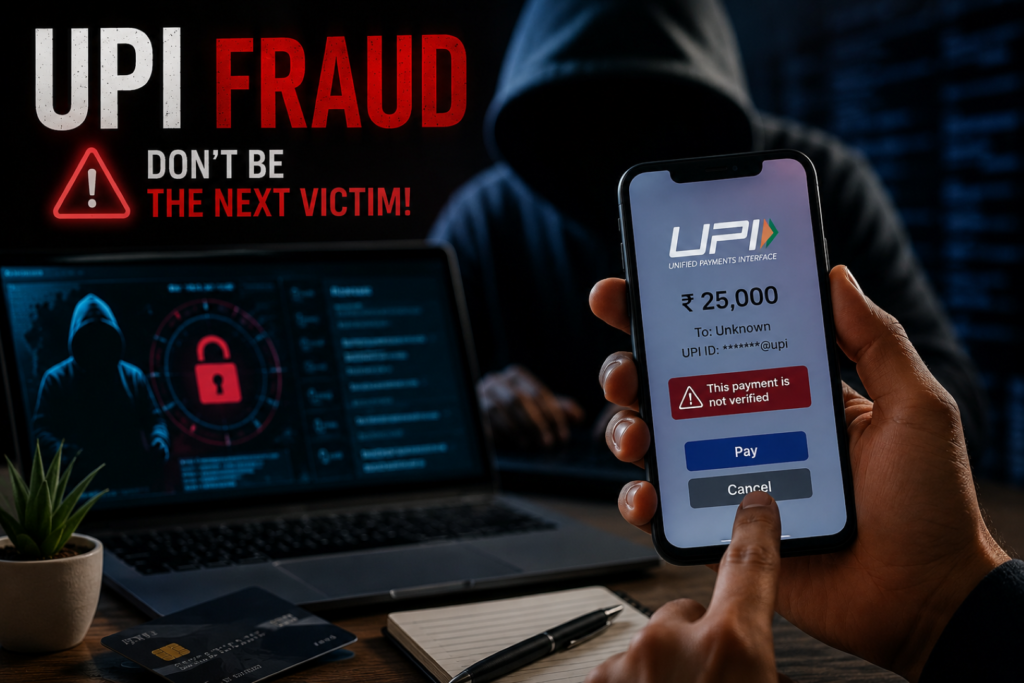
Introduction: UPI Fraud — Why It Matters
India’s Unified Payments Interface (UPI) has transformed digital payments by enabling instant bank-to-bank transfers with just a smartphone. However, its growing popularity has also made it a prime target for cybercriminals. UPI Fraud continues to rise as scammers employ increasingly sophisticated tactics to trick users into authorizing fraudulent transactions instead of hacking banking systems.
Rather than exploiting weaknesses in the technology itself, most fraudsters manipulate users through phishing, fake QR codes, impersonation, fraudulent customer support numbers, and social engineering. According to guidance issued by the National Payments Corporation of India and the Reserve Bank of India, users remain the first and strongest line of defense against payment fraud.
As India continues moving toward a cashless economy, UPI Fraud awareness has become essential for individuals, businesses, and organizations that rely on digital payments every day.
What is UPI?
The Unified Payments Interface (UPI) is India’s real-time payment system developed by the National Payments Corporation of India. It allows users to instantly transfer money between bank accounts using mobile applications such as PhonePe, Google Pay, Paytm, and BHIM. Although UPI offers secure transactions, UPI Fraud continues to increase as cybercriminals exploit user trust through social engineering attacks.
UPI has become one of the world’s largest digital payment systems due to its speed, convenience, and interoperability between banks. Every day, millions of individuals use UPI to:
- Pay merchants
- Transfer money to family and friends
- Pay utility bills
- Shop online
- Receive salaries and reimbursements
Despite its strong security architecture, scammers exploit human trust rather than technical vulnerabilities.
What Causes UPI Fraud?
Unlike traditional cyberattacks, most UPI fraud incidents do not involve hacking bank servers or payment applications. Instead, criminals manipulate victims into willingly authorizing payments. Understanding how UPI Fraud works is the first step toward protecting yourself from financial cybercrime.
Common techniques include:
- Social engineering
- Phishing messages
- Fake customer support
- QR code manipulation
- Remote access applications
- Fake investment schemes
- Identity impersonation
Cybercriminals constantly adapt their methods based on trending payment applications and public events, making awareness one of the strongest forms of protection.
UPI Fraud: Full Breakdown
Timeline of a Typical Scam
A typical UPI scam generally follows these stages:
- The attacker contacts the victim through a phone call, SMS, WhatsApp, email, or social media.
- The scammer creates urgency by claiming:
- KYC verification has expired
- A refund is pending
- Cashback is available
- A bank account will be blocked
- Customer support assistance is required
- The victim is instructed to scan a QR code, install an application, or approve a payment request.
- Once the victim enters the UPI PIN or approves the transaction, the money is transferred to the fraudster.
- The attacker immediately moves the funds through multiple accounts to make recovery difficult.
Most Common UPI Scams in India
hese techniques represent some of the most common forms of UPI Fraud reported across India.
1. Fake QR Code Scam
Fraudsters send a QR code claiming it is needed to receive money.
In reality:
- Scanning the QR code initiates a payment.
- The victim unknowingly authorizes the transfer.
- Money is debited instead of credited.
Remember:
A QR code can also be used to request money—not just receive it.
2. Fake Customer Care Scam
Cybercriminals create fake customer support numbers that appear in internet search results.
Victims searching for help accidentally contact scammers instead of official support.
The fraudster may ask users to:
- Share OTPs
- Reveal UPI PINs
- Install remote access software
- Approve fake payment requests
3. KYC Update Scam
Victims receive messages claiming their bank account or UPI service will be blocked unless KYC is updated immediately.
The message often includes:
- Fake banking websites
- Fraudulent APK files
- Malicious links
- Fake verification forms
These pages are designed to steal banking credentials and personal information.
4. Collect Request Scam
One of the most successful fraud methods involves fraudulent “Collect Requests.”
Instead of sending money, scammers send a request asking the victim to approve a payment.
If approved using the UPI PIN, money is transferred directly to the attacker.
Many users mistakenly believe they are accepting incoming funds.
5. Cashback and Refund Scam
Victims receive calls claiming they have won:
- Cashback offers
- Lottery rewards
- Tax refunds
- Shopping refunds
To receive the money, they are instructed to:
- Scan a QR code
- Approve a collect request
- Enter their UPI PIN
Instead of receiving money, they unknowingly send it.
6. Screen-Sharing App Scam
Attackers convince victims to install applications such as remote desktop or screen-sharing software.
Once installed, criminals can:
- Observe banking activity
- View OTP messages
- Monitor account balances
- Guide victims into authorizing fraudulent payments
This method is frequently combined with fake customer support scams.
7. Fake Investment Scam
Fraudsters advertise unrealistic investment opportunities through:
- Telegram groups
- WhatsApp communities
- Social media advertisements
- Fake trading platforms
Victims are promised guaranteed returns before being instructed to transfer money through UPI.
After payment, the scammers disappear.
8. Bank Official Impersonation Scam
Scammers pretend to represent:
- Banks
- Payment applications
- Government agencies
- Financial institutions
Using fear and urgency, they convince victims to disclose confidential banking information.
Legitimate banks never ask customers to reveal their UPI PIN or OTP over phone calls.
What Information Do Scammers Target?
Cybercriminals primarily seek information that enables unauthorized financial transactions.
Their targets include:
- UPI PIN
- One-Time Passwords (OTP)
- Debit card details
- Internet banking credentials
- Mobile banking passwords
- Aadhaar-linked banking information
- PAN details used for verification
- Personal identity information
- Device access through remote applications
Importantly, a UPI PIN is only required to send money.
Receiving money never requires entering your UPI PIN.
Potential Risks & Impact
Falling victim to UPI Fraud can result in financial losses, identity theft, and unauthorized banking transactions.
Identity and Financial Risk
UPI fraud can result in immediate financial loss, unauthorized transactions, and identity theft. Victims may also experience unauthorized access to linked bank accounts if additional personal information has been compromised.
In many cases, scammers rapidly transfer stolen funds across multiple accounts, making recovery significantly more challenging if the fraud is not reported immediately.
Business and Reputational Risk
Businesses that accept UPI payments may also become targets through fake merchant support scams, payment confirmation fraud, and impersonation attacks. Small businesses, in particular, may suffer financial losses and customer trust issues if fraudulent transactions are not identified promptly.
Organizations handling digital payments should regularly educate employees about payment verification procedures and emerging social engineering techniques.
Regulatory and Compliance Risk
Financial institutions and payment service providers continue to strengthen security measures under the guidance of the Reserve Bank of India and National Payments Corporation of India. Enhanced fraud monitoring, AI-powered transaction analysis, device binding, and mandatory two-factor authentication have significantly improved payment security.
However, compliance measures alone cannot prevent fraud if users voluntarily disclose confidential credentials or authorize malicious payment requests.
Official Response / Statement
The National Payments Corporation of India consistently advises users to:
- Never share their UPI PIN or OTP.
- Never scan QR codes received from unknown individuals.
- Carefully verify every payment request before approving it.
- Download payment applications only from official app stores.
- Report suspicious transactions immediately through their payment app and bank.
Similarly, the Reserve Bank of India continues to promote stronger digital payment security through mandatory two-factor authentication, enhanced fraud detection systems, and public awareness campaigns. The Indian Cyber Crime Coordination Centre also encourages victims to promptly report cyber-enabled financial fraud through the national cybercrime helpline 1930 and the National Cyber Crime Reporting Portal. These recommendations are designed to help individuals reduce the risk of becoming victims of UPI Fraud.
Industry Context: Why UPI Fraud Is Increasing
India’s rapid adoption of digital payments has created tremendous convenience for consumers and businesses alike. However, the same convenience has also attracted cybercriminals who continuously adapt their tactics to exploit human psychology rather than technical vulnerabilities.
Unlike traditional banking fraud, modern UPI scams rely heavily on social engineering. Fraudsters impersonate trusted entities, create a false sense of urgency, and convince victims to voluntarily authorize transactions. AI-generated voice calls, phishing messages, fake websites, and cloned customer support portals are making these scams increasingly convincing.
Readers interested in similar financial cyber threats can explore CyberNexora News’ Learn & Protect section for practical cybersecurity awareness guides and prevention tips.
For updates on the latest cybercrime incidents targeting individuals and businesses, visit the Cyber Incidents section.
Government agencies, financial institutions, and payment providers continue investing in AI-powered fraud detection, behavioral analytics, transaction monitoring, and public awareness campaigns. Nevertheless, cybersecurity experts agree that informed users remain the strongest defense against UPI-related fraud.
How to Protect Yourself from UPI Fraud
Following these best practices can significantly reduce the risk of becoming a victim of digital payment fraud.
1. Never Share Your UPI PIN or OTP
Your UPI PIN and OTP are confidential credentials.
No bank, payment app, NPCI representative, or customer support executive will ever ask for them.
2. Verify Every Payment Request
Always read payment requests carefully.
Remember:
- Receiving money does not require entering your UPI PIN.
- Entering your PIN usually means you are authorizing a payment.
3. Never Scan Unknown QR Codes
QR codes can initiate payments instead of receiving money.
Only scan QR codes from trusted merchants or verified individuals.
4. Avoid Installing Screen-Sharing Apps
Applications that provide remote access can expose sensitive banking information.
Never install:
- AnyDesk
- TeamViewer
- Remote desktop applications
unless you personally trust the source and understand their purpose.
5. Download Apps Only from Official App Stores
Always install banking and payment applications through:
- Google Play Store
- Apple App Store
Avoid APK files shared through WhatsApp, Telegram, SMS, or email.
6. Enable Biometric Authentication and App Locks
Additional authentication layers help prevent unauthorized access if your smartphone is lost or stolen.
Recommended security features include:
- Fingerprint authentication
- Face unlock
- App lock
- Device PIN
7. Monitor Your Bank Statements Regularly
Review your transaction history frequently.
Immediate detection allows faster reporting and improves the chances of recovering stolen funds.
8. Keep Your Phone and Banking Apps Updated
Software updates often include important security patches.
Enable automatic updates whenever possible.
9. Verify Customer Care Numbers
Many fake customer support websites appear in internet search results.
Instead of relying on search engines:
- Visit the official website.
- Use the support number provided within the banking app.
- Verify contact information before calling.
10. Report Fraud Immediately
If you suspect fraudulent activity:
- Freeze or block your account through your payment app.
- Contact your bank immediately.
- Call the National Cybercrime Helpline 1930.
- File a complaint through the National Cyber Crime Reporting Portal.
- Preserve screenshots, messages, and transaction IDs as evidence.
Prompt reporting significantly increases the likelihood of successful fund recovery.
Readers can also explore CyberNexora News’ Resources section for additional cybersecurity guides, security checklists, and practical digital safety references.
Key Takeaways
- UPI fraud continues to evolve through sophisticated social engineering techniques rather than technical attacks.
- Never share your UPI PIN or OTP with anyone.
- Receiving money never requires entering your UPI PIN.
- Verify every payment request before approval.
- Avoid scanning unknown QR codes or installing screen-sharing applications.
- Download payment apps only from official app stores.
- Report suspicious transactions immediately through your bank, payment app, the Cyber Crime Helpline (1930), and the National Cyber Crime Reporting Portal.
- Staying informed about UPI Fraud is one of the most effective ways to protect your digital payments.
Conclusion: UPI Fraud and What Happens Next
As India’s digital payment ecosystem continues to expand, cybercriminals are expected to develop increasingly sophisticated methods to deceive users. Artificial intelligence, deepfake technology, and more convincing phishing campaigns may further enhance the effectiveness of social engineering attacks in the coming years.
Fortunately, most UPI fraud incidents remain preventable through awareness and responsible digital habits. By verifying payment requests, safeguarding confidential credentials, avoiding suspicious QR codes, and reporting fraudulent activity without delay, users can significantly reduce their risk of financial loss.
For more cybersecurity awareness articles and practical security guidance, readers can visit the Learn & Protect category on CyberNexora News.
Frequently Asked Questions(FAQs)
UPI Fraud refers to the growing trend of cybercriminals exploiting Unified Payments Interface users through phishing, fake QR codes, social engineering, and impersonation scams. Most attacks target users rather than the payment system itself.
No. Simply knowing your UPI ID is generally not enough to withdraw money. Fraud usually occurs when victims share their UPI PIN, OTP, or approve fraudulent payment requests.
No. A UPI PIN is only required when sending money or authorizing a payment. If someone asks you to enter your PIN to receive funds, it is almost certainly a scam.
Immediately contact your bank, report the incident through your payment application, call the National Cybercrime Helpline (1930), and file a complaint on the National Cyber Crime Reporting Portal. Acting quickly improves the chances of recovering lost funds.
Always verify customer support numbers through official banking websites or the payment application’s official help section. Avoid calling numbers found in advertisements or unverified internet search results.
The National Payments Corporation of India (NPCI), the Reserve Bank of India (RBI), banks, payment service providers, and the Indian Cyber Crime Coordination Centre (I4C) work together to strengthen digital payment security and promote fraud awareness.