
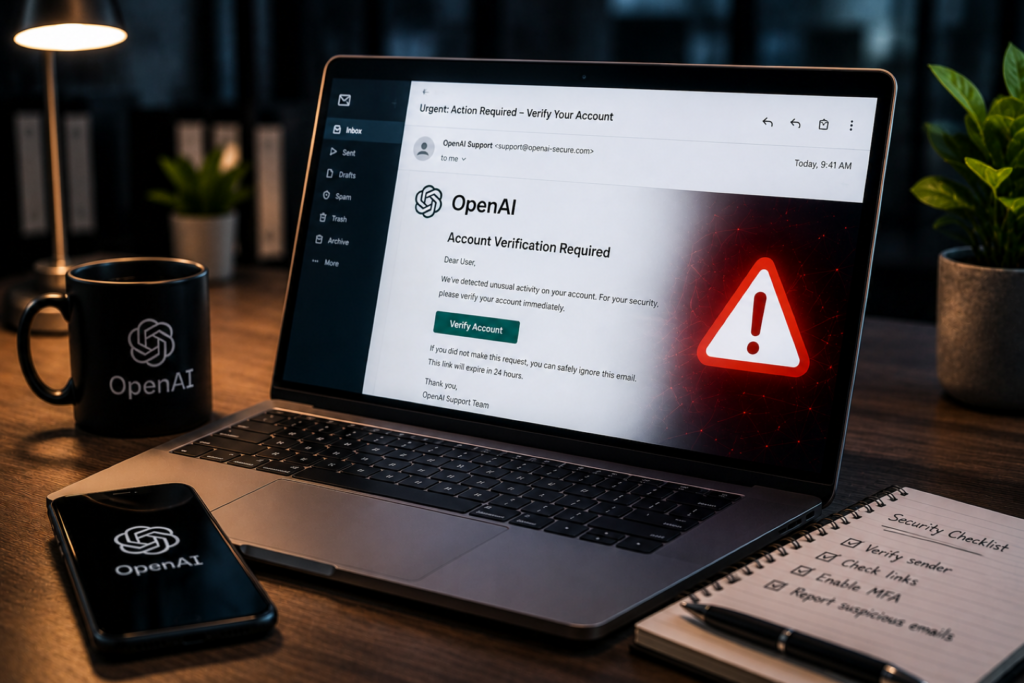
AI Phishing Emails — Why It Matters
AI Phishing Emails are rapidly becoming one of the most concerning cybersecurity threats facing individuals and organizations worldwide. Cybercriminals are increasingly leveraging generative artificial intelligence tools such as ChatGPT and other Large Language Models (LLMs) to create highly convincing phishing emails that are difficult to distinguish from legitimate business communications.
Unlike traditional phishing messages that often contained spelling mistakes, awkward grammar, and poor formatting, modern AI-generated phishing emails are polished, professional, and contextually accurate. This evolution makes conventional methods of identifying phishing attempts far less effective.
Security researchers have observed a notable rise in AI-assisted phishing campaigns throughout late 2025 and into 2026. As generative AI becomes more accessible, attackers can produce personalized phishing emails at scale without requiring advanced language skills or technical expertise. The result is a growing global cyber threat targeting businesses, government agencies, educational institutions, and everyday internet users.
The objective of these attacks remains the same: trick victims into revealing login credentials, financial information, Multi-Factor Authentication (MFA) codes, or other sensitive data. However, AI enables cybercriminals to achieve these goals with greater efficiency and significantly higher success rates.
The increasing sophistication of AI Phishing Emails highlights an important shift in cybersecurity. Trust can no longer be based on polished writing or professional appearance alone. Instead, users must carefully verify every unexpected request before responding or clicking embedded links. Security experts believe AI Phishing Emails will continue evolving as generative AI becomes more accessible.
What is ChatGPT?
ChatGPT is a conversational artificial intelligence system developed by OpenAI. Built on advanced Large Language Models (LLMs), it is designed to understand natural language and generate human-like responses for a wide range of legitimate purposes, including writing assistance, coding, research, customer support, translation, and education.
Millions of individuals and organizations use ChatGPT responsibly to improve productivity and automate routine tasks. The platform itself is not malicious and incorporates safeguards intended to discourage harmful or illegal activities.
However, like many powerful technologies, generative AI can be misused. Threat actors are increasingly exploiting publicly available AI tools—including various LLMs—to improve the quality of phishing emails, fake customer support messages, fraudulent invoices, and other social engineering content. While ChatGPT has implemented safety measures to reduce abuse, cybercriminals may use alternative AI models, modified tools, or carefully crafted prompts to produce convincing phishing material.
This growing misuse of generative AI demonstrates how emerging technologies can be weaponized alongside traditional cybercrime techniques, making security awareness more important than ever. Although ChatGPT has legitimate uses, AI Phishing Emails demonstrate how attackers can misuse generative AI technologies.
What Caused the Rise of AI-Powered Phishing?
Several technological and social factors have contributed to the rapid increase in AI-generated phishing campaigns. The rapid growth of AI Phishing Emails is largely driven by accessible generative AI tools.
Easy Access to Generative AI
Generative AI tools have become widely available, allowing users to create professional-quality text within seconds. This accessibility significantly lowers the barrier for cybercriminals who previously relied on poor-quality templates or limited writing skills.
Publicly Available Personal Information
Modern phishing campaigns often combine artificial intelligence with Open-Source Intelligence (OSINT). Attackers gather information from publicly accessible sources, including:
- LinkedIn profiles
- Company websites
- Social media platforms
- Public business directories
- Press releases
- Conference speaker biographies
This information allows attackers to personalize phishing emails using an individual’s name, employer, job role, recent projects, or professional relationships, making fraudulent messages appear authentic.
Improved Language Quality
Traditional phishing emails were often easy to recognize because of grammatical mistakes and unnatural wording. AI-generated content now produces:
- Natural conversation flow
- Correct grammar and spelling
- Professional business language
- Consistent formatting
- Context-aware messaging
As a result, recipients can no longer rely solely on writing quality to determine whether an email is genuine.
Faster Attack Automation
Generative AI enables attackers to produce thousands of customized phishing emails within minutes. Rather than manually writing each message, cybercriminals can automatically generate personalized campaigns targeting multiple organizations simultaneously.
This automation allows phishing operations to scale dramatically while maintaining a high degree of personalization, increasing the likelihood that recipients will trust and respond to malicious emails.
Impersonation of Trusted Brands
Researchers have also observed phishing campaigns impersonating well-known technology companies, financial institutions, cloud service providers, and even AI platforms themselves. Victims may receive convincing emails claiming to involve:
- ChatGPT account verification
- AI subscription renewals
- Password expiration notices
- Microsoft 365 security alerts
- Banking verification requests
- Cloud storage notifications
These messages frequently contain malicious links designed to steal credentials or redirect users to counterfeit login pages.
As AI technology continues to advance, cybersecurity experts warn that phishing attacks will become increasingly sophisticated, emphasizing the need for stronger security awareness, identity verification practices, and modern email protection technologies.
AI Phishing Emails: Full Technical Breakdown
Artificial intelligence has transformed phishing from a mass-email scam into a highly targeted cyberattack. Instead of sending generic messages to thousands of recipients, attackers can now generate personalized phishing emails within seconds using generative AI tools and publicly available information.
Unlike conventional phishing kits that relied on copied templates, AI enables cybercriminals to dynamically generate emails that match the victim’s profession, industry, writing style, and recent activities. This dramatically improves the likelihood that recipients will trust and engage with fraudulent messages.
Security researchers, including Microsoft Threat Intelligence, have warned that AI-assisted phishing campaigns continue to evolve as attackers combine generative AI with social engineering, credential theft, and fake login portals.
Timeline of Events
The increase in AI Phishing Emails accelerated throughout late 2025 and into 2026.
Late 2025
- Security vendors observed a sharp increase in phishing campaigns using generative AI.
- Threat actors began creating emails with human-like grammar and professional formatting.
Early 2026
- AI-generated phishing became more personalized by incorporating Open-Source Intelligence (OSINT).
- Cybercriminals increasingly targeted businesses through Business Email Compromise (BEC) attacks enhanced by AI-generated content.
Mid-2026
- Researchers reported phishing campaigns impersonating trusted AI services, cloud providers, financial institutions, and enterprise software platforms.
- Organizations worldwide strengthened phishing awareness programs as AI-generated scams became increasingly difficult to detect.
How Attackers Use ChatGPT and Other AI Tools
Generative AI has become a powerful tool for cybercriminals—not because it creates malware directly, but because it dramatically improves social engineering.
A typical AI-powered phishing campaign often follows these stages:
1. Collecting Victim Information
Attackers begin by gathering publicly available information from sources such as:
- X (formerly Twitter)
- Company websites
- Press releases
- Conference attendee lists
- Professional portfolios
This process allows attackers to identify:
- Job titles
- Managers
- Business partners
- Recent projects
- Office locations
- Email formats
The more information collected, the more convincing the phishing email becomes. Many AI Phishing Emails begin with extensive OSINT gathering.
2. Generating Convincing Email Content
Rather than writing phishing emails manually, attackers use AI to generate professional messages that include:
- Perfect spelling
- Correct grammar
- Business terminology
- Personalized greetings
- Industry-specific language
- Natural conversation flow
For example, an attacker could instruct an AI model to write an email that appears to come from a company’s finance department requesting invoice approval or payment verification.
The resulting message often appears legitimate enough to bypass the recipient’s initial suspicion. The realism of AI Phishing Emails makes them harder to detect.
3. Impersonating Trusted Organizations
AI-generated phishing campaigns frequently imitate trusted brands and services, including:
- Microsoft 365
- Google Workspace
- PayPal
- Amazon
- Banking institutions
- Cloud storage providers
- AI platforms such as ChatGPT
These emails typically claim:
- Password expiration
- Account suspension
- Subscription renewal
- Security verification
- Invoice approval
- Payroll update
- MFA verification
Victims are then directed to fraudulent websites designed to steal credentials. Many AI Phishing Emails imitate trusted brands to steal credentials.
4. Credential Harvesting
Instead of immediately installing malware, many AI phishing campaigns aim to steal:
- Usernames
- Passwords
- Multi-Factor Authentication (MFA) codes
- Banking information
- Corporate VPN credentials
- Cloud service logins
Once credentials are obtained, attackers may:
- Access corporate systems
- Launch ransomware attacks
- Conduct Business Email Compromise (BEC)
- Steal confidential documents
- Perform financial fraud
The primary objective of AI Phishing Emails is credential theft.
5. Scaling the Campaign
Before generative AI, creating personalized phishing emails for thousands of victims required significant time and effort.
Today, AI enables attackers to generate:
- Thousands of customized emails
- Multiple language versions
- Industry-specific messages
- Personalized greetings
- Unique email variations
This allows threat actors to operate phishing campaigns at unprecedented speed and scale. Automation enables AI Phishing Emails to target thousands of victims simultaneously.
What Data or Systems Are Typically Targeted?
Although AI-generated phishing campaigns vary, attackers commonly seek access to the following information:
Frequently Targeted Data
- Email usernames and passwords
- Corporate VPN credentials
- Microsoft 365 accounts
- Google Workspace accounts
- Banking credentials
- Credit and debit card information
- Cryptocurrency wallets
- Payment gateway accounts
- Multi-Factor Authentication codes
- Identity documents
- Customer databases
- Financial records
Commonly Targeted Systems
- Enterprise email servers
- Cloud storage platforms
- Customer Relationship Management (CRM) systems
- Human Resources portals
- Payroll systems
- Online banking platforms
- Remote access gateways
- Collaboration platforms such as Microsoft Teams and Slack
Compromising these systems enables attackers to move laterally across networks, steal sensitive information, or launch additional cyberattacks.
Potential Risks & Impact
The increasing sophistication of AI-generated phishing poses significant risks for both individuals and organizations. Organizations should prepare for the continued rise of AI Phishing Emails.
Identity and Financial Risk
Individuals who fall victim to AI-powered phishing may experience:
- Identity theft
- Unauthorized financial transactions
- Credit card fraud
- Cryptocurrency theft
- Account takeover
- Loss of personal information
Because AI-generated emails appear authentic, victims may unknowingly submit credentials without recognizing the deception.
Business and Reputational Risk
Organizations face even greater consequences if employees are successfully targeted.
Potential impacts include:
- Business Email Compromise (BEC)
- Unauthorized access to confidential files
- Financial losses
- Supply chain attacks
- Operational disruption
- Customer trust erosion
- Intellectual property theft
A single compromised employee account can provide attackers with access to sensitive corporate resources.
Regulatory and Compliance Risk
Organizations affected by phishing-related breaches may also encounter regulatory obligations under applicable privacy and cybersecurity laws.
Depending on the jurisdiction, organizations could face:
- Mandatory breach notifications
- Regulatory investigations
- Legal liability
- Compliance penalties
- Contractual disputes
- Increased cybersecurity audit requirements
Strong employee awareness and modern email security controls remain essential components of regulatory compliance.
Official Response / Statement
Microsoft Threat Intelligence has repeatedly warned that threat actors are increasingly incorporating generative AI into phishing operations to improve the quality, credibility, and effectiveness of social engineering attacks.
The U.S. Federal Trade Commission (FTC) also continues to advise users to verify unexpected emails independently, avoid clicking suspicious links, and never provide passwords or verification codes through unsolicited communications.
Security experts emphasize that the danger does not lie in ChatGPT itself. Rather, it stems from cybercriminals exploiting generative AI technologies to enhance traditional phishing techniques. Cybersecurity professionals expect AI Phishing Emails to remain one of the most significant social engineering threats throughout the year.
OpenAI has implemented safeguards intended to reduce misuse of ChatGPT for malicious purposes. However, researchers note that attackers may employ alternative AI models, modified systems, or carefully crafted prompts to produce deceptive content. Researchers continue to monitor AI Phishing Emails as a growing cyber threat.
Industry Context: Why AI-Powered Phishing Is Increasing
Artificial intelligence is reshaping both cybersecurity defense and cybercrime.
While defenders increasingly rely on AI to detect malicious behavior, attackers are also adopting AI to improve phishing success rates, automate reconnaissance, and personalize social engineering campaigns.
Several trends are contributing to this shift:
- Widespread availability of generative AI tools
- Increased public exposure of personal information through social media
- Growth of remote and hybrid work environments
- Expansion of cloud-based business services
- Increasing reliance on digital communication
Organizations should therefore treat AI-assisted phishing as an evolving threat rather than a temporary trend. Experts expect AI Phishing Emails to become even more sophisticated in the coming years.
Readers interested in similar cyber incidents can explore CyberNexora News’ Cyber Incidents category.
To understand emerging cybersecurity awareness topics and practical defense strategies, visit the Learn & Protect section.
For official phishing prevention guidance, readers can also consult:
- Microsoft Security
- U.S. Federal Trade Commission (FTC)
How to Protect Yourself and Your Organization from AI Phishing Emails
As AI Phishing Emails become increasingly sophisticated, organizations and individuals must move beyond relying on spelling mistakes or poor formatting to identify scams. Modern phishing attacks often appear indistinguishable from legitimate business communications, making proactive security measures essential. Every organization should develop defenses specifically against AI Phishing Emails.
The following best practices can significantly reduce the risk of falling victim to AI-powered phishing attacks.
1. Verify Unexpected Requests Through Another Channel
Never act immediately on emails requesting:
- Password resets
- Financial transfers
- Invoice payments
- Payroll changes
- Gift card purchases
- Sensitive documents
- Multi-Factor Authentication (MFA) codes
Instead, verify the request using a trusted communication method such as a phone call, official company messaging platform, or face-to-face conversation.
2. Carefully Check the Sender’s Email Address
Cybercriminals often register domains that closely resemble legitimate organizations.
For example:
- microsoft-support.co instead of microsoft.com
- paypaI.com (using a capital “I”) instead of paypal.com
- secure-openai-support.com instead of the official OpenAI domain
Even a single altered character can indicate a phishing attempt.
3. Inspect Links Before Clicking
Always hover over hyperlinks before clicking them.
Look for:
- Misspelled domain names
- Shortened URLs
- Unusual subdomains
- Random character strings
- Non-HTTPS websites
If a login page appears suspicious, close the browser and visit the official website manually.
4. Enable Multi-Factor Authentication (MFA)
Even if attackers steal your password, MFA adds another layer of protection that can prevent unauthorized account access.
Organizations should enable MFA across:
- Email accounts
- Cloud services
- VPN access
- Administrative portals
- Financial applications
Whenever possible, use authenticator apps or hardware security keys instead of SMS-based authentication.
5. Limit Publicly Available Personal Information
Attackers frequently use Open-Source Intelligence (OSINT) to personalize phishing emails.
Consider limiting publicly available information such as:
- Phone numbers
- Corporate email addresses
- Organizational charts
- Travel plans
- Project details
- Employee directories
Reducing publicly accessible information makes phishing campaigns less convincing.
6. Train Employees Regularly
Security awareness training remains one of the most effective defenses against phishing.
Organizations should conduct regular exercises covering:
- AI-generated phishing emails
- Business Email Compromise (BEC)
- QR code phishing (Quishing)
- Voice phishing (Vishing)
- SMS phishing (Smishing)
- Social engineering techniques
Periodic phishing simulations can help employees recognize evolving attack methods.
7. Deploy Advanced Email Security Solutions
Modern email security platforms use artificial intelligence and behavioral analysis to detect suspicious emails before they reach users.
Recommended capabilities include:
- AI-powered phishing detection
- URL reputation analysis
- Attachment sandboxing
- Domain impersonation detection
- Real-time threat intelligence
- Email authentication protocols such as SPF, DKIM, and DMARC
These technologies can significantly reduce successful phishing attempts.
8. Keep Software and Security Tools Updated
Although phishing primarily relies on social engineering, attackers often exploit software vulnerabilities after obtaining access.
Organizations should regularly update:
- Operating systems
- Browsers
- Email clients
- Antivirus software
- Endpoint Detection and Response (EDR) solutions
- Web browsers and productivity applications
Timely patching reduces opportunities for attackers to escalate privileges or deploy malware.
9. Report Suspicious Emails Immediately
If you receive a suspicious email:
- Do not click any links.
- Do not download attachments.
- Do not reply to the sender.
- Report the email to your IT or security team.
- Delete the message only after reporting it.
Early reporting helps prevent similar attacks from reaching other users.
10. Remember That Good Grammar Does Not Mean an Email Is Legitimate
One of the biggest changes introduced by generative AI is that professional writing is no longer proof of authenticity.
Always evaluate:
- Why was this email sent?
- Was I expecting it?
- Does the request make sense?
- Is the sender genuine?
- Can I independently verify this request?
Verification should always take precedence over appearance.
Indicators of Compromise (IoCs)
Although AI-generated phishing emails are more convincing than traditional scams, several warning signs remain consistent.
Watch for the following Indicators of Compromise (IoCs):
- Unexpected password reset requests
- Urgent payment or invoice demands
- Requests for MFA or verification codes
- Emails requesting confidential information
- Suspicious hyperlinks
- Fake login pages
- Newly registered or unfamiliar sender domains
- Unexpected file attachments
- Requests to bypass standard company procedures
- Emails claiming immediate account suspension
- Messages impersonating executives or trusted vendors
- Requests to install software or browser extensions
Users should report any suspicious email immediately rather than interacting with it. Recognizing AI Phishing Emails early can prevent credential compromise
Key Takeaways
- Cybercriminals are increasingly using generative AI to produce highly convincing phishing emails.
- Traditional phishing indicators such as poor grammar and spelling errors are no longer reliable warning signs.
- Public information collected from social media and professional networking platforms enables attackers to create personalized phishing campaigns.
- AI-powered phishing attacks frequently impersonate trusted organizations, cloud providers, financial institutions, and technology companies.
- Organizations should strengthen employee awareness, implement Multi-Factor Authentication (MFA), and deploy advanced email security solutions.
- Verifying unexpected requests through trusted communication channels remains one of the most effective defenses against phishing.
- As generative AI continues to evolve, cybersecurity awareness will play an increasingly important role in protecting both individuals and businesses.
- AI Phishing Emails are among the fastest-growing AI-enabled cyber threats.
Conclusion: AI Phishing Emails and What Happens Next
AI Phishing Emails represent a significant evolution in cybercrime, demonstrating how generative artificial intelligence can enhance traditional social engineering techniques. By producing polished, personalized, and contextually accurate emails, attackers are making phishing campaigns more convincing than ever before.
While artificial intelligence offers tremendous benefits for productivity and innovation, it also presents new opportunities for cybercriminals to scale their operations. Organizations can no longer rely solely on outdated phishing detection methods and must instead adopt a layered security strategy that combines employee awareness, strong authentication, modern email protection, and continuous monitoring.
As AI technology continues to advance, cybersecurity professionals expect phishing campaigns to become even more sophisticated. Individuals and organizations should remain vigilant, verify unexpected requests, and stay informed about emerging cyber threats to reduce their risk of compromise. Remaining informed about AI Phishing Emails will help individuals and organizations strengthen their cybersecurity posture.
For more updates on emerging cyber threats, explore CyberNexora News’ Cyber Incidents section.
To learn practical cybersecurity tips and best practices, visit the Learn & Protect category.
Readers interested in cybersecurity regulations and compliance updates can also explore the Laws & Government section.
Frequently Asked Questions(FAQs)
AI Phishing Emails are phishing emails created or enhanced using generative artificial intelligence tools such as ChatGPT and other Large Language Models (LLMs). These emails often feature flawless grammar, professional formatting, and personalized content, making them significantly more convincing than traditional phishing attempts.
Cybercriminals use generative AI to create realistic email content, imitate business communications, and personalize phishing messages using publicly available information. While ChatGPT itself includes safeguards against malicious use, threat actors may exploit AI technologies or alternative language models to improve social engineering attacks.
Instead of looking for spelling or grammar mistakes, focus on contextual warning signs. Unexpected requests, urgent language, unfamiliar sender domains, suspicious hyperlinks, requests for passwords or MFA codes, and unusual payment instructions are stronger indicators of phishing than writing quality.
Multi-Factor Authentication significantly reduces the risk of account compromise even if a password is stolen. However, some advanced phishing campaigns attempt to steal MFA codes or session tokens, so users should always verify requests and avoid entering credentials on suspicious websites.
The widespread availability of generative AI has lowered the barrier for cybercriminals to create convincing phishing campaigns. AI enables attackers to automate email creation, personalize messages at scale, and produce professional-quality content that is more likely to deceive victims.
Organizations should implement a layered cybersecurity strategy that includes employee security awareness training, Multi-Factor Authentication (MFA), advanced email filtering, regular software updates, phishing simulations, and verification procedures for financial or sensitive requests.