
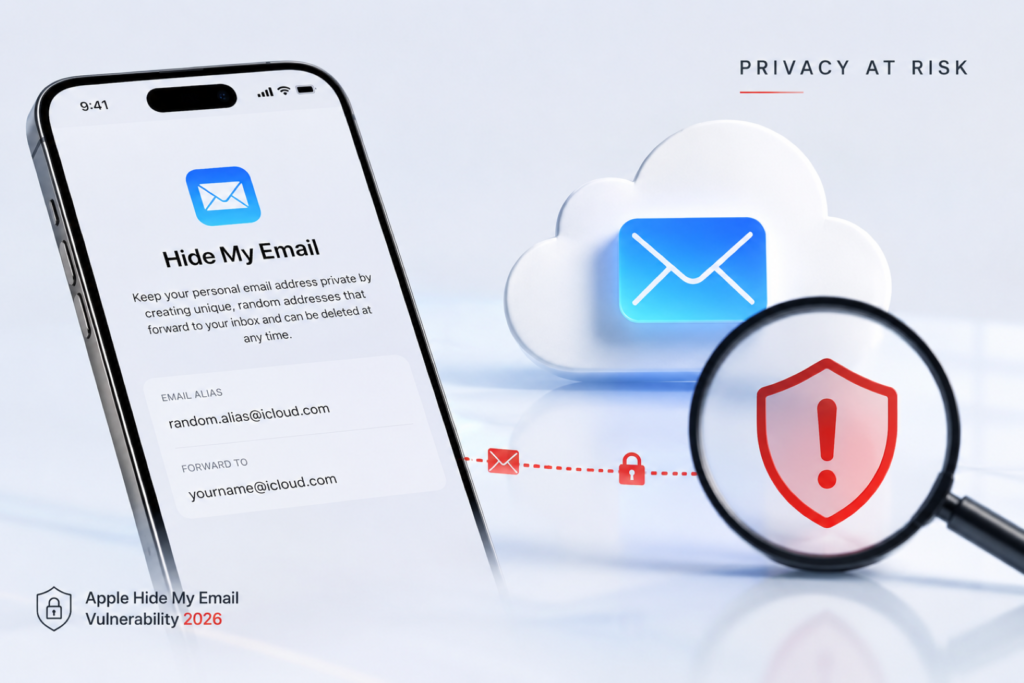
Introduction: Apple Hide My Email Vulnerability — Why It Matters
Apple has released a security update to address the Apple Hide My Email Vulnerability, a privacy issue that reportedly allowed attackers to reveal a user’s real email address from an anonymized Hide My Email alias. The flaw affected one of iCloud+’s most privacy-focused features and raised concerns about how effectively email aliases protected user identities.
The issue was responsibly disclosed by security researcher Tyler Murphy in June 2025, but according to reports, the vulnerability remained unresolved for more than a year before Apple issued a fix on July 3, 2026. Security researchers also warn that aliases created before the fix may already have been exposed through historical email logs, although Apple has not confirmed how many users, if any, were affected.
What is Apple Hide My Email?
Hide My Email is an iCloud+ privacy feature that allows users to generate random email aliases instead of sharing their personal email addresses with websites, apps, and online services.
Whenever someone sends an email to the generated alias, Apple forwards it to the user’s actual inbox without revealing the original address. This approach helps users:
- Protect their personal email identity
- Reduce spam and phishing attempts
- Prevent online tracking
- Disable unwanted aliases at any time
Because of these privacy benefits, Hide My Email has become widely used by Apple customers who wish to limit exposure of their personal email addresses.
What Caused the Incident?
According to security researcher Tyler Murphy, the Apple Hide My Email Vulnerability reportedly allowed attackers to determine the real email address linked to an anonymous Hide My Email alias under certain conditions.
Although Apple has not publicly disclosed the complete technical details, researchers indicate that information contained within email processing and logging mechanisms could be used to correlate anonymous aliases with their underlying email addresses.
This meant the privacy protection offered by Hide My Email could potentially be bypassed, defeating the primary purpose of the feature.
Murphy responsibly reported the issue to Apple in June 2025. Apple investigated the vulnerability and eventually released a security fix on July 3, 2026.
Apple Hide My Email Vulnerability: Full Technical Breakdown
The vulnerability did not reportedly expose passwords, iCloud accounts, or stored mailbox contents. Instead, it weakened the anonymity provided by Hide My Email by allowing researchers to determine the real email address associated with an alias.
Timeline of Events
- June 2025: Security researcher Tyler Murphy responsibly reports the vulnerability to Apple.
- Apple investigates the issue over the following months.
- Researchers continue warning about potential privacy implications.
- July 3, 2026: Apple releases a security update fixing the vulnerability.
- Researchers recommend rotating older email aliases created before the patch.
What Was Potentially Exposed?
Although Apple has not confirmed widespread exploitation of the Apple Hide My Email Vulnerability, researchers warn the following information could potentially have been exposed.
- Real email addresses linked to Hide My Email aliases
- Historical alias mappings
- Previously created email aliases
- Email forwarding relationships
No evidence has been publicly provided indicating exposure of:
- Apple IDs
- Passwords
- Payment information
- Photos
- iCloud Drive files
- Messages
At the time of writing, Apple has not announced whether users whose aliases may have been exposed will receive individual notifications.
Potential Risks & Impact
Identity and Privacy Risks
The primary concern of the Apple Hide My Email Vulnerability is the loss of anonymity. Users who relied on Hide My Email to separate their personal identity from online services may now have their actual email addresses linked to accounts they intended to keep anonymous.
Once an email address becomes known, attackers could potentially use it for:
- Targeted phishing campaigns
- Credential stuffing attempts
- Spam campaigns
- Social engineering attacks
- Cross-platform identity tracking
Business and Organizational Risk
Organizations whose employees use Hide My Email for testing, research, or privacy purposes may also face increased exposure if aliases can be connected to real corporate email accounts.
Businesses should review their email privacy practices alongside other identity protection measures. Readers interested in broader privacy incidents can also explore CyberNexora News’ Cyber Incidents section.
Regulatory and Compliance Considerations
While Apple has fixed the vulnerability, privacy experts note that organizations handling personal information should continue evaluating whether their privacy controls comply with evolving regulations.
Companies operating under frameworks such as GDPR and other global privacy laws are expected to implement layered security measures rather than relying on a single privacy feature.
Official Response
Apple has released a security update addressing the Apple Hide My Email Vulnerability and restoring the intended privacy protections of Hide My Email.
However, the company has not publicly disclosed:
- Whether the vulnerability was actively exploited
- The number of potentially affected users
- Whether impacted customers will receive notifications
- Additional technical details regarding the flaw
Security researchers continue recommending that users rotate sensitive email aliases created before July 2026, especially those associated with financial accounts, healthcare services, or other high-value online platforms.
For official security guidance, administrators and users can monitor Apple Security Releases and the CVE Program for future updates.
Industry Context: Why Privacy Vulnerabilities Are Increasing
The Apple Hide My Email Vulnerability highlights how privacy-focused services have become prime targets for security researchers and attackers alike because they often protect sensitive identity information. Even a small flaw in an anonymization system can undermine the trust users place in privacy features.
As organizations increasingly adopt email masking, identity protection, and anonymous communication tools, attackers continue searching for ways to bypass these safeguards. This incident reinforces the importance of layered privacy protections rather than relying on a single security feature.
For readers interested in similar cybersecurity developments, explore CyberNexora News’ Learn & Protect section.
Organizations should also stay informed about evolving cybersecurity regulations through CyberNexora News’ Laws & Government section.
How to Protect Yourself After the Apple Hide My Email Vulnerability
Although Apple has patched the Apple Hide My Email Vulnerability, users should take additional precautions, particularly if they created email aliases before July 2026.
- Rotate email aliases used for banking, healthcare, and other sensitive accounts.
- Monitor your inbox for unexpected login alerts, phishing emails, or suspicious activity.
- Enable Multi-Factor Authentication (MFA) on all important online accounts.
- Review connected websites and disable unused Hide My Email aliases.
- Avoid relying solely on email masking for privacy protection; combine it with strong passwords and MFA.
- Keep Apple devices updated to receive the latest security patches.
- Regularly review your online accounts for unauthorized changes.
For additional cybersecurity best practices, visit CyberNexora News’ Resources section.
Indicators of Compromise (IoCs)
While this vulnerability is not associated with malware, users should remain alert for the following warning signs:
- Unexpected phishing emails referencing private accounts.
- Login attempts from unfamiliar devices or locations.
- Password reset requests you did not initiate.
- Increased spam sent to your primary email address.
- Notifications indicating unauthorized account activity.
Key Takeaways
- Apple fixed the Apple Hide My Email Vulnerability affecting the Hide My Email feature on July 3, 2026.
- The vulnerability reportedly allowed real email addresses to be linked to anonymous aliases.
- The issue was responsibly disclosed by researcher Tyler Murphy in June 2025.
- Users should consider rotating sensitive email aliases created before the security update.
- Layered security measures remain essential for protecting online identities.
Conclusion: Apple Hide My Email Vulnerability and What Happens Next
The Apple Hide My Email Vulnerability demonstrates that even privacy-focused technologies require continuous security review and timely patching. While Apple has addressed the issue, questions remain regarding whether any aliases were exposed before the fix and whether affected users will be notified.
Users and organizations should continue monitoring official Apple security advisories and adopt layered privacy practices, including MFA, strong passwords, and regular account reviews. As privacy threats evolve, staying informed and proactive remains the best defense.
Frequently Asked Questions(FAQs)
The Apple Hide My Email Vulnerability is a privacy flaw that reportedly allowed attackers to identify a user’s real email address from an anonymized Hide My Email alias. Apple released a fix on July 3, 2026.
Based on currently available information, there is no evidence that passwords, Apple IDs, payment information, or iCloud files were exposed. The reported issue primarily affected email anonymity.
Security researchers recommend rotating aliases created before July 2026, especially those linked to financial, healthcare, or other sensitive accounts.
As of now, Apple has not announced whether users whose aliases may have been exposed will receive notifications.
Use strong unique passwords, enable Multi-Factor Authentication, monitor accounts for suspicious activity, regularly rotate sensitive email aliases, and keep all Apple devices updated with the latest security patches.