
Introduction: Revolut Data Breach — Why It Matters
The Revolut Data Breach reportedly exposed sensitive customer information after a fraudulent request impersonating a legitimate government agency was accepted as genuine. The Revolut Data Breach reportedly affected a limited number of customers and involved highly sensitive identity and financial information.
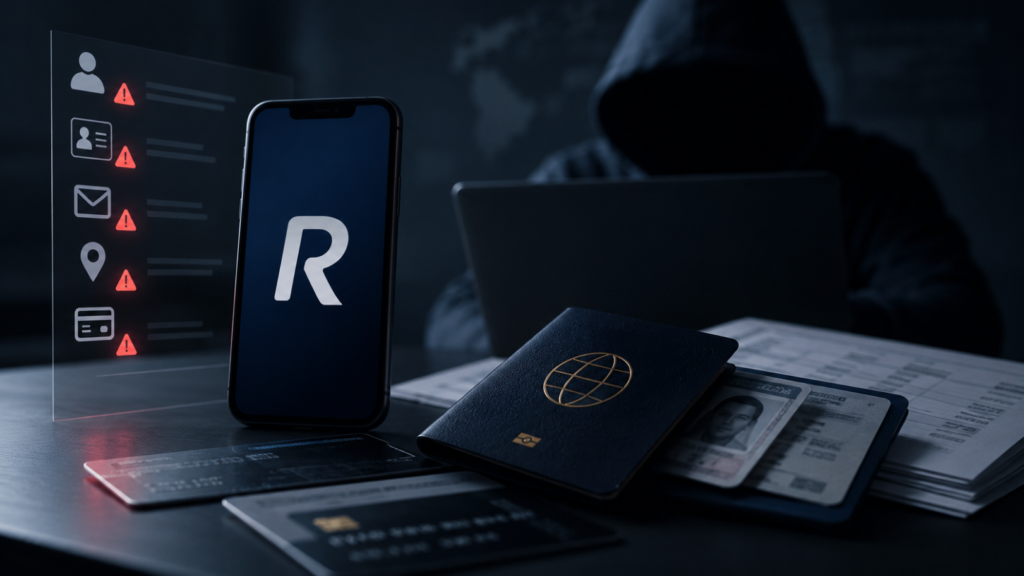
According to the available incident details, the exposed records reportedly included identity documents, verification selfies, contact information, account statements, IBANs and full transaction histories, including Bitcoin activity. Revolut said the incident did not involve a compromise of its core systems, mobile application or customer accounts.
The incident is significant because it demonstrates how attackers can potentially obtain sensitive information without directly breaching a company’s core infrastructure.
What is Revolut?
Revolut is a financial technology platform that provides digital banking and financial services to customers across multiple markets. Like other financial platforms, its operations depend on handling highly sensitive personal and financial information for identity verification, account management and transactions.
The reported incident highlights that protecting this information involves more than securing applications and databases. External communications and processes used to respond to official information requests can also become targets for attackers.
What Caused the Incident?
The Revolut Data Breach involved an unauthorized email account that used the domain of an official government agency. Because the fraudulent request reportedly carried valid domain-authentication credentials, Revolut believed the request was a legitimate legal or government request.
The company then reportedly provided customer information in response to the request. This means the incident appears to have centered on the abuse of trusted communication channels rather than a direct intrusion into Revolut’s core technology environment.
Revolut Data Breach: Full Technical and Factual Breakdown
Timeline of Events
Based on the available information, the incident can be summarized as follows:
- An unauthorized email account reportedly operated using an official government agency’s domain.
- The account sent a fraudulent request for sensitive customer information.
- The request reportedly passed domain-authentication checks, increasing its apparent legitimacy.
- Revolut reportedly treated the request as a genuine legal or government demand.
- Customer information was subsequently released.
- The unauthorized email source was blocked, relevant authorities were notified and affected customers were contacted.
What Data Was Allegedly Affected?
The Revolut Data Breach reportedly exposed several categories of highly sensitive information:
- Passport and driving-license copies
- Identity-verification selfies
- Full names and dates of birth
- Residential addresses
- Email addresses and phone numbers
- Account statements and IBANs
- Wallet reference numbers and account details
- Full transaction histories
- Bitcoin-related transaction activity
The combination of these records could provide attackers with enough information to create highly convincing impersonation or phishing attempts.
Potential Risks & Impact
Identity and Financial Risk
The exposed identity documents and verification information could increase the risk of identity theft and impersonation. Attackers could potentially use legitimate-looking personal details to make phishing messages appear more credible.
Financial histories also create additional risks. Information about account activity, IBANs and cryptocurrency transactions could help criminals construct targeted scams based on a customer’s actual financial behavior.
Readers can find additional practical security guidance through CyberNexora’s Learn & Protect resources.
Business and Reputational Risk
For a financial technology company, the Revolut Data Breach shows how customer trust is closely connected to the protection of personal and financial information. Even when core systems remain uncompromised, an incident involving unauthorized disclosure can create reputational and operational challenges.
Customers may also become more vulnerable to follow-up scams if criminals obtain enough information to convincingly impersonate financial institutions, government bodies or support personnel.
Regulatory and Compliance Risk
The reported disclosure of personal and financial information could also raise regulatory questions, depending on the jurisdictions and customers involved. Financial companies typically operate under strict privacy, security and data-handling obligations.
The incident therefore reinforces the importance of examining not only technical controls but also procedures for validating external requests for customer information.
Official Response / Statement
According to a Reuters report on the Revolut customer data incident, Revolut confirmed that sensitive customer information was disclosed after fraudulent requests appeared to come from a legitimate government agency. The company also indicated that customer funds remained safe.
Following discovery of the Revolut Data Breach, Revolut reportedly blocked the unauthorized email source, notified relevant authorities and contacted affected customers. The available information does not provide a confirmed total number of affected users.
Industry Context: Why This Type of Attack Is Increasing
The Revolut Data Breach illustrates a broader security problem: attackers do not always need to compromise a company’s infrastructure when they can manipulate trusted processes.
Email authentication technologies can help organizations determine whether a message originated from an authorized domain, but successful authentication does not necessarily prove that the person sending the request is authorized to obtain sensitive information. Guidance from NIST on phishing and email-based impersonation similarly recommends independently verifying suspicious requests rather than relying solely on the message itself.
Organizations should therefore combine technical email controls with independent verification procedures. Similar incidents and developments can be followed through CyberNexora’s Cyber Incidents coverage.
How to Protect Yourself / Your Organization
Organizations handling sensitive customer data should consider the following measures:
- Verify sensitive requests independently: Confirm government or legal requests through a separate, trusted communication channel.
- Do not rely only on email authentication: Domain authentication should support, not replace, human and procedural verification.
- Apply least-privilege access: Employees should only access or disclose the minimum information required for a legitimate request.
- Require secondary approval: High-risk data disclosures should receive review from authorized personnel before release.
- Monitor unusual requests: Security teams should investigate unexpected requests for large volumes of identity or financial information.
- Train employees against impersonation: Staff should understand that a legitimate-looking domain does not automatically make a request trustworthy.
- Prepare customers for follow-up scams: Potentially affected users should be warned about targeted phishing, impersonation and cryptocurrency fraud.
- Maintain detailed audit logs: Organizations should record who requested information, who approved it and what data was disclosed.
Additional security awareness guidance is available through CyberNexora’s Learn & Protect category.
Indicators of Compromise (IoCs)
This incident does not provide traditional malware-style IoCs such as file hashes, IP addresses or malicious domains. However, organizations can watch for process-level warning signs, including:
- Unexpected requests from government or legal domains
- Requests for unusually broad customer information
- External requests that bypass established verification procedures
- Messages relying heavily on domain legitimacy as proof of authorization
- Unusual requests involving identity documents or complete financial histories
Key Takeaways
- The Revolut Data Breach reportedly resulted from a fraudulent request impersonating a government agency.
- The Revolut Data Breach reportedly exposed identity documents, contact details and detailed financial histories.
- Revolut said its core systems, app and customer accounts were not compromised.
- Customer funds reportedly remained safe.
- The incident demonstrates why email-domain authentication should not be the sole validation mechanism for sensitive information requests.
Conclusion: Revolut Data Breach and What Happens Next
The Revolut Data Breach highlights a critical security lesson: trusted communication channels can themselves become attack vectors. Organizations handling sensitive customer information need independent verification controls alongside email-security technologies.
Affected customers should remain alert for targeted phishing, identity-theft attempts and cryptocurrency scams. Organizations should review procedures for validating external information requests and follow further updates from Revolut and relevant authorities. CyberNexora’s Cyber Incidents coverage will provide relevant cybersecurity developments as they emerge.
Frequently Asked Questions (FAQs)
The incident reportedly involved a fraudulent request sent from an unauthorized email account using a government agency’s domain. Revolut reportedly believed the request was legitimate and disclosed sensitive customer information.
Reportedly exposed information included passport and driving-license copies, verification selfies, names, dates of birth, addresses, contact details, account statements, IBANs and transaction histories.
No direct compromise of Revolut’s core systems, mobile application or customer accounts was reported in the provided information. Revolut also said customer funds remained safe.
Yes, the combination of identity documents, personal information and financial histories could increase the risk of identity theft, impersonation and targeted phishing.
The request reportedly came from an unauthorized email account using an official government domain and carried valid domain-authentication credentials. This made the communication appear legitimate to Revolut.
Companies should independently verify sensitive requests, use secondary approvals, limit access to customer information and avoid treating email-domain authentication as sufficient proof of authorization.