
Introduction: InjectEave Attack — Why It Matters
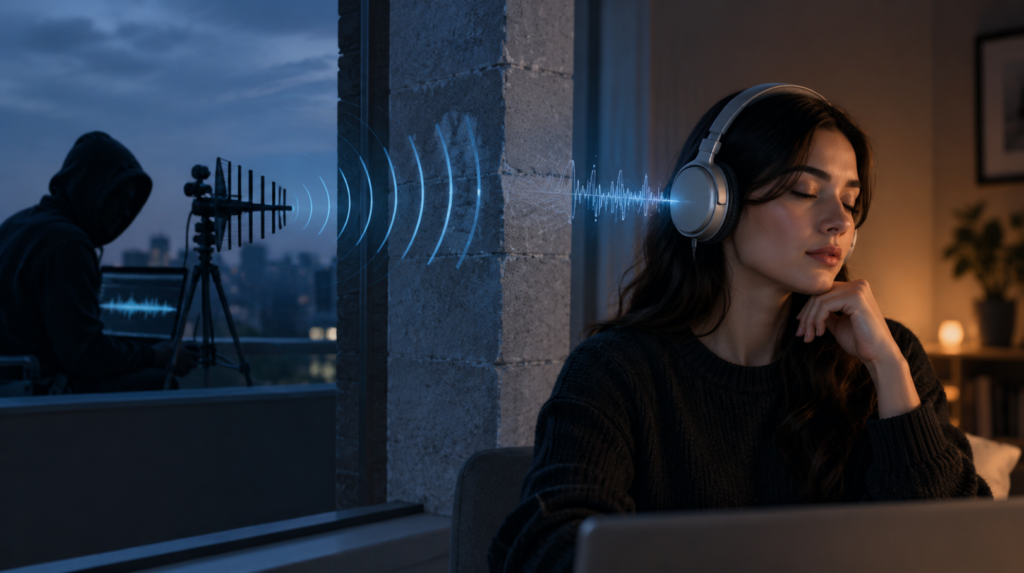
Researchers have uncovered InjectEave Attack, a new electromagnetic (EM) side-channel technique that can remotely recover audio played through wired and wireless headphones. The research demonstrates that an attacker may be able to capture intelligible audio from distances of up to 30 meters, including scenarios where walls separate the attacker from the target.
The InjectEave Attack technique does not depend on breaking Wi-Fi, Bluetooth, or conventional encryption. Instead, it actively injects a tuned radio-frequency signal into nearby electronics and exploits nonlinear hardware components to make otherwise difficult-to-observe audio signals leak through electromagnetic emissions. The work was presented as part of USENIX Security ’26.
What Caused the Incident?
InjectEave Attack targets a hardware property found in many electronic devices: nonlinearity. Components such as amplifiers, analog-to-digital converters and power converters can unintentionally mix signals when exposed to an injected electromagnetic carrier.
Researchers describe this as an “Injection-Modulation-Emission” process. The injected carrier interacts with nonlinear components, effectively moving low-frequency information such as speech into a frequency range that can be measured remotely. The resulting electromagnetic leakage can then be captured and processed by an attacker.
This makes the InjectEave Attack fundamentally different from traditional passive EM eavesdropping, which attempts to observe naturally emitted signals without actively stimulating the target hardware.
InjectEave Attack: Technical Breakdown
How the Attack Works
At a high level, the attack follows three stages:
- Injection: An attacker transmits an electromagnetic carrier toward a target device.
- Modulation: Nonlinear components inside the device interact with the carrier and the device’s low-frequency electrical signals.
- Emission and recovery: The resulting electromagnetic emissions can be received and processed to reconstruct information such as audio.
The researchers have also published a dedicated InjectEave research and demonstration page containing technical details, demonstrations and information about the attack methodology. The results show that the attack is not limited to one particular headphone design or communication protocol.
30-Meter and Through-Wall Eavesdropping
One of the most significant findings is the demonstrated range. Researchers reported audio eavesdropping from headphones at distances reaching 30 meters when additional RF amplification was used. They also demonstrated through-wall scenarios, showing that physical barriers do not necessarily eliminate the leakage.
The research indicates that concrete walls reduced the relevant signal by approximately 5.8 dB in one evaluation, highlighting why conventional assumptions about physical separation may not provide complete protection.
Near 50 centimeters, the researchers achieved close to 100% recognition on most tested audio devices, demonstrating that the recovered signals could contain highly usable information.
Potential Risks & Impact
Audio Privacy Risk
The most direct concern of the InjectEave Attack is the possibility of remotely recovering conversations, meetings, passwords or other speech played through headphones. Because the attack works at the hardware level, disabling wireless connectivity alone may not eliminate the exposure.
Smart-Home Privacy Risk
The research also extends beyond audio. Electromagnetic leakage from smart fans and lamps can reveal information about power consumption, device activity and operating states. In a household environment, such patterns could potentially provide clues about occupancy or daily routines.
AI Voice-Cloning Risk
The researchers also demonstrated an attack chain in which intercepted speech can potentially feed into AI-based voice cloning and subsequent audio manipulation. Such a combination could increase the impact of eavesdropping by turning stolen speech into convincing synthetic audio.
Official Research Response
The research paper, “Injected and Leaked: Actively Inducing Side-Channel Leakage Using Electromagnetic Injection and Hardware Nonlinearity,” was accepted at the 35th USENIX Security Symposium in 2026. The complete research paper is available through the official USENIX Security ’26 research page. The authors describe InjectEave as a new class of injection-induced EM side channels.
The researchers also released supporting research material, while withholding certain operational details such as vulnerable injection frequencies and active injection-control logic to reduce the risk of direct misuse.
For additional coverage of cybersecurity incidents and emerging attack techniques, readers can follow Cyber Incidents on CyberNexora.
Industry Context: Why This Attack Matters
InjectEave Attack highlights a broader security problem: protecting digital communications does not necessarily protect every physical pathway through which information can leak.
Traditional security controls such as encryption, authentication and software hardening operate primarily in the digital domain. However, InjectEave exploits an analog hardware pathway before information is fully protected by those controls. The researchers specifically note that digital defenses such as encryption, masking and randomization do not directly eliminate this form of analog leakage.
This creates a growing need for hardware-aware security testing, particularly for connected devices, audio peripherals, smart-home equipment and systems deployed in sensitive environments.
How to Protect Yourself or Your Organization
Organizations handling confidential conversations should consider the following measures:
- Use hardware designed with EM security in mind, particularly for sensitive communications.
- Evaluate shielding and filtering around audio and analog components where practical.
- Use twisted-pair or better-protected wiring where applicable to reduce electromagnetic coupling.
- Conduct physical security assessments that consider EM side channels, not just network attacks.
- Avoid assuming encrypted wireless communication eliminates hardware-level risks.
- Place sensitive devices away from exposed windows, walls and uncontrolled areas when practical.
- Include electromagnetic leakage testing in IoT and hardware security assessments.
The researchers note that shielding, filtering and protected wiring can reduce exposure, although these measures may not guarantee immunity against sufficiently well-resourced attackers.
Organizations looking for practical cybersecurity guidance can also explore CyberNexora’s Learn & Protect resources.
Key Takeaways
- InjectEave Attack 2026 demonstrates a new form of electromagnetic side-channel eavesdropping.
- Researchers recovered headphone audio from distances of up to 30 meters.
- The technique can operate against wired and wireless headphones and may work through walls.
- Nonlinear hardware components create the pathway for low-frequency information to leak.
- The research shows why hardware and analog security deserve greater attention alongside traditional cybersecurity controls.
Conclusion: InjectEave Attack and What Happens Next
InjectEave Attack demonstrates that sensitive information can potentially escape through physical hardware behavior even when conventional digital security mechanisms remain intact. The research is particularly significant for headphones, smart-home devices and other electronics containing analog components.
Security teams should watch for further research into injection-induced EM side channels and incorporate hardware-level leakage into risk assessments. The findings also reinforce the need for manufacturers to consider electromagnetic resilience during device design rather than treating it solely as a post-deployment security concern. Further cybersecurity research can be tracked through CyberNexora Resources.
Frequently Asked Questions(FAQs)
InjectEave Attack is an electromagnetic side-channel attack that actively injects an RF signal into electronic hardware to induce measurable leakage. Researchers demonstrated that the technique can recover audio from wired and wireless headphones.
Researchers demonstrated audio eavesdropping from distances of up to 30 meters using accessible RF equipment and additional amplification. Through-wall scenarios were also demonstrated.
No. InjectEave does not depend on exploiting Bluetooth or Wi-Fi vulnerabilities. It targets electromagnetic behavior and nonlinear hardware components inside electronic devices.
Yes. Researchers evaluated other commercial devices, including phones, smart fans and smart lamps. The work shows that power consumption and other low-frequency analog signals may also be exposed.
Encryption alone may not stop this attack because the leakage occurs through an analog hardware pathway. Hardware-focused protections such as shielding, filtering and improved wiring can reduce exposure.
InjectEave demonstrates that cybersecurity must consider physical and analog side channels alongside software and network defenses. It expands the threat model for devices that process sensitive audio or other analog information.