
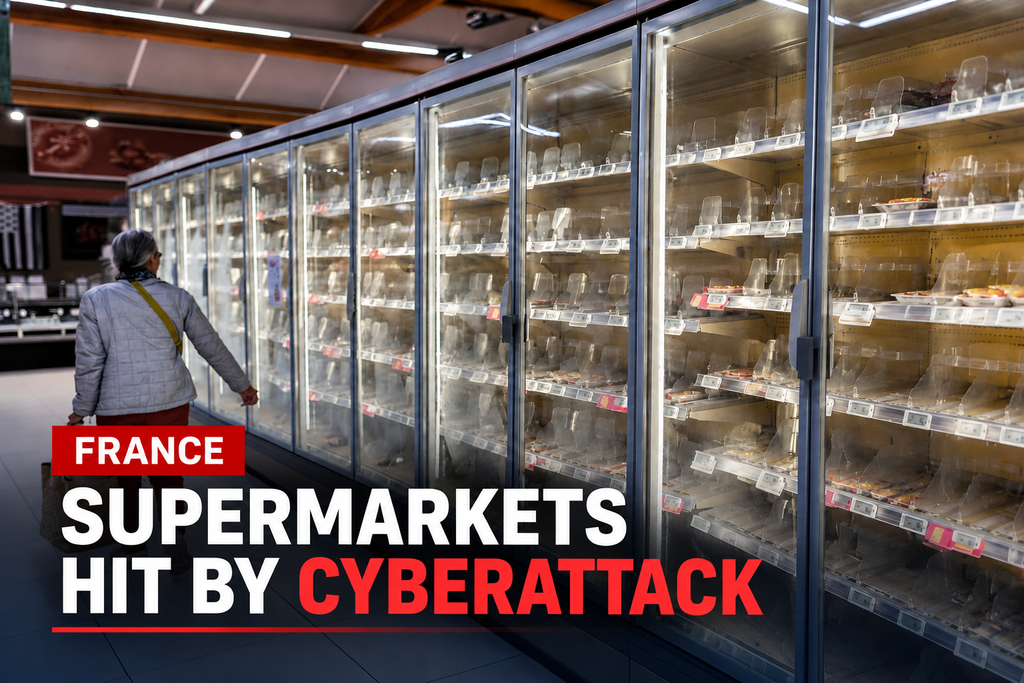
A cyberattack targeting connected refrigeration systems disrupted supermarkets across France in October 2026, causing food losses and raising serious concerns about the security of internet-connected industrial equipment.
The incident demonstrated that cyberattacks do not always involve stolen passwords, leaked customer databases or encrypted business files. Attackers can also disrupt physical equipment controlled by software, potentially affecting business operations, food safety and supply chains.
According to reporting by Reuters, hackers manipulated refrigeration systems at hundreds of French supermarkets, causing temperatures to rise as high as 50°C (122°F) in some affected units. Retailers had to discard affected fresh and frozen food, while reports also described fires at some locations. French authorities opened an investigation into the incident. Reuters
The key cybersecurity lesson is clear: connected equipment needs security testing, access controls, updates and continuous monitoring—not just physical maintenance.
What Happened in the France Supermarket Cyberattack?
The incident affected refrigeration systems used by several major supermarket groups in France.
Reportedly affected retailers included:
- Intermarché
- Carrefour
- Monoprix
- Coopérative U
- Other supermarket locations reported by the media
Reuters reported that around 150 Intermarché stores were affected, while Carrefour reported 80 stores and Monoprix said approximately 5% of its stores were affected. The exact overall impact has varied across reports as more information became available. Reuters
On October 14, the Associated Press reported that France’s cybersecurity authority believed the attacks might still be underway. French authorities advised affected businesses to reconnect refrigeration systems only through secure VPN connections or protected networks, install firmware updates and change passwords. AP News
The incident was particularly concerning because refrigeration is essential to preserving food and maintaining normal supermarket operations.
What Was the Impact?
The reported consequences included:
- Fresh and frozen food being discarded
- Refrigeration equipment becoming unavailable
- Disruption to supermarket operations
- Financial losses for retailers
- Reports of fires at some affected locations
- Additional pressure on incident-response and technical teams
Reuters reported that Intermarché’s chief executive estimated the nationwide losses could reach tens of millions of euros in a single day. This was an estimate, not a final audited figure for the entire incident. Reuters
The incident shows how a cybersecurity weakness in operational technology can create consequences beyond computers and networks.
How Were the Refrigeration Systems Vulnerable?
Supermarket refrigeration systems often use digital controllers and management software to regulate temperatures, monitor equipment and allow authorized technicians to manage systems remotely.
Remote access can improve maintenance and operational efficiency. However, if the equipment is exposed to the internet without adequate protection, attackers may have an opportunity to target it.
Reuters reported that affected French systems included refrigeration management equipment supplied by Danish manufacturer Danfoss. The company said affected units were running outdated firmware and reiterated the importance of keeping supported systems updated. Reuters
The Associated Press also reported that French authorities were aware of compromises involving refrigeration remote-control modules associated with Danfoss and US-based Copeland. Some affected equipment was older and no longer receiving security updates. AP News
Why Outdated Firmware Is a Security Risk
Firmware is software embedded in a device that controls its basic functions.
When a manufacturer identifies and fixes a security vulnerability, the correction may be delivered through a firmware or software update.
If a device continues running outdated firmware, it may remain exposed to weaknesses addressed in later releases.
Potential risks include:
- Unauthorized access to management interfaces
- Weak or improperly configured authentication
- Exposure of remote administration services
- Abuse of insecure network connections
- Difficulty detecting unauthorized configuration changes
These are general risks associated with connected industrial equipment. They should not be interpreted as a confirmed list of vulnerabilities exploited in this particular incident.
Were Known Danfoss Vulnerabilities Responsible?
Cybersecurity research published by Claroty’s Team82 examined vulnerabilities affecting the Danfoss AK-SM 800A refrigeration controller and discussed risks involving internet-accessible management systems. The research identified weaknesses that could affect authentication and device security, and the vendor had released fixes for the reported issues. Claroty
However, the existence of previously reported vulnerabilities does not prove that attackers used those exact vulnerabilities in the October 2026 supermarket incident.
Public reporting has not established the complete attack path. Investigators are still working to determine how the affected systems were accessed and who was responsible. AP News
This distinction matters because responsible cybersecurity reporting must separate confirmed facts from technical possibilities.
Why This Was More Than a Traditional IT Cyberattack
Many businesses concentrate their cybersecurity efforts on websites, email accounts, employee computers and customer databases.
Those systems are important, but businesses also rely on operational technology (OT) and connected devices.
Operational technology includes systems that monitor or control physical equipment. Examples include:
- Industrial refrigeration systems
- Building management systems
- Manufacturing equipment
- Warehouse control systems
- Heating, ventilation and air-conditioning systems
- Industrial sensors and controllers
If an attacker gains unauthorized control of these systems, the impact may extend beyond information security.
A compromised system could interrupt operations, change equipment settings or create safety and business-continuity concerns.
The French supermarket incident highlights why organizations should include operational technology and internet-connected equipment in their cybersecurity risk assessments.
Why Businesses Need VAPT Before an Attack
VAPT stands for Vulnerability Assessment and Penetration Testing.
It is a structured security assessment used to identify vulnerabilities and, within an authorized scope, test whether weaknesses can be exploited.
A cybersecurity audit may also review security policies, system configurations, access controls, update procedures, monitoring and incident-response readiness.
For organizations operating connected refrigeration or industrial equipment, these assessments can help reveal security gaps before an incident occurs.
1. Identify Internet-Exposed Devices
An assessment can help organizations identify which devices, management interfaces and remote-access services are reachable from outside their intended networks.
Systems that do not need public internet access should not be unnecessarily exposed.
2. Find Weak Configurations
Security reviews can examine whether equipment has secure configurations, appropriate access restrictions and properly protected management interfaces.
3. Review Authentication and Access Controls
Assessors can evaluate whether authorized access is appropriately restricted and whether unnecessary accounts or excessive privileges create avoidable risks.
4. Check Firmware and Patch Management
A vulnerability assessment can help identify outdated software and firmware that require vendor review or security updates.
Legacy devices that no longer receive updates may need additional isolation, compensating controls or replacement planning.
5. Assess Network Segmentation
Industrial equipment should not automatically be trusted simply because it is connected to an organization’s internal network.
A properly scoped assessment can review whether refrigeration controllers are separated from office computers, guest networks and other systems that do not need direct access.
Network segmentation can limit how far an attacker may move if one device is compromised.
6. Validate Detection and Response
Organizations should know whether they can detect unexpected configuration changes, unauthorized access and abnormal system behavior.
A security assessment can review logging, alerting and incident-response procedures to identify gaps.
Important: VAPT cannot guarantee that a cyberattack will never happen. It is one part of a wider security program that should also include patch management, network protection, monitoring, backups where appropriate, vendor coordination and incident-response planning.
What a Cybersecurity Audit Should Cover for Refrigeration Systems
Businesses relying on connected industrial equipment should consider a security review that includes the following areas.
| Assessment Area | What Should Be Reviewed |
|---|---|
| Asset inventory | Identify refrigeration controllers, management systems and connected devices |
| Internet exposure | Determine whether management interfaces are unnecessarily accessible from the public internet |
| Firmware security | Identify outdated firmware and unsupported equipment |
| Authentication | Review access permissions and account security |
| Network segmentation | Check separation between operational technology and corporate IT |
| Remote access | Review VPNs, authorized connections and remote administration |
| Monitoring | Assess logs and alerts for suspicious changes |
| Vendor security | Review supplier responsibilities and security-update arrangements |
| Incident response | Confirm that teams know how to isolate and recover affected equipment |
| Retesting | Verify that identified weaknesses have been addressed |
The assessment should be conducted by qualified professionals with explicit authorization from the system owner.
For operational technology, testing must also consider safety and business continuity. Uncontrolled testing against live refrigeration controllers could interrupt operations or damage equipment. The testing plan should therefore be agreed upon with the responsible engineering and operations teams.
How to Protect Connected Refrigeration Systems
Businesses can reduce their exposure by following practical security measures.
Keep Supported Systems Updated
Install vendor-recommended firmware and security updates after appropriate testing and operational planning.
For equipment that has reached end of life, evaluate migration or replacement options.
Avoid Unnecessary Internet Exposure
Do not expose industrial management interfaces directly to the public internet unless there is a documented requirement and appropriate security architecture.
Use protected remote-access methods, such as properly configured VPNs, and restrict access to authorized users and devices.
Change Weak or Default Credentials
Ensure that device credentials are unique, appropriately protected and managed securely.
Apply the strongest authentication controls supported by the equipment.
Separate Industrial and Corporate Networks
Limit communication between refrigeration controllers and unrelated business systems.
Only allow the network connections necessary for legitimate operations.
Monitor Critical Configuration Changes
Establish alerts for unexpected temperature-setting changes, unusual administrative activity and other events that may indicate unauthorized access.
Prepare an Incident-Response Plan
Businesses should know how to isolate affected equipment safely, contact vendors, preserve relevant logs and maintain operations during an incident.
For food retailers, cybersecurity and food-safety procedures should work together to ensure that products are handled appropriately when refrigeration conditions cannot be verified.
What This Incident Means for Businesses in India
Although the reported incident occurred in France, its lessons apply to businesses worldwide.
Indian supermarkets, cold-storage facilities, pharmaceutical warehouses, food-processing companies and logistics providers may also rely on connected monitoring and temperature-control equipment.
These organizations should assess whether their systems are:
- Exposed unnecessarily to the internet
- Running outdated firmware
- Using weak access controls
- Connected to broader corporate networks without sufficient separation
- Covered by clear vendor security agreements
- Monitored for unauthorized configuration changes
A cybersecurity audit can help organizations understand these risks and prioritize corrective actions based on business impact.
The objective is not to assume that every connected refrigeration system is vulnerable. It is to verify the security of each organization’s own equipment, configuration and operating environment.
How CyberNexora Can Help
Cybersecurity should be proactive rather than reactive.
CyberNexora provides cybersecurity and VAPT services to help organizations identify security weaknesses and improve their security posture.
For businesses using connected systems, an appropriately scoped assessment can help review exposed services, configurations, access controls and network security, subject to the technologies and systems included in the agreed scope.
Organizations should confirm that any assessment involving operational technology is conducted by qualified personnel using a plan designed to protect equipment availability and safety.
The goal is to identify and address weaknesses before they contribute to a serious security incident.
Learn more through the official CyberNexora website: CyberNexora
Frequently Asked Questions
What happened in the France supermarket cyberattack?
In October 2026, a cyberattack disrupted connected refrigeration systems at hundreds of supermarkets across France. Some units reportedly reached temperatures as high as 50°C, resulting in spoiled food and reports of fires.
Which supermarket refrigeration systems were affected?
Public reports identified incidents involving refrigeration management equipment associated with Danfoss and Copeland. The precise scope and attack path remained under investigation in the reports available by October 15, 2026.
Did hackers exploit the previously disclosed Danfoss vulnerabilities?
That has not been publicly confirmed. Claroty documented vulnerabilities in refrigeration controllers, but the available reporting does not establish that those exact vulnerabilities were exploited in this incident.
What is VAPT?
Vulnerability Assessment and Penetration Testing is a structured process for identifying security weaknesses and testing exploitability within an authorized scope.
Can VAPT prevent every cyberattack?
No. VAPT can help identify and validate security weaknesses, but it cannot guarantee complete protection. Organizations also need secure configurations, updates, access controls, monitoring and incident-response procedures.
Why should businesses audit connected industrial equipment?
Connected devices may provide remote access to physical systems. A security audit can help identify unnecessary exposure, outdated firmware, weak access controls and other risks before they cause operational disruption.
Conclusion
The France supermarket refrigeration cyberattack is a reminder that cybersecurity affects more than websites and computers. Connected industrial equipment can also become a target, and a security failure can disrupt physical operations, damage inventory and create financial losses.
Businesses should identify their connected assets, keep supported systems updated, restrict remote access, segment networks and regularly assess security weaknesses.
A proactive cybersecurity audit and properly scoped VAPT assessment can help organizations discover and address weaknesses before attackers exploit them.