
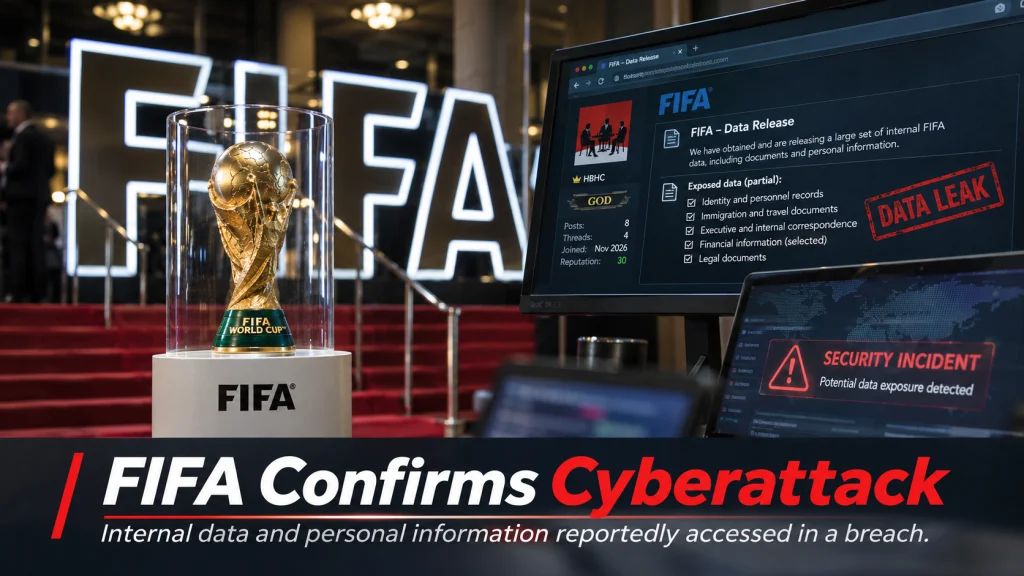
World football’s governing body has confirmed unauthorized access to personal and business information. A hacking group claims to have stolen more than 12GB of internal files, but the full scale of the incident remains unverified.
FIFA Confirms Criminal Cyberattack Involving Internal Information
FIFA, the international governing body of football, has confirmed that it suffered a criminal cyberattack involving unauthorized access to a limited amount of personal and business information.
The disclosure has raised concerns about the security of sensitive organizational records, employee information, confidential documents and the growing threat of social engineering attacks against major international institutions.
According to Reuters’ reporting on the incident, FIFA acknowledged the unauthorized access and said it was cooperating with relevant authorities, including law enforcement.
The organization also condemned the unlawful acquisition and publication of information, particularly personal data.
A hacking group calling itself Handsome Boy Hacking Club (HBHC) has claimed responsibility and alleged that it obtained more than 12GB of internal information.
However, FIFA has not independently confirmed the amount of information allegedly stolen or the complete contents of the claimed dataset.
What Happened in the FIFA Cyberattack?
Reports indicate that the incident became publicly visible after a hacking group posted screenshots allegedly showing FIFA-related documents on the social media platform X around November 19.
The group subsequently claimed responsibility for accessing confidential organizational information.
FIFA later confirmed that unauthorized access had occurred.
According to Telegraph India’s coverage, sources familiar with the matter indicated that attackers had impersonated staff members to obtain access.
This reported method suggests a possible social engineering component rather than a publicly demonstrated software vulnerability.
However, FIFA has not released a complete technical investigation or publicly established every step of the attack.
Key Developments
| Development | Reported information |
|---|---|
| Public threat-actor activity | Around November 19 |
| Organization targeted | FIFA |
| Attack type | Criminal cyberattack involving unauthorized information access |
| Suspected method | Staff impersonation, according to media sources |
| Group claiming responsibility | Handsome Boy Hacking Club |
| Claimed data volume | More than 12GB |
| FIFA-confirmed data volume | Not disclosed |
| Number of affected individuals | Not disclosed |
| Official response | Investigation and cooperation with law enforcement |
How Much FIFA Data Was Allegedly Stolen?
One of the most significant questions surrounding the incident concerns the amount of data accessed.
The Handsome Boy Hacking Club claims to have obtained approximately 12GB or more of FIFA-related files.
Cybersecurity reporting has described allegations involving several categories of information.
These allegedly include:
- Personal identity and immigration documents
- Executive and administrative information
- Financial records
- Legal documents
- Internal governance information
- Organizational communications and related files
These categories are based on the group’s claims and media reporting. They should not be treated as a complete, independently verified inventory of stolen FIFA data.
A person with knowledge of the incident told Reuters that less than 0.1% of FIFA’s total data holdings were affected.
That percentage is a sourced estimate, not a published forensic breakdown.
The exact number of affected individuals, the complete contents of the accessed information and the total verified data volume remain undisclosed.
Who Is the Handsome Boy Hacking Club?
The Handsome Boy Hacking Club, also known as HBHC, is the name used by the group claiming responsibility for the incident.
According to Recorded Future News’ coverage, the group publicly claimed to possess FIFA-related information and reportedly attempted to publicize the alleged stolen material.
Relatively little independently verified information is available about the group’s history, structure, location or operational capabilities.
Its claim of responsibility does not, by itself, establish the identity of the individuals responsible.
Investigators would need to examine technical evidence, access logs, relevant infrastructure and other forensic indicators before attributing the incident conclusively.
How Did Attackers Reportedly Access FIFA Information?
One particularly important aspect of the reported attack is the possible use of employee impersonation.
Social engineering is a technique in which attackers manipulate people into revealing information, granting access or performing actions that compromise security.
In corporate environments, these attacks may involve pretending to be employees, IT administrators, service providers or trusted business partners.
An attacker who successfully impersonates an authorized person may be able to bypass ordinary operational checks without necessarily exploiting a software vulnerability.
This is why cybersecurity protection requires more than firewalls, antivirus software and vulnerability scanning.
Organizations also need strong identity verification, phishing-resistant authentication, access restrictions, employee awareness and monitoring for suspicious activity.
Importantly, the precise technical route used in FIFA’s case has not been fully established in public reporting.
The staff-impersonation explanation should therefore be understood as reported information, not a complete official forensic conclusion.
Were Sensitive World Cup Business Documents Affected?
The incident attracted additional attention because FIFA holds significant confidential commercial and governance information.
According to Reuters, a person with direct knowledge of the matter said files connected to the abandoned FIFA Forward Enterprise project were not accessed.
Other reporting has also suggested that the incident was limited in scope relative to the organization’s total information holdings.
These details are relevant when assessing the possible business impact.
Nevertheless, a relatively small percentage of organizational data can still include sensitive personal records or commercially important information.
The seriousness of a breach depends on the sensitivity and potential misuse of the affected data, not simply the number of gigabytes involved.
Why This Cyberattack Matters for Global Businesses
The FIFA incident demonstrates an important cybersecurity lesson: even internationally recognized organizations can face risks involving identity verification, human interaction and sensitive information access.
Several potential business consequences deserve attention.
1. Personal Data and Privacy Risks
Unauthorized access to identity documents, employee information or other personal records can create privacy risks and potential opportunities for identity fraud.
The actual effect depends on which records were accessed and whether they were subsequently misused.
2. Business Confidentiality
Internal communications, legal records and financial information may contain commercially sensitive details.
Unauthorized disclosure can affect negotiations, institutional relationships and competitive interests.
3. Reputation and Stakeholder Confidence
Publicly reported security incidents may affect how customers, employees, partners and other stakeholders perceive an organization’s security governance.
Clear communication and appropriate incident response are essential.
4. Social Engineering Exposure
Employee impersonation highlights the importance of verifying identities and restricting privileged access, even when a request appears to come from a trusted colleague.
5. Third-Party and Enterprise Security
Complex organizations rely on employees, contractors, external technology providers and interconnected systems.
Security assessments should examine relevant relationships and access pathways, not only public-facing websites.
What Cybersecurity Measures Can Help Prevent Similar Incidents?
Although the full technical details of FIFA’s attack have not been released, organizations can strengthen their defenses through established security practices.
Phishing-resistant multi-factor authentication: Use stronger authentication methods for sensitive applications, identity systems and administrative access.
Identity verification procedures: Require independent verification for sensitive requests, especially changes involving access permissions or confidential information.
Least-privilege access controls: Ensure employees and third parties can access only the information required for their roles.
Centralized logging and monitoring: Detect unusual account activity, suspicious document access and unexpected authentication patterns.
Security awareness training: Educate staff about impersonation, phishing and other social engineering techniques.
Incident response planning: Establish procedures for investigation, containment, evidence preservation, recovery and appropriate notifications.
Regular security assessments: Conduct authorized vulnerability assessments, penetration testing and access-control reviews to identify technical weaknesses.
The US Cybersecurity and Infrastructure Security Agency provides additional guidance on phishing-resistant MFA and incident response planning.
What Does the FIFA Incident Mean for Indian Organizations?
Indian businesses, especially those handling customer records, payment information, identity documents and sensitive corporate data, face similar categories of cybersecurity risk.
Organizations should evaluate authentication, access controls, employee awareness, third-party data handling and incident response capabilities.
Where applicable, organizations must also assess their obligations under Indian cybersecurity and data protection laws, taking account of the relevant provisions and their commencement dates.
Readers interested in related cybersecurity developments can explore CyberNexora News’ coverage of Persistent Systems and LTTS cybersecurity alerts.
Businesses seeking to review their technical security posture can also learn about CyberNexora’s Penetration Testing and VAPT Services.
CyberNexora Security Analysis
The reported FIFA incident reinforces the need for a layered cybersecurity strategy.
Technical vulnerability testing remains important, but organizations must also evaluate identity management, authorized access, employee impersonation risks and the protection of sensitive information.
No single security assessment can guarantee that an organization will never experience a cyberattack.
However, properly scoped assessments and effective security governance can help businesses identify weaknesses, prioritize improvements and reduce avoidable exposure.
For organizations developing or operating web applications, APIs, cloud infrastructure and digital business platforms, proactive security validation should be part of ongoing risk management.
Businesses can contact CyberNexora to discuss an authorized security assessment.
Frequently Asked Questions (FAQs)
Was FIFA really hacked?
Yes. FIFA confirmed that it experienced a criminal cyberattack resulting in unauthorized access to a limited amount of personal and business information. It said it was cooperating with relevant authorities.
How much data was stolen in the FIFA cyberattack?
The group claiming responsibility alleges that it obtained more than 12GB of information. FIFA has not independently confirmed that volume. Reuters reported, citing a knowledgeable source, that less than 0.1% of FIFA’s total data holdings were affected.
Who claimed responsibility for the FIFA data breach?
A group calling itself the Handsome Boy Hacking Club claimed responsibility. Its identity and the full scope of its involvement have not been independently established in public reporting.
How did the FIFA cyberattack happen?
Media reports, citing sources familiar with the incident, suggest that attackers impersonated FIFA staff members to gain access. The complete technical attack chain has not been publicly confirmed.
What can organizations learn from the FIFA cyberattack?
Businesses should strengthen identity verification, access controls, phishing-resistant authentication, security monitoring and incident response. Regular authorized security assessments and staff awareness are also important parts of a broader defense strategy.