
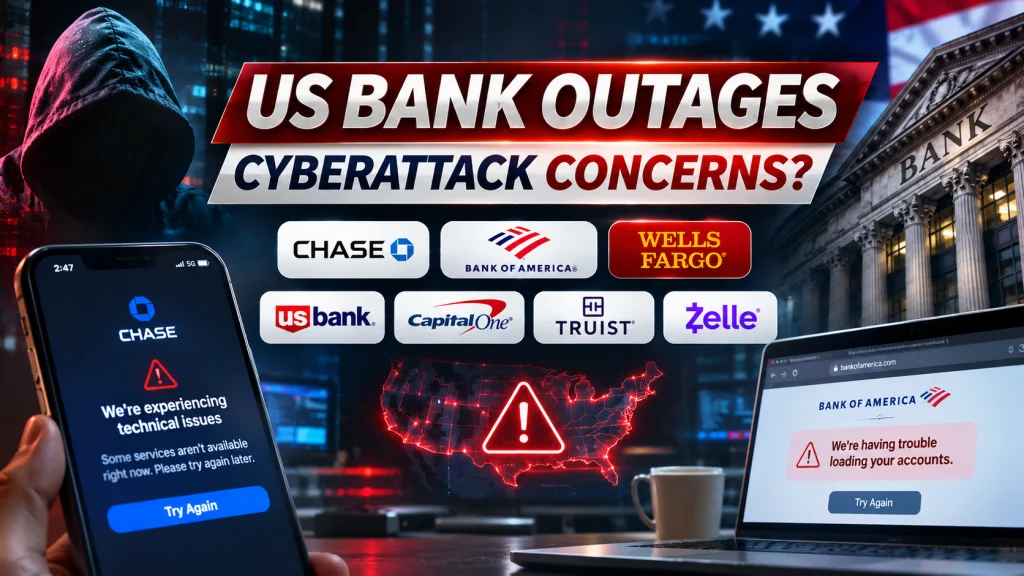
Thousands of customers reported online banking and payment disruptions across major US financial institutions on November 16, 2026. JPMorgan Chase attributed its issue to a software bug in its on-premises hardware systems, while reports also emerged involving Bank of America, Wells Fargo, U.S. Bank, Capital One, Truist and Zelle. The disruption raised questions about a possible cyberattack, but Chase said the incident was not cyber-related.
What Happened to Major US Banks?
On Monday, November 16, 2026, customers across the United States reported difficulties accessing online banking services at several major financial institutions.
Reports included login failures, difficulties checking account balances, delayed bank transfers, payment problems and mobile banking access issues.
According to Downdetector, a platform that tracks user-submitted reports of service disruptions, JPMorgan Chase received the highest volume of complaints.
The situation attracted attention because customers were reporting problems across multiple financial institutions within the same period. However, the available evidence does not establish that all the affected banks experienced independent system-wide outages.
Which US Banks Reported Service Disruptions?
The following financial institutions and payment services appeared in outage reports on November 16.
1. JPMorgan Chase
JPMorgan Chase experienced the most significant reported disruption.
Customers reported problems accessing online accounts, logging into the mobile application, checking balances and completing transactions, including bank transfers and wire transfers.
Some customers received the following message:
“Some services aren’t available. We’re working on them. Please try back later.”
Chase confirmed that it was experiencing a temporary technical issue involving a software bug in its on-premises hardware systems.
The bank stated that some transactions were taking longer than usual, while customers could still access their accounts and funds.
2. Bank of America
Bank of America customers also submitted outage reports.
Reported problems included difficulties with:
- Online and mobile banking access
- ATM services
- Checking account balances
- Performing financial transactions
However, a Bank of America spokesperson told CBS News that its systems had been operating normally that day.
The distinction is important: customer complaints were recorded, but the bank did not confirm a system-wide outage.
3. Wells Fargo
Wells Fargo customers reported problems accessing their online accounts.
Reported issues included:
- Login failures
- Difficulty viewing account balances
- Problems completing transactions
- Online banking access difficulties
Downdetector also recorded an increase in Wells Fargo-related complaints.
However, the bank had not independently confirmed a widespread outage in the reporting available at the time.
4. U.S. Bank
Customers reported issues involving U.S. Bank’s online accounts, mobile application and money transfers.
However, U.S. Bank stated that its own systems were not directly affected.
The bank warned that customers sending or receiving Zelle payments involving another financial institution could experience transaction delays.
5. Capital One and Truist
Downdetector also recorded increased reports involving Capital One and Truist.
These reports indicated that some customers were experiencing difficulties accessing financial services.
However, the reports should not be treated as confirmation that both banks experienced independent, system-wide outages.
6. Zelle Payment Network
Customers also reported difficulties with Zelle payments.
Zelle is a digital payment network used by customers of several major US banks to send and receive money.
However, its operator, Early Warning Services, said the Zelle network itself was fully operational.
The company explained that issues at individual financial institutions could delay some payments.
What Caused the Chase Banking Outage?
According to JPMorgan Chase, the disruption was caused by a temporary software bug in its on-premises hardware systems.
The issue slowed the processing of some transactions and affected customers trying to access certain banking services.
Reuters reported that Chase believed other financial institutions could experience delays when processing transactions involving Chase.
The bank described the incident as a technical problem rather than a systemic failure.
Fox Business, citing an FBI official, reported that the disruption was traced to a software release deployed earlier on Monday that affected a subset of Chase systems.
The official said there was no indication of malicious or external cyber activity.
Was This a Cyberattack on US Banks?
The disruption raised cybersecurity concerns because customers were reporting problems at multiple financial institutions at approximately the same time.
When banking applications, payment services and transaction systems become unavailable, people naturally question whether a cyberattack could be responsible.
However, the available evidence does not confirm a cyberattack.
JPMorgan Chase explicitly stated that its issue was not cyber-related.
An FBI official cited by Fox Business also reported no indication of malicious or external cyber activity.
There is also no confirmed evidence in the available reporting of ransomware, data theft, customer account compromise or an attack targeting multiple US banks.
At present, the publicly reported cause of the main Chase incident is a software bug, not a confirmed cyberattack.
Why Did Other Banks Experience Transaction Delays?
The disruption at Chase had the potential to affect transactions involving other financial institutions.
For example, when a customer at another bank tried to send or receive money through a transaction involving Chase, processing could be delayed.
This is particularly relevant to digital payment services such as Zelle.
The Washington Post and Associated Press reported that customers at other banks could experience slower transactions involving Chase, even when those banks’ own systems were operating normally.
This demonstrates how financial institutions depend on interconnected banking infrastructure, payment networks and transaction-processing systems.
How Many Customers Reported Problems?
Downdetector recorded a significant increase in complaints during the incident.
According to Fortune:
- Chase recorded nearly 4,500 reports shortly after 1:30 PM Eastern Time.
- By 2:22 PM Eastern Time, reports concerning Chase had exceeded 20,000.
- Bank of America recorded approximately 2,000 reports by around 2 PM.
- U.S. Bank and Wells Fargo each recorded approximately 1,000 reports around that time.
These figures represent user-submitted outage reports, not verified counts of affected customers or compromised accounts.
The numbers also changed throughout the incident as customers submitted reports.
Were Banking Services Restored?
Chase said it was working to restore normal service.
By Monday evening, November 16, a Chase spokesperson confirmed that transactions were processing normally again.
NBC News reported that the bank announced transactions were posting normally at approximately 6:30 PM Eastern Time.
Reports of problems across other financial institutions also began declining, although individual customer experiences could vary.
What Does This Incident Mean for Financial Sector Cybersecurity?
Even when an outage is caused by a software defect rather than a cyberattack, it demonstrates how dependent modern banking has become on interconnected technology.
A disruption affecting one financial institution can create delays for customers using services connected to other institutions.
For banks and financial service providers, this incident highlights several important security and resilience priorities:
- Operational resilience: Banking services must be designed to withstand technical failures and unexpected disruptions.
- Incident response: Institutions need effective processes to identify, investigate and resolve service interruptions.
- Transaction monitoring: Banks should continuously monitor unusual delays, failed transactions and service availability.
- Dependency management: Third-party applications, payment networks and financial integrations can introduce additional operational risks.
- Business continuity: Customers should have reliable ways to access essential banking services during technical disruptions.
From a cybersecurity perspective, service availability is an important part of protecting digital financial infrastructure. Not every outage is a cyberattack, but every major disruption deserves a clear technical investigation.
Frequently Asked Questions
Were major US banks hit by a cyberattack on November 16, 2026?
There is no confirmed evidence of a cyberattack. JPMorgan Chase said its disruption was caused by a software bug and was not cyber-related.
Which banks experienced outage reports?
JPMorgan Chase, Bank of America, Wells Fargo, U.S. Bank, Capital One and Truist appeared in customer outage reports. Zelle also received reports of payment difficulties.
What caused the JPMorgan Chase outage?
Chase attributed the incident to a temporary software bug in its on-premises hardware systems that slowed some transactions.
Was customer money or banking data stolen?
The available reports do not establish that customer funds or banking data were stolen as part of this incident.
Were Chase banking services restored?
Chase said transactions were processing normally again by Monday evening, November 16, 2026.