
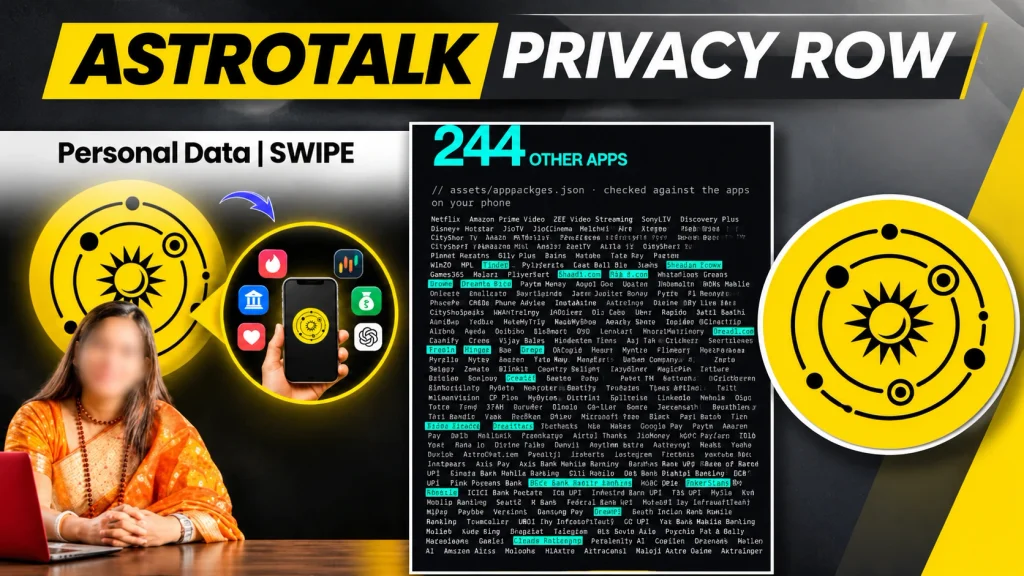
India’s popular astrology platform AstroTalk is facing growing scrutiny over its Android application’s data collection practices after a viral video alleged that it checks which other apps are installed on users’ smartphones.
What began as a claim involving 244 applications has developed into a broader privacy investigation.
On November 28, the Internet Freedom Foundation (IFF) published an independent analysis of AstroTalk’s Android app. Researchers identified a list containing 787 applications and code designed to check which of those apps are installed on a user’s device.
The findings have intensified questions about user consent, data collection transparency, third-party analytics, and whether such information is necessary for providing astrology consultations.
AstroTalk has reportedly defended its installed-app data collection as a security measure rather than a method of profiling users.
However, significant questions remain about how the information is used and whether users receive sufficiently clear disclosures.
How the AstroTalk Privacy Controversy Started
The controversy began when marketing consultant and content creator Prathamesh Bhosle published an Instagram video describing his reverse-engineering analysis of AstroTalk’s application.
Bhosle claimed that the app contained a predefined list of 244 third-party applications and could identify which of them were installed on users’ Android devices.
The applications he highlighted included:
- Dating and matrimony platforms such as Tinder, Bumble, Hinge and Shaadi.com.
- Financial and investment services such as Zerodha and Groww.
- Gaming applications such as Dream11 and PokerStars.
- Banking and loan applications.
- AI platforms, including ChatGPT.
According to the original allegations, the app periodically transmitted the matching applications to AstroTalk’s servers together with user-related identifiers.
The video attracted considerable attention and was subsequently covered by NDTV, Moneycontrol, India Today and other news outlets.
At the time of those initial reports, the claims had not been independently established.
The situation changed when a digital-rights organization published a technical analysis of the application’s code.
Independent Investigation Finds a List of 787 Apps
On November 28, the Internet Freedom Foundation published an examination of AstroTalk Android application version 1.1.545, dated November 20, 2026.
The researchers examined the application’s files and decompiled code.
They identified a file called apppackges.json, containing 787 application identifiers, alongside code for detecting matching installed applications.
The researchers also identified functionality designed to submit the matches to an AstroTalk server endpoint, associated with account and device identifiers.
According to their findings, the application’s logic includes a seven-day interval following a successful upload.
Importantly, 787 does not mean every AstroTalk user has 787 apps installed or that the application collects every app on their phone. It refers to the number of applications in the detection list examined by researchers.
The researchers performed static code analysis. They did not execute the application or independently capture its live network traffic.
Their findings therefore provide technical evidence of the application’s implemented collection logic, but do not independently establish every production transmission or explain how the company subsequently uses the information.
The version examined also differs from the one underlying the original viral claim, so the reason for the difference between 244 and 787 applications remains unclear.
What Types of Applications Were Identified?
The independently examined list extended beyond dating and financial applications.
Researchers identified categories including reproductive health, mental health, borrowing, gaming, matrimony, employment-related services and government welfare applications.
Examples discussed in the investigation included health-related apps such as Flo and Clue, therapy platforms, lending services, dating platforms and government applications such as DigiLocker and mAadhaar.
From a privacy perspective, this is significant.
An application’s presence does not prove anything definite about someone’s circumstances. However, combinations of installed apps can reveal potentially meaningful clues about personal interests, financial needs, family matters or health concerns.
For example, identifying a financial-services app does not expose the user’s balance or transactions. Nevertheless, the fact that someone uses a particular service may itself be sensitive.
When associated with an identifiable account, such information can become a potentially valuable component of a broader behavioral profile.
There is currently no established evidence that AstroTalk uses this information to personalize astrology predictions, manipulate consultations or assess users’ creditworthiness.
The concern is whether the collection is necessary, adequately explained and proportionate to its stated purpose.
AstroTalk Responds: Data Used for Security, Not Profiling
Following the viral controversy, AstroTalk provided a response through a senior company executive.
According to reporting based on comments made to The Hindu, the executive said that information about installed applications is used for security purposes rather than behavioral profiling or creditworthiness assessments.
Installed-app checks can have legitimate security applications.
For example, some financial applications check for known malicious software, device-tampering utilities or applications associated with fraud.
However, the purpose must be considered alongside the categories of data collected.
A security justification becomes harder to evaluate when the checked applications include dating services, health-related platforms or competing consumer products.
The company has not publicly provided a sufficiently detailed explanation of why every category is necessary for its stated security use case.
This does not prove wrongdoing. It highlights the need for greater transparency about the specific threat being addressed, the data retention period, access controls and the use of the collected information.
Does AstroTalk Record Calls and Allow Access to Private Chats?
The original viral video also raised concerns about recordings and the information shared during consultations.
Among the allegations were that astrologers could potentially access previous chat conversations, download images shared by users, take screenshots or access call recordings.
The independent technical analysis identified text inside the Android application referring to a Manage my privacy section.
The settings mentioned access to call recordings, chat histories, downloaded images and screenshots.
This provides additional evidence that the application contains privacy controls related to those activities.
However, the existence of these settings does not establish that every astrologer can freely access every user’s records.
The researchers could not determine whether the relevant permissions are enabled or disabled by default, because those settings depend on server-side behavior.
The scope of recording, actual access privileges, retention policies and enforcement of the settings require further clarification.
Users should review these controls rather than assume that consultation information is automatically private or automatically accessible.
Microsoft Clarity Raises Additional Privacy Questions
Another concern involves Microsoft Clarity, an analytics platform that helps developers understand user interactions through session replay and behavioral analysis.
The independent review found that AstroTalk’s Android code initializes Clarity for logged-in users and associates sessions with an AstroTalk account identifier.
Session-replay technology is not inherently malicious. Businesses commonly use it to identify usability problems and improve application performance.
However, privacy depends heavily on configuration.
Microsoft’s documentation states that Clarity includes default protections for sensitive information, including masking input fields and certain types of text.
Developers can configure additional masking for specific application screens.
Consequently, the presence of Clarity does not establish that AstroTalk is collecting complete private conversations, passwords or other sensitive screen contents.
The critical unanswered question is whether AstroTalk’s consultation-related screens and other sensitive interfaces are appropriately protected from session recording.
Without reviewing the platform’s actual analytics configuration and captured sessions, that cannot be conclusively determined.
What Does AstroTalk’s Privacy Policy Disclose?
AstroTalk’s publicly available privacy policy includes provisions covering device information and technical data.
It refers to information about a device’s software, identifiers and applications available on it.
The policy also describes purposes such as operating the platform, detecting fraud, maintaining security and improving services.
That means it would be inaccurate to say the company’s policy makes no reference whatsoever to application information.
The more important issue concerns the level of disclosure.
A broad reference to device information may not clearly communicate that an application checks for hundreds of named consumer apps, associates matches with user identifiers, and implements recurring collection logic.
From a privacy-by-design perspective, users should be able to understand:
- What device information is collected.
- Why specific application categories are required.
- Whether data collection is necessary for the service.
- How long the information is retained.
- Whether users have meaningful choices about the processing.
These questions are central to assessing the transparency and proportionality of the practice.
How Can an Android App Detect Other Installed Apps?
Modern Android versions restrict how applications discover other software installed on a device.
Android 11 introduced package-visibility filtering, reducing the information available to applications by default.
Developers can declare specific applications they need to interact with using the Android manifest’s queries element.
Broader discovery through QUERY_ALL_PACKAGES is subject to additional restrictions under Google Play policies.
The independent investigation found that AstroTalk’s examined version declared a large set of specific application packages rather than using that broad permission for the identified checking functionality.
Google treats installed-app inventory information as personal and sensitive user data.
Its policies require developers to justify access and comply with relevant disclosure and consent requirements.
Whether AstroTalk’s implementation violates a particular Google Play policy has not been conclusively established and would require a platform-level review.
Google Play Data Safety Disclosures Face Scrutiny
The controversy has also raised questions about the information presented to users through the Google Play Store.
IFF reported observing inconsistent Data Safety summaries while reviewing AstroTalk’s listing on November 27 and 28.
Some observations indicated that no data was collected, while another identified App activity as a collected data category.
The researchers could not determine whether the difference resulted from an update or variation in how Google Play presented the listing.
The publicly accessible listing reviewed for this report identifies App activity among the data types the app may collect.
Google Play’s Data Safety section is based on declarations supplied by developers.
It should therefore be considered alongside, rather than as a replacement for, independent technical verification.
The key question is whether all relevant collection practices, including associated identifiers, are accurately disclosed to users.
Why Was AstroTalk Removed From Apple’s App Store?
Separate reports have noted that AstroTalk’s iOS application became unavailable through Apple’s App Store in early November 2026.
The timing has prompted online speculation about whether the removal is connected to the Android privacy controversy.
However, no reliable evidence has established such a connection.
The independently published code analysis examined the Android application, not the iOS version.
Neither Apple’s reason for the app’s unavailability nor a confirmed relationship to the installed-app findings has been established.
It would therefore be misleading to describe the App Store situation as punishment for the tracking allegations.
What Does India’s DPDP Act Mean for This Case?
India’s Digital Personal Data Protection Act, 2023 establishes a framework for the processing of digital personal data.
Its principles place importance on lawful processing, transparency, specified purposes and individual rights.
However, the legal framework has a phased implementation schedule.
Under the notified commencement arrangements, substantial provisions governing personal-data processing and corresponding rules are scheduled to become effective on May 13, 2027.
Certain provisions had already commenced before that date.
Other existing legal requirements and applicable Google Play policies remain relevant.
As a result, it would be premature to declare that AstroTalk has violated the DPDP Act merely because this investigation identified installed-app collection code.
Any formal legal conclusion would require examination of the applicable provisions, actual processing practices, disclosures and other relevant evidence.
The broader issue remains important: companies should not wait for new compliance deadlines before clearly explaining the personal information they collect.
What Can AstroTalk Users Do to Protect Their Privacy?
Users concerned about the findings can take several practical steps.
First, review AstroTalk’s privacy policy and available in-app privacy controls.
Check the Manage my privacy section for settings related to chat history, call recordings, image downloads and screenshots, where those options are available.
Second, examine Android permissions and remove unnecessary access to sensitive device features.
However, ordinary Android permission controls may not provide a way to disable the specific installed-app detection mechanism discussed in this investigation.
Third, avoid sharing unnecessary sensitive information during consultations and review the data associated with the account.
Users can also contact the platform through its official support or grievance channels to request information about collected data and available deletion options.
Uninstalling the app can prevent further collection by that installation, but it does not automatically erase information already stored by a service.
What Businesses Should Learn From the AstroTalk Controversy
This controversy highlights a growing challenge in mobile application security: an application can implement technically functioning features while still raising questions about their necessity and privacy implications.
For companies developing applications that handle personal information, responsible security reviews should assess more than conventional vulnerabilities.
Important assessment areas include:
Application Permissions and Data Minimization
Determine whether every requested permission and collected data category is needed for the product’s core functionality.
Assess local data storage, application components, insecure configurations, communications and sensitive-information handling.
Third-Party SDK Privacy
Review analytics, advertising, customer-support and session-replay tools to identify what information they can collect and how their privacy controls are configured.
API and Backend Security
Verify authentication, authorization, data access controls, transmission security and protections against unauthorized information disclosure.
Consent and Transparency
Ensure privacy notices accurately describe actual application behavior, including background data collection and third-party processing.
Retention and Access Controls
Limit access to sensitive customer information and define appropriate retention and deletion procedures.
Regular, authorized mobile application assessments can help organizations identify security weaknesses and privacy risks before they develop into major user-trust problems.
Frequently Asked Questions (FAQs)
Does AstroTalk really check other apps installed on users’ phones?
An independent November 28, 2026 analysis identified Android code designed to check for named applications installed on a device and submit matching results to an AstroTalk endpoint. The researchers did not capture live network traffic, so their technical findings should be understood within that limitation.
Does AstroTalk track 244 apps or 787 apps?
The original viral video alleged a list of 244 applications. A later independent examination of Android version 1.1.545 identified a list containing 787 applications. These numbers describe lists of apps the software can check for, not the number installed on each user’s phone. The researchers could not establish why the versions differed.
Can AstroTalk astrologers access private chats, photos and call recordings?
The application’s examined code contains privacy-setting text referring to access to consultation histories, images, screenshots and recordings. However, the default settings and actual access granted to individual astrologers have not been independently established. Users should review the available controls and seek clarification from the platform.
Does Microsoft Clarity record everything users do on AstroTalk?
The examined Android code includes Microsoft Clarity session-replay functionality. However, Clarity supports masking of sensitive content, and Microsoft documents default masking protections. Whether particular AstroTalk consultation screens are captured, masked or excluded has not been independently verified.
Has AstroTalk been hacked, and what should users do?
There is no established evidence in these reports of an external attacker breaching AstroTalk or stealing its customer database. The controversy primarily concerns application-level data collection, transparency and privacy controls.