
Introduction: Apple Beats Studio Buds Vulnerability 2026 — Why It Matters
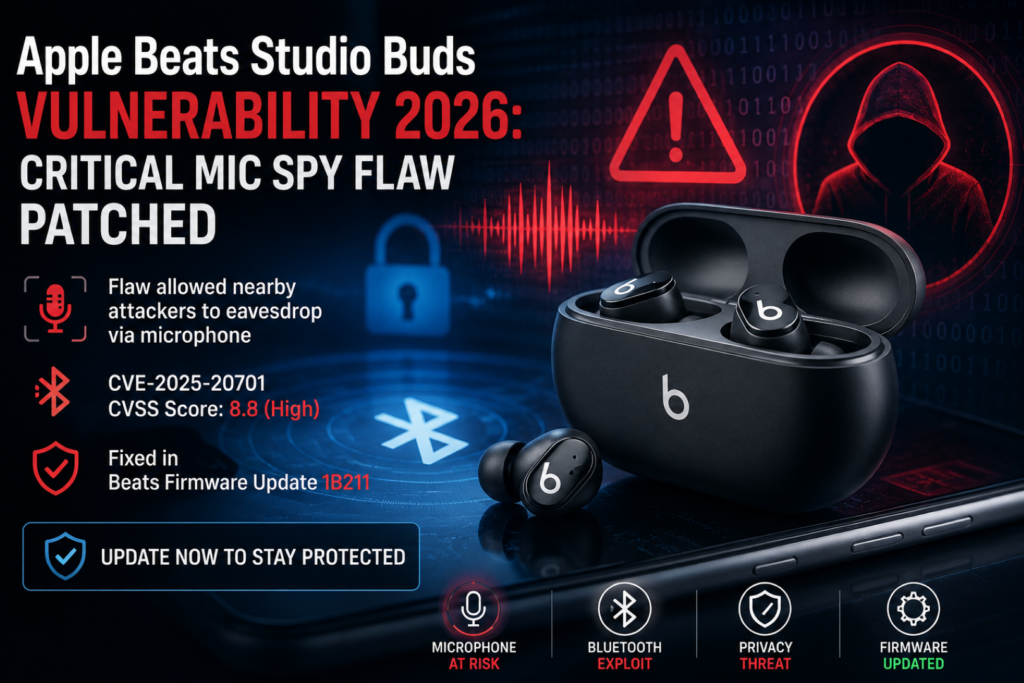
Apple has released a firmware update to address a serious Bluetooth security flaw affecting Beats Studio Buds wireless earbuds. The issue, tracked as CVE-2025-20701, could reportedly allow attackers within Bluetooth range to access a device’s microphone without user consent.
The Apple Beats Studio Buds Vulnerability 2026 has drawn attention from the cybersecurity community because successful exploitation allegedly required no authentication, pairing approval, or user interaction. Apple fixed the flaw through Beats Firmware Update 1B211.
The vulnerability highlights growing concerns around wireless device security and the risks associated with third-party Bluetooth software components embedded in consumer electronics.
What is Beats Studio Buds?
Beats Studio Buds are wireless Bluetooth earbuds developed by Apple under its Beats brand. The earbuds are widely used for music streaming, voice calls, and integration with Apple and Android ecosystems.
Like many modern audio devices, Beats Studio Buds rely on Bluetooth chipsets and software development kits (SDKs) supplied by third-party vendors. In this case, the affected component was the Airoha Bluetooth audio SDK.
As wireless audio products continue to gain popularity, security vulnerabilities affecting Bluetooth communication can expose users to privacy and surveillance risks.
What Caused the Incident?
According to Apple’s security advisory, the issue stemmed from incorrect authorization handling within the Airoha Bluetooth audio SDK.
The vulnerability was assigned CVE-2025-20701 and received a CVSS score of 8.8, indicating high severity.
Security researchers from ERNW GmbH, Dennis Heinze and Frieder Steinmetz, initially disclosed the issue during the TROOPERS security conference in Germany in June 2025. Their research also identified two related vulnerabilities, CVE-2025-20700 and CVE-2025-20702.
Researchers reported that attackers located within Bluetooth range could potentially bypass normal pairing protections and gain unauthorized access to affected devices.
Apple Beats Studio Buds Vulnerability 2026: Full Technical Breakdown
Timeline of Events
- June 2025: ERNW researchers disclose multiple vulnerabilities affecting Airoha Bluetooth SoCs.
- June 2025: Findings presented publicly at the TROOPERS security conference.
- December 2025: Similar security updates released by Jabra for affected products.
- June 2026: Apple releases Beats Firmware Update 1B211 addressing CVE-2025-20701.
- Apple publishes security advisory warning users of potential microphone eavesdropping risks.
What Data/Systems Were Allegedly Affected
According to Apple and researchers, successful exploitation could reportedly affect:
- Device microphone access
- Bluetooth pairing mechanisms
- Trusted device relationships
- Device memory operations
- Wireless communication functions
Researchers further stated that attackers could allegedly:
- Pair with vulnerable devices without consent
- Read portions of device memory
- Write malicious data to device storage
- Hijack trusted Bluetooth connections
- Launch additional attacks against paired devices
The exact number of affected users has not been disclosed.
Potential Risks & Impact
Identity and Privacy Risk
The most concerning aspect of CVE-2025-20701 is the possibility of unauthorized microphone access.
If successfully exploited, attackers within Bluetooth range could reportedly listen to conversations captured by the earbuds’ microphone. This creates significant privacy concerns for users in public places, workplaces, and sensitive environments.
Business and Reputational Risk
Organizations whose employees use vulnerable Bluetooth audio devices could face increased exposure to eavesdropping threats.
Executives, journalists, government officials, and corporate personnel frequently use wireless earbuds for calls and meetings. Unauthorized access to audio streams could potentially expose sensitive business discussions.
Readers interested in similar cybersecurity incidents can explore CyberNexora’s coverage of ongoing threats in the Cyber Incidents category.
Regulatory and Compliance Risk
For regulated sectors handling sensitive information, Bluetooth vulnerabilities can create compliance concerns related to:
- Data protection obligations
- Privacy regulations
- Corporate security policies
- Industry cybersecurity frameworks
Organizations may need to review wireless device management policies to reduce exposure to similar threats.
Official Response / Statement
Apple confirmed that the vulnerability has been addressed through Beats Firmware Update 1B211.
According to Apple’s advisory, an attacker within Bluetooth range could potentially listen through the microphone of an unpaired device actively seeking pairing requests.
Apple has advised users to install the latest firmware updates to ensure protection against the identified vulnerability.
Security researchers from ERNW also noted that affected vulnerabilities could potentially allow attackers to gain extensive control over vulnerable headphones without requiring authentication.
No evidence has been publicly disclosed indicating widespread exploitation of the flaw in real-world attacks.
Industry Context: Why This Type of Attack is Increasing
Bluetooth-enabled devices have become an increasingly attractive target for threat actors due to their widespread adoption and often-overlooked security controls.
Modern wireless devices depend on complex firmware, third-party chipsets, and embedded software libraries. A single vulnerability in these components can affect multiple brands simultaneously.
Recent cybersecurity trends show increasing research into:
- Bluetooth exploitation techniques
- IoT device vulnerabilities
- Wireless surveillance risks
- Supply chain software weaknesses
Organizations seeking guidance on emerging cyber threats can review CyberNexora’s Learn & Protect resources and practical cybersecurity awareness content in the Resources section.
The disclosure also coincides with separate research from Paradigm Shift involving a new SecureROM exploit known as “usbliter8” affecting Apple’s A12 and A13 chips. While unrelated to the Beats vulnerability, both disclosures highlight how hardware and firmware security continue to present challenges for device manufacturers.
For additional Bluetooth and IoT security guidance, readers can review recommendations published by the Cybersecurity and Infrastructure Security Agency (CISA) and the National Institute of Standards and Technology (NIST).
How to Protect Yourself / Your Organization
To reduce exposure to Bluetooth-based attacks, users should:
- Install firmware updates immediately when available.
- Disable Bluetooth when it is not actively needed.
- Avoid leaving devices in pairing mode unnecessarily.
- Review device security notifications regularly.
- Use trusted accessories from reputable vendors.
- Maintain current operating system updates on paired devices.
- Monitor manufacturer security advisories.
- Establish Bluetooth security policies for enterprise environments.
Organizations can also leverage CyberNexora’s Learn & Protect cybersecurity guidance to strengthen user awareness programs.
Indicators of Compromise (IoCs)
Because no public exploitation indicators have been released, definitive IoCs remain limited. However, users should watch for:
- Unexpected Bluetooth pairing requests
- Unknown devices appearing in Bluetooth history
- Unusual microphone activation behavior
- Unexpected battery drain
- Unrecognized Bluetooth connections
- Firmware integrity warnings
Any suspicious behavior should be investigated and reported through internal security processes.
Key Takeaways
- Apple patched CVE-2025-20701 through Beats Firmware Update 1B211.
- The vulnerability carried a CVSS score of 8.8.
- Attackers within Bluetooth range could reportedly access microphone functionality without user consent.
- No user interaction or authentication was reportedly required.
- Users should install available firmware updates immediately.
- The incident highlights growing Bluetooth and IoT security risks.
Conclusion: Apple Beats Studio Buds Vulnerability 2026 and What Happens Next
The Apple Beats Studio Buds Vulnerability 2026 serves as another reminder that cybersecurity risks extend beyond computers and smartphones into everyday connected devices.
While Apple has released a fix, the incident demonstrates how flaws in third-party Bluetooth components can create significant privacy concerns. Users and organizations should continue monitoring security advisories, applying firmware updates promptly, and following best practices for wireless device security.
For ongoing coverage of vulnerabilities, breaches, ransomware incidents, and cybersecurity developments, readers can follow CyberNexora’s dedicated Cyber Incidents section.