
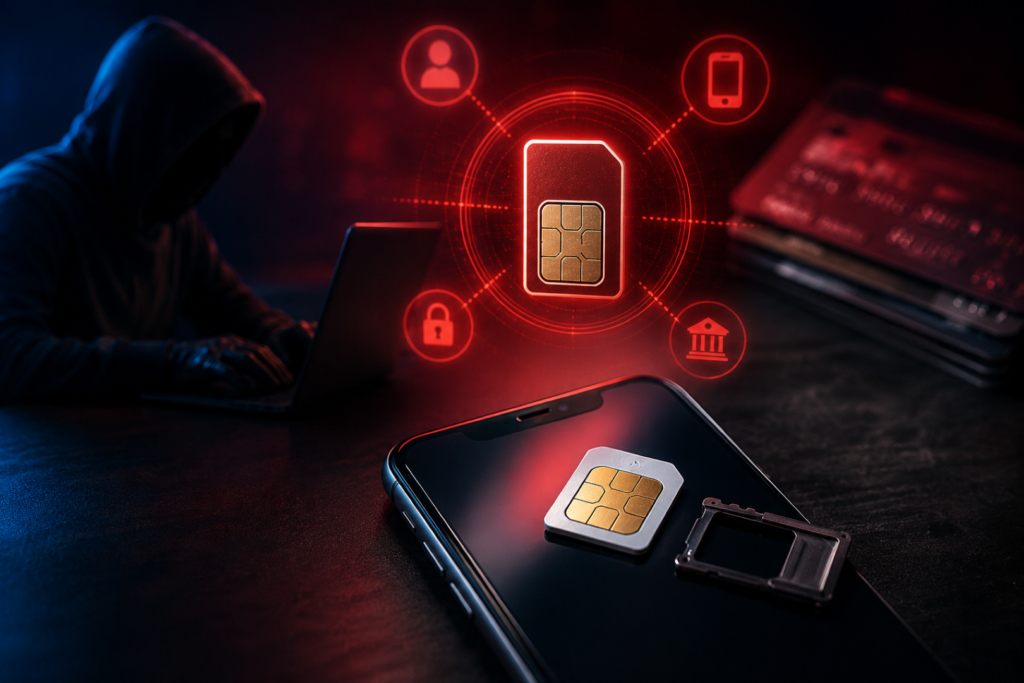
Introduction: SIM Swap Fraud — Why It Matters
SIM Swap Fraud is emerging as one of the most dangerous forms of financial cybercrime, allowing criminals to gain access to victims’ bank accounts without ever physically stealing their smartphones. Instead of attacking the device itself, cybercriminals target the victim’s mobile phone number, which has become a critical authentication method for banking, digital wallets, email accounts, and numerous online services.
The rise of digital payments and mobile banking has made phone numbers a valuable target. Once attackers successfully hijack a victim’s mobile number, they can intercept SMS-based One-Time Passwords (OTPs), bypass two-factor authentication (2FA), reset account passwords, and rapidly transfer funds before victims even realize what has happened.
Although SIM Swap Fraud is not tied to a single organization or country, cybersecurity agencies, banks, and telecom providers worldwide continue to warn customers about the increasing frequency of these attacks. The scam affects both individuals and businesses, making awareness and stronger authentication practices essential for protecting financial assets.
What is SIM Swap Fraud?
SIM Swap Fraud, also known as SIM hijacking or SIM port-out fraud, is a cybercrime in which attackers fraudulently convince a mobile network operator to transfer a victim’s phone number to a SIM card under the attacker’s control.
Once the telecom provider activates the new SIM card, the legitimate user’s phone immediately loses network connectivity, while the attacker begins receiving:
- SMS messages
- Banking OTPs
- Password reset codes
- Two-factor authentication codes
- Verification messages
- Phone calls
Because many online services rely on SMS verification for identity confirmation, attackers can exploit this access to compromise financial and personal accounts within minutes.
Unlike traditional smartphone theft, SIM swap fraud does not require criminals to physically possess the victim’s device. Instead, the attack relies on identity theft, social engineering, and weaknesses in account verification processes.
What Caused the Increase in SIM Swap Fraud?
Several cybersecurity trends have contributed to the rapid rise of SIM swapping attacks across the world.
Increasing Data Breaches
Massive data breaches have exposed billions of personal records containing names, email addresses, phone numbers, birth dates, and identification details. Criminals purchase or obtain these records on underground marketplaces and use them to impersonate victims during telecom verification.
Phishing Campaigns
Attackers frequently distribute phishing emails and fake login pages that trick victims into revealing sensitive information such as:
- Banking credentials
- Telecom account passwords
- Email logins
- Identity documents
- Security questions
These details help attackers convince customer support representatives that they are the legitimate account owners.
Social Engineering
Cybercriminals often manipulate telecom customer service representatives through carefully crafted stories involving:
- Lost phones
- Damaged SIM cards
- Emergency travel
- Device upgrades
If identity verification is weak, the telecom provider may unknowingly transfer the victim’s number.
Reliance on SMS Authentication
Despite improvements in cybersecurity, many financial institutions still rely heavily on SMS-based OTPs for customer authentication.
This dependence makes mobile numbers one of the most valuable assets for cybercriminals. Once attackers gain control of a phone number, they often gain access to multiple online accounts simultaneously.
SIM Swap Fraud: Full Technical Breakdown
SIM swap attacks typically occur in several carefully planned stages rather than through a single event.
Timeline of Events
Stage 1 – Information Gathering
The attacker collects personal information from multiple sources, including:
- Previous data breaches
- Phishing websites
- Social media profiles
- Public records
- Malware infections
- Social engineering conversations
The objective is to gather enough information to impersonate the victim during identity verification.
Stage 2 – SIM Swap Request
Using the stolen information, the attacker contacts the victim’s telecom provider and requests a replacement SIM card.
Common excuses include:
- Lost phone
- Damaged SIM
- Upgrading to a new device
- Switching to eSIM
If verification procedures are bypassed or successfully manipulated, the telecom operator activates the attacker’s SIM card.
Stage 3 – Mobile Number Hijacking
Immediately after the SIM transfer:
- The victim suddenly loses network signal.
- Calls fail.
- SMS messages stop arriving.
- Mobile data becomes unavailable.
Meanwhile, every call and text message intended for the victim is redirected to the attacker’s device.
This loss of mobile service is often the earliest warning sign of an ongoing SIM swap attack.
Stage 4 – Account Takeover
Once the attacker controls the victim’s phone number, they begin resetting passwords for valuable online services such as:
- Internet banking
- Digital wallets
- Credit card accounts
- Investment platforms
- Cryptocurrency exchanges
- Email accounts
- Social media platforms
Since OTP verification messages are delivered directly to the attacker, security protections based solely on SMS authentication become ineffective.
Stage 5 – Financial Theft
After gaining access, attackers quickly attempt to maximize financial gain before the victim notices.
Common activities include:
- Unauthorized bank transfers
- Online shopping purchases
- Cryptocurrency withdrawals
- Digital wallet transfers
- Changing recovery email addresses
- Updating linked phone numbers
- Creating new payment beneficiaries
Many victims only discover the fraud after checking their bank balance or contacting their mobile provider regarding the sudden loss of network service.
What Accounts and Systems Are Commonly Targeted?
SIM swap attacks can compromise numerous services linked to a victim’s mobile number, including:
- Online banking platforms
- Mobile banking applications
- Unified Payments Interface (UPI) accounts
- Credit card portals
- Digital payment wallets
- Investment and trading accounts
- Cryptocurrency exchanges
- Email services
- Cloud storage accounts
- Government digital identity services
- Social media platforms
- Corporate business accounts protected by SMS-based authentication
Because a single phone number often secures dozens of online accounts, successful SIM hijacking can trigger a chain reaction of account compromises and financial losses.
Potential Risks & Impact
SIM swap fraud extends far beyond the loss of a mobile phone number. Once cybercriminals gain control of a victim’s SIM card, they can quickly compromise multiple online accounts and cause significant financial, personal, and business damage.
Identity and Financial Risk
For individual users, the immediate consequence is often unauthorized access to banking and financial services. Since many institutions still rely on SMS-based authentication, attackers can exploit intercepted OTPs to perform high-value transactions.
Potential risks include:
- Unauthorized bank transfers
- UPI payment fraud
- Digital wallet theft
- Credit card misuse
- Cryptocurrency theft
- Identity theft using stolen personal information
- Email account compromise
- Social media account hijacking
In many cases, victims are locked out of their own accounts before they even realize their mobile number has been hijacked.
Business and Organizational Risk
Businesses are also increasingly targeted by SIM swap attacks, especially when executives or finance personnel use SMS authentication for corporate accounts.
Potential business impacts include:
- Business email compromise (BEC)
- Unauthorized payroll payments
- Corporate banking fraud
- Theft of confidential business information
- Loss of customer trust
- Operational disruption
- Financial losses from fraudulent transactions
Organizations that rely solely on SMS-based verification for privileged accounts face a significantly higher risk of account takeover.
Regulatory and Compliance Risk
Organizations handling customer financial data may also encounter regulatory challenges following a successful SIM swap-related compromise.
Depending on the country and industry, affected organizations could face:
- Data privacy investigations
- Financial compliance reviews
- Customer compensation claims
- Mandatory incident reporting
- Increased cybersecurity audit requirements
As governments strengthen cybersecurity and privacy regulations, businesses are expected to adopt stronger authentication methods that reduce reliance on SMS-based security.
Official Response
Although this article focuses on the broader threat landscape rather than a single incident, banks, telecom providers, and cybersecurity agencies worldwide continue to warn customers about the risks associated with SIM swap fraud.
Several financial institutions have encouraged customers to:
- Enable stronger authentication methods
- Regularly review account activity
- Report suspicious telecom service disruptions immediately
- Avoid sharing personal information with unknown callers
Likewise, telecom providers have implemented additional identity verification procedures for SIM replacement requests, although attackers continue attempting to bypass these controls through social engineering.
Cybersecurity agencies also recommend reducing dependence on SMS authentication wherever possible, especially for financial accounts.
Industry Context: Why SIM Swap Fraud Is Increasing
The rapid growth of digital banking, mobile payments, and online identity verification has transformed mobile phone numbers into valuable digital assets.
Unlike traditional financial fraud, SIM swapping enables attackers to compromise multiple accounts by controlling a single authentication channel.
Several factors are driving this trend:
- Increasing availability of stolen personal data from data breaches
- Professional phishing-as-a-service operations
- Sophisticated social engineering techniques
- Widespread dependence on SMS-based authentication
- Expansion of mobile banking worldwidex
- Growing cryptocurrency adoption
Cybercriminal groups increasingly combine SIM swapping with phishing campaigns, credential theft, malware infections, and identity fraud to maximize financial gains. Security guidance from the National Institute of Standards and Technology (NIST) recommends using phishing-resistant authentication methods such as passkeys and hardware security keys instead of relying solely on SMS-based verification.
As SIM swap fraud continues to evolve, cybercriminals are increasingly combining phishing, identity theft, and social engineering to compromise financial accounts. Readers interested in similar cyber fraud cases can explore CyberNexora’s Cyber Incidents section for the latest coverage on cyberattacks and emerging threats. For practical cybersecurity awareness, prevention strategies, and online safety tips, visit the Learn & Protect section. Organizations and security professionals looking to stay informed about cybersecurity regulations, privacy laws, and compliance requirements can also explore the Laws & Government section.
How to Protect Yourself from SIM Swap Fraud
Preventing SIM swap fraud requires strengthening both personal cybersecurity practices and account authentication methods.
1. Use Authenticator Apps Instead of SMS OTPs
Whenever possible, enable authentication apps such as Google Authenticator or Microsoft Authenticator rather than relying on SMS verification codes.
2. Set a SIM PIN
Many telecom providers allow customers to configure a SIM PIN that prevents unauthorized SIM activation.
3. Strengthen Telecom Account Security
Protect your telecom account with:
- Strong passwords
- Security questions
- Additional identity verification
- Account PINs
Avoid using easily guessed personal information.
4. Watch for Sudden Loss of Mobile Service
Unexpected loss of:
- Mobile signal
- Calls
- SMS messages
- Mobile data
may indicate an unauthorized SIM transfer.
Contact your telecom provider immediately if this occurs.
5. Monitor Financial Accounts Regularly
Enable transaction alerts and frequently review:
- Bank statements
- Credit card activity
- UPI transactions
- Digital wallet history
Early detection can significantly reduce financial losses.
6. Never Share OTPs or Personal Information
Banks and telecom providers never ask customers to share:
- OTPs
- PINs
- Passwords
- CVV numbers
- Full account credentials
Treat unsolicited calls requesting such information as suspicious.
7. Enable Multi-Factor Authentication Beyond SMS
Whenever available, choose authentication methods based on:
- Authentication apps
- Hardware security keys
- Passkeys
- Biometric verification
These methods are generally more resistant to SIM swap attacks.
8. Act Immediately if You Suspect a SIM Swap
If your phone suddenly loses network service:
- Contact your telecom operator immediately.
- Freeze online banking if possible.
- Inform your bank.
- Reset passwords from a trusted device.
- Check recent financial transactions.
- Report unauthorized activity to relevant authorities.
Rapid action can prevent attackers from completing fraudulent transactions.
Indicators of Compromise (IoCs)
Users should immediately investigate if they observe one or more of the following:
- Sudden loss of mobile network signal
- Unable to receive OTPs
- Calls and SMS stop working unexpectedly
- Notifications about SIM replacement that were not requested
- Password reset emails you did not initiate
- Unauthorized banking login alerts
- Unexpected financial transactions
- Locked out of online accounts
- New devices appearing in account login history
- Changes to recovery email or phone number
These indicators do not always confirm SIM swap fraud but warrant immediate action.
Key Takeaways
- SIM swap fraud allows attackers to hijack a victim’s mobile number without stealing the physical phone.
- Intercepted OTPs enable cybercriminals to bypass SMS-based authentication and access financial accounts.
- Victims often notice only a sudden loss of mobile network connectivity before financial fraud begins.
- App-based authenticators, passkeys, and hardware security keys provide stronger protection than SMS OTPs.
- Immediate reporting to both the telecom provider and bank is critical to minimizing financial losses.
Conclusion: SIM Swap Fraud and What Happens Next
SIM Swap Fraud highlights a growing weakness in modern digital authentication. As banking, payment services, and online platforms continue to rely on mobile numbers for identity verification, cybercriminals are increasingly targeting telecom accounts instead of smartphones themselves.
While banks, telecom providers, and cybersecurity agencies continue strengthening security controls, users also play a critical role in protecting their accounts. Moving away from SMS-based authentication, monitoring mobile service disruptions, and responding quickly to suspicious activity can significantly reduce the risk of financial loss.
Readers looking to further strengthen their cybersecurity knowledge can also explore CyberNexora’s Resources section for practical security guides, checklists, and educational materials covering a wide range of cyber threats and best practices.
Frequently Asked Questions(FAQs)
SIM Swap Fraud is a cybercrime in which attackers fraudulently transfer a victim’s mobile phone number to a SIM card they control. Once the swap is complete, criminals can intercept OTPs, bypass SMS-based two-factor authentication, and gain unauthorized access to banking, email, and other online accounts.
One of the earliest warning signs is the sudden loss of mobile network service without any apparent reason. You may also stop receiving calls, SMS messages, or OTPs while noticing unauthorized login attempts, password reset emails, or suspicious banking transactions.
SMS-based authentication depends entirely on your mobile number. If attackers successfully hijack your SIM card, they receive all verification codes sent via SMS, allowing them to bypass this security layer. Authentication apps, passkeys, and hardware security keys offer stronger protection.
Contact your telecom provider immediately to verify your SIM status and request that any unauthorized changes be reversed. Next, notify your bank, freeze online banking if possible, change passwords from a trusted device, and review recent account activity for unauthorized transactions.
Yes. Businesses can also become victims, especially when executives or finance teams use SMS-based authentication for corporate banking, email, or cloud services. A successful SIM swap attack may result in business email compromise, financial fraud, and unauthorized access to sensitive company information.
The best defenses include using authenticator apps instead of SMS OTPs, enabling a SIM PIN, securing telecom accounts with strong passwords, monitoring mobile service interruptions, and acting immediately if your phone unexpectedly loses network connectivity.