
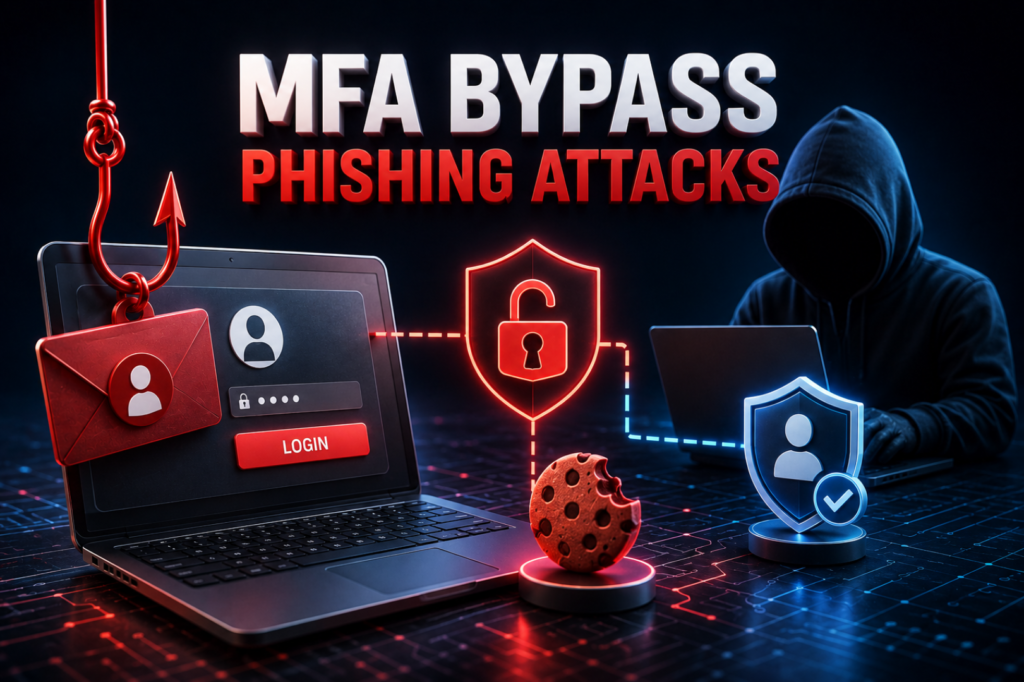
Introduction: MFA Bypass Phishing Attacks Are Becoming a Major Cybersecurity Threat
Multi-Factor Authentication (MFA) has long been considered one of the most effective defenses against unauthorized account access. However, cybercriminals are increasingly adopting advanced phishing techniques that allow them to bypass traditional authentication protections without directly breaking MFA itself.
One of the fastest-growing threats is the rise of MFA Bypass Phishing Attacks powered by Adversary-in-the-Middle (AiTM) phishing kits. These sophisticated attack frameworks act as intermediaries between users and legitimate websites, enabling attackers to capture authenticated sessions, steal session cookies, and gain unauthorized access to accounts.
Unlike conventional phishing attacks that focus solely on stealing usernames and passwords, AiTM phishing campaigns target the entire authentication process. This allows attackers to exploit trusted login sessions even after a user successfully completes MFA verification.
As organizations increasingly rely on cloud services, remote access solutions, and identity-based security controls, understanding how these attacks operate has become essential for both businesses and individual users.
What Are MFA Bypass Phishing Attacks?
MFA Bypass Phishing Attacks are advanced credential theft campaigns designed to circumvent authentication protections by exploiting trusted login sessions.
Rather than attacking MFA mechanisms directly, attackers deploy phishing infrastructure that sits between the victim and the legitimate service. The victim interacts with what appears to be a genuine login page while the attacker silently intercepts authentication traffic.
These attacks are specifically designed to capture:
- Usernames and passwords
- Authentication tokens
- Session cookies
- Access tokens
- Cloud account credentials
- Corporate login sessions
The ultimate goal is account takeover and unauthorized access to protected systems and sensitive information.
Incident Overview: Rise of Adversary-in-the-Middle (AiTM) Phishing Kits
Cybersecurity researchers have reported a significant increase in the use of commercially available AiTM phishing kits that enable threat actors to conduct highly effective phishing campaigns.
These kits often provide:
- Pre-configured phishing templates
- Reverse proxy infrastructure
- Session cookie capture capabilities
- Multi-factor authentication interception
- Automated credential harvesting
- Real-time victim monitoring
Unlike traditional phishing pages that simply collect login credentials, AiTM frameworks create a live connection between the victim and the legitimate platform, allowing attackers to steal authenticated sessions after successful login.
This evolution represents a major shift in modern phishing tactics, where attackers focus on session hijacking rather than password theft alone.
How Adversary-in-the-Middle (AiTM) Phishing Attacks Work
Security analysts have identified a common attack chain used in most AiTM phishing campaigns.
1. Phishing Infrastructure Deployment
Attackers create phishing domains that closely resemble legitimate services such as:
- Microsoft 365
- Google Workspace
- Banking portals
- Cloud platforms
- Enterprise VPN systems
The fake pages are designed to appear identical to official login portals.
2. Victim Delivery
Victims are targeted through:
- Phishing emails
- SMS phishing (Smishing)
- Social engineering messages
- Fake advertisements
- Malicious QR codes
The objective is to convince the user to access the fraudulent login page.
3. Real-Time Authentication Relay
Once the victim enters credentials, the phishing server forwards them to the legitimate service in real time.
The legitimate website then requests Multi-Factor Authentication verification.
4. MFA Verification
The victim completes the authentication challenge using:
- Authenticator applications
- SMS codes
- Push notifications
- One-time passwords
Because the process appears legitimate, users rarely suspect malicious activity.
5. Session Cookie Theft
After successful authentication, the legitimate platform generates a session cookie.
The attacker intercepts and stores this authenticated session token.
6. Account Takeover
Using the stolen session cookie, attackers can gain access to the account without requiring another MFA challenge.
This technique enables attackers to bypass authentication protections while maintaining a legitimate user session.
Affected Systems and Services
AiTM phishing attacks do not typically target a specific software vulnerability. Instead, they exploit authentication workflows used across multiple platforms.
Commonly Targeted Services
- Microsoft 365
- Google Accounts
- Enterprise VPN Portals
- Cloud Service Providers
- Banking Applications
- SaaS Platforms
- Corporate Email Systems
Because these attacks focus on authentication sessions, any web-based platform that relies on session cookies may be a potential target.
Session Cookie Theft: Why It Matters
Session cookies are essential for maintaining authenticated user sessions after login.
Once a user successfully completes authentication, the platform issues a session token that confirms the user has already been verified.
If attackers obtain this session cookie, they may be able to:
- Access sensitive data
- Read corporate emails
- Download confidential documents
- Modify account settings
- Create persistence mechanisms
- Conduct business email compromise attacks
In many cases, possession of a valid session cookie eliminates the need to repeatedly enter credentials or MFA codes.
This makes session cookies one of the most valuable assets for modern cybercriminals.
Potential Impact of MFA Bypass Phishing Attacks
Account Compromise
Attackers may gain unauthorized access to user accounts despite MFA being enabled.
Business Email Compromise (BEC)
Compromised email accounts can be used to conduct fraud, social engineering, and internal phishing campaigns.
Data Exposure
Unauthorized access may lead to theft of:
- Internal documents
- Customer information
- Corporate communications
- Cloud-stored files
Lateral Movement
Attackers may leverage compromised accounts to access additional systems within an organization.
Financial Losses
Successful account compromise can result in fraud, ransomware deployment, and operational disruptions.
Indicators of Compromise (IoCs)
Organizations should monitor for signs of session hijacking and phishing-related activity.
Common Warning Signs
- Unexpected login notifications
- Authentication activity from unusual locations
- Multiple login attempts from different regions
- Unauthorized session creation
- Suspicious account configuration changes
- Unknown devices appearing in account activity logs
- Unexpected email forwarding rules
Early detection can significantly reduce the impact of a successful compromise.
Risk Assessment: MFA Bypass Phishing Attacks
Severity: High
Although MFA remains an important security control, AiTM phishing attacks have demonstrated that authentication systems can still be abused through session hijacking techniques.
Technical Risks
- Session cookie theft
- Account takeover
- Credential harvesting
- Authentication abuse
- Identity compromise
Operational Risks
- Unauthorized access to business systems
- Increased incident response costs
- Service disruption
- Security team workload escalation
Business Risks
- Financial fraud
- Reputation damage
- Regulatory consequences
- Customer trust erosion
- Potential legal liabilities
Security Recommendations for Organizations
1. Adopt Phishing-Resistant Authentication
Organizations should prioritize:
- FIDO2 Security Keys
- Hardware Authentication Tokens
- Certificate-Based Authentication
- Passkeys
These technologies provide stronger protection against phishing-based attacks.
2. Implement Continuous Session Monitoring
Monitor:
- Session anomalies
- Device trust changes
- Geographic login inconsistencies
- Token reuse attempts
Continuous monitoring helps identify compromised sessions quickly.
3. Strengthen Email Security
Deploy:
- DMARC
- SPF
- DKIM
- URL filtering
- Attachment sandboxing
These controls reduce phishing delivery success rates.
4. Enhance User Awareness
Educate users about:
- Modern phishing tactics
- Domain verification
- Session hijacking risks
- Secure login practices
User awareness remains a critical layer of defense.
User Protection Guidelines
Individual users should:
- Use passkeys whenever available
- Avoid logging in through email links
- Verify website URLs carefully
- Enable security alerts
- Regularly review active sessions
- Use trusted password managers
- Keep software and browsers updated
These practices can significantly reduce the likelihood of successful account compromise.
Strategic Cybersecurity Implications
The growth of AiTM phishing kits demonstrates a significant evolution in cybercriminal tactics.
Key trends include:
- Increased focus on identity-based attacks
- Abuse of trusted authentication workflows
- Rising popularity of session hijacking techniques
- Growing demand for phishing-resistant authentication
- Greater reliance on cloud identity systems
Organizations can no longer rely solely on traditional MFA protections and must adopt a layered identity security strategy.
Conclusion: MFA Bypass Phishing Attacks Highlight the Need for Stronger Authentication
The rise of MFA Bypass Phishing Attacks illustrates how cybercriminals continue to evolve beyond traditional credential theft techniques. By leveraging Adversary-in-the-Middle (AiTM) phishing kits, attackers can intercept authenticated sessions and steal session cookies, enabling account compromise even when Multi-Factor Authentication is enabled.
While MFA remains a critical component of modern cybersecurity, organizations and users must recognize its limitations and implement additional safeguards such as phishing-resistant authentication, passkeys, hardware security keys, and continuous session monitoring.
As identity-based attacks continue to increase, proactive security measures and user awareness will play a vital role in protecting accounts, data, and business operations from emerging phishing threats.
What are MFA Bypass Phishing Attacks?
MFA Bypass Phishing Attacks are advanced phishing campaigns that allow cybercriminals to gain unauthorized access to accounts even when Multi-Factor Authentication (MFA) is enabled. These attacks typically use Adversary-in-the-Middle (AiTM) phishing kits to intercept login sessions and steal authentication tokens or session cookies.
What is an Adversary-in-the-Middle (AiTM) Phishing Attack?
An AiTM phishing attack is a technique where attackers position themselves between a user and a legitimate website. The attacker relays login requests in real time, capturing credentials, MFA responses, and session cookies without the victim realizing it.
Can MFA Really Be Bypassed?
Yes, but attackers are not directly breaking MFA itself. Instead, they exploit authenticated sessions by stealing session cookies after the user successfully completes the MFA process. This allows attackers to access accounts without needing the MFA code again.
What Is Session Cookie Theft?
Session cookie theft occurs when attackers steal the authentication cookie generated after a successful login. Because the cookie proves that the user has already been authenticated, attackers can use it to access the account without re-entering credentials or MFA codes.
Which Platforms Are Commonly Targeted by AiTM Phishing Kits?
Cybercriminals frequently target:
Microsoft 365
Google Workspace
Banking Portals
Cloud Services
Enterprise VPN Platforms
Corporate Email Accounts
SaaS Applications
Any platform that relies on web-based authentication and session cookies can potentially be targeted.