
Introduction
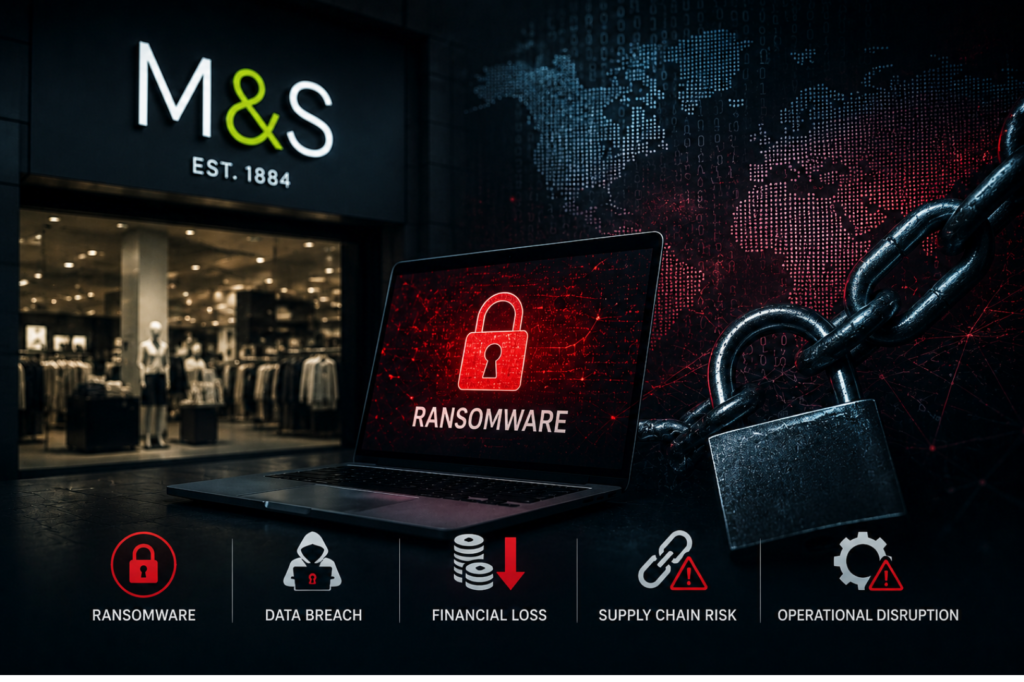
The Marks & Spencer Cyberattack has become one of the most significant retail cybersecurity incidents reported this year. The attack resulted in substantial financial losses, operational disruption, and executive accountability, ultimately leading to the cancellation of CEO Stuart Machin’s annual bonus.
According to company disclosures, the cyberattack caused approximately £131.3 million ($175 million) in losses through business interruption, remediation expenses, recovery operations, and lost profits. The incident disrupted online retail services for an extended period and highlighted the growing threat posed by sophisticated ransomware and social engineering campaigns targeting large enterprises.
Security analysts believe the attack was linked to the notorious cybercriminal group Scattered Spider, with ransomware infrastructure reportedly associated with DragonForce. The incident serves as a critical reminder that even well-established global organizations remain vulnerable to modern cyber threats, particularly those exploiting third-party relationships and human factors.
Understanding Marks & Spencer’s Digital Operations
Marks & Spencer (M&S) is one of the United Kingdom’s largest and most recognized retail brands, operating across:
- Fashion and apparel
- Food and grocery services
- Home and lifestyle products
- E-commerce and digital retail platforms
- International retail operations
With millions of customers relying on its online services, M&S maintains a highly interconnected technology ecosystem that includes third-party suppliers, contractors, cloud services, payment systems, and logistics platforms.
Such digital complexity significantly increases the organization’s attack surface, making cybersecurity a critical business function.
Cyber Incident Overview
What Happened?
In April , Marks & Spencer became the target of a sophisticated cyberattack that reportedly combined:
- Social engineering tactics
- Third-party contractor compromise
- Unauthorized access to internal systems
- Ransomware deployment
- Business service disruption
Investigations indicate that attackers may have gained initial access by manipulating or compromising a trusted third-party relationship rather than exploiting a traditional software vulnerability.
This attack method reflects a growing trend among advanced cybercriminal groups that target people and supply chains instead of directly attacking security controls.
Attack Attribution: Scattered Spider and DragonForce
Cybersecurity experts have linked the incident to tactics commonly associated with Scattered Spider, a financially motivated cybercrime group known for:
- Advanced social engineering
- Help desk impersonation
- Credential theft
- Multi-factor authentication bypass attempts
- Targeting large enterprises
Reports also suggest ransomware infrastructure connected to DragonForce may have been involved during later stages of the attack.
The combination of social engineering and ransomware represents a highly effective attack chain that continues to impact organizations worldwide.
Financial Impact of the Marks & Spencer Cyberattack
The business consequences of the incident were significant.
Reported Financial Losses
Marks & Spencer disclosed losses totaling approximately:
£131.3 Million ($175 Million)
These losses were attributed to:
- Revenue disruption
- Recovery and remediation costs
- Security investigations
- Incident response operations
- Technology restoration efforts
- Operational downtime
For many organizations, cyberattacks are no longer purely technical incidents; they have evolved into major financial and business risks capable of affecting shareholder value and long-term growth.
CEO Bonus Cancelled Following Cyber Incident
One of the most notable outcomes of the attack was its impact on executive compensation.
Marks & Spencer CEO Stuart Machin reportedly received:
£0 Annual Bonus for Fiscal Year 2025/26
As a result:
- Total executive compensation fell by approximately 44%
- Annual pay decreased to around £3.97 million
The decision demonstrates how cybersecurity performance is increasingly being treated as a board-level responsibility.
Organizations worldwide are beginning to integrate cybersecurity resilience into executive accountability frameworks, recognizing that cyber risk directly affects business performance.
Operational Disruption and Customer Impact
The cyberattack reportedly caused significant disruption to online operations.
Business Challenges Observed
- Interrupted online shopping services
- Customer service delays
- Order processing challenges
- Technology recovery activities
- Temporary operational limitations
Although there has been no public confirmation of widespread customer data theft directly linked to the incident, prolonged service outages can significantly impact customer trust and brand reputation.
In today’s digital economy, service availability is often just as important as data security.
Why Supply Chain Attacks Are Increasing
The Marks & Spencer incident highlights a growing cybersecurity concern:
Third-Party Risk Exposure
Modern organizations depend heavily on:
- Vendors
- Contractors
- Managed service providers
- Cloud providers
- Technology partners
Attackers increasingly view these relationships as easier entry points into larger organizations.
Common Supply Chain Attack Methods
- Contractor account compromise
- Credential theft
- Social engineering attacks
- Remote access abuse
- Third-party software exploitation
A single compromised vendor account can potentially provide access to critical business environments.
Key Cybersecurity Lessons from the Incident
The attack offers important lessons for businesses across all sectors.
1. Human Factors Remain a Major Risk
Many sophisticated attacks begin with:
- Phishing
- Impersonation
- Social engineering
- Credential harvesting
Technical controls alone cannot eliminate these risks.
2. Third-Party Security Must Be Strengthened
Organizations should continuously evaluate:
- Vendor security programs
- Access permissions
- Authentication controls
- Monitoring capabilities
Supply chain security has become a core component of enterprise risk management.
3. Rapid Incident Response Is Critical
Effective response plans should include:
- Threat containment procedures
- Backup recovery processes
- Communication strategies
- Business continuity planning
The speed of response often determines the overall impact of a cyber incident.
4. Executive Leadership Must Prioritize Cybersecurity
Cybersecurity is no longer solely an IT issue.
Business leaders must actively support:
- Security investments
- Risk management programs
- Employee awareness training
- Incident preparedness exercises
The M&S case demonstrates how cybersecurity failures can directly influence executive performance evaluations.
Recommended Security Measures for Organizations
To reduce exposure to similar attacks, organizations should consider implementing:
Identity and Access Security
- Multi-factor authentication (MFA)
- Privileged access management
- Conditional access policies
Third-Party Risk Management
- Vendor security assessments
- Continuous monitoring
- Contractual security requirements
Employee Awareness Programs
- Social engineering simulations
- Phishing training
- Security awareness campaigns
Incident Response Readiness
- Regular tabletop exercises
- Backup testing
- Recovery planning
Threat Detection and Monitoring
- Security Operations Center (SOC)
- Endpoint Detection and Response (EDR)
- Threat intelligence integration
Strategic Implications for the Retail Industry
The Marks & Spencer Cyberattack reflects a broader trend impacting global retailers.
Emerging Threat Trends
- Ransomware targeting retail organizations
- Supply chain compromise campaigns
- Identity-based attacks
- Social engineering operations
- Business disruption-focused extortion
Retail companies possess large customer bases, complex digital infrastructures, and extensive third-party ecosystems, making them attractive targets for cybercriminals.
As attackers continue evolving their tactics, organizations must adopt a proactive security posture rather than relying solely on traditional perimeter defenses.
Conclusion
The Marks & Spencer Cyberattack demonstrates the growing financial, operational, and reputational consequences of modern cyber threats. With reported losses exceeding £131 million, months of disruption to online operations, and the cancellation of the CEO’s annual bonus, the incident has become a prominent example of how cybersecurity incidents can impact every level of an organization.
The attack also reinforces the increasing risks associated with social engineering, third-party compromises, and ransomware operations. As cybercriminal groups such as Scattered Spider continue targeting major enterprises, organizations must strengthen security controls, enhance supply chain risk management, and ensure cybersecurity remains a strategic business priority.
Frequently Asked Questions(FAQs)
The Marks & Spencer cyberattack involved a sophisticated ransomware incident that reportedly combined social engineering, third-party contractor compromise, unauthorized access to internal systems, and business disruption. The attack caused significant financial losses and disrupted the company’s online retail operations.
Marks & Spencer reported approximately £131.3 million ($175 million) in losses due to the cyberattack. The costs included business interruption, incident response, recovery efforts, remediation expenses, technology restoration, and lost profits.
Cybersecurity experts have linked the attack to tactics commonly associated with the Scattered Spider cybercrime group, while ransomware infrastructure reportedly connected to DragonForce was believed to have been used during the later stages of the attack.
Following the cyberattack, Marks & Spencer cancelled CEO Stuart Machin’s annual bonus for the 2025/26 fiscal year. The decision reflected the company’s emphasis on executive accountability for cybersecurity performance after the incident caused major financial and operational impacts.
The incident highlights the importance of strengthening third-party risk management, improving employee awareness against social engineering, implementing strong identity and access controls, and maintaining robust incident response and business continuity plans to reduce the impact of ransomware attacks.