
Berlin, April 2026
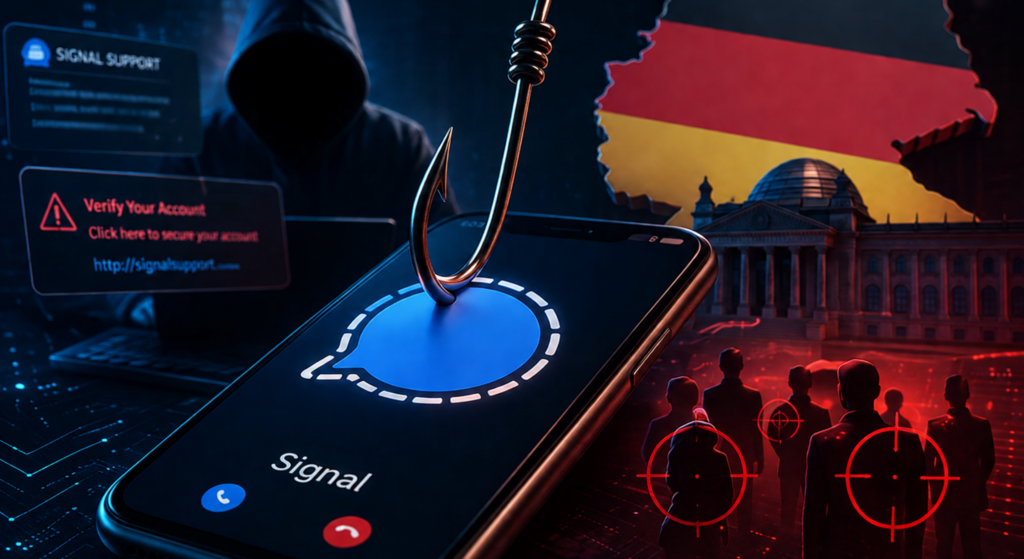
A large-scale cyberattack targeting over 300 high-profile individuals in Germany has raised serious concerns about the security of encrypted communication platforms and the growing sophistication of phishing operations. The incident, which primarily exploited the popular messaging application Signal, is being investigated as a potential state-backed cyber operation.
The attack specifically targeted politicians, military personnel, journalists, and other individuals connected to sensitive government functions. Authorities believe the objective was to gain access to private communications and contact networks, which could be used for intelligence gathering or further cyber operations.
How the Attack Happened
According to initial findings, the attackers used a highly targeted phishing technique disguised as official communication from “Signal Support.” Victims received messages prompting them to verify or secure their accounts, often accompanied by links that appeared legitimate.
Once users interacted with these links, attackers were able to compromise their accounts. This allowed unauthorized access to:
- Private chats
- Contact lists
- Potentially linked accounts and metadata
Unlike traditional hacking methods, this attack did not rely on breaking encryption. Instead, it exploited human trust through social engineering — a tactic that continues to be one of the most effective tools in cybercrime.
Why Signal Was Targeted
Signal is widely regarded as one of the most secure messaging platforms, offering end-to-end encryption and strong privacy protections. It is commonly used by journalists, activists, and government officials for sensitive communication.
However, this incident highlights a critical reality in cybersecurity: even the most secure platforms can be compromised if users are manipulated into giving access themselves.
Experts have emphasized that the vulnerability was not in Signal’s encryption, but in the phishing method used to deceive users.
Scale and Impact
The scale of the attack has made it one of the most significant targeted phishing campaigns reported in recent months.
With over 300 individuals affected, the breach has potential implications for:
- National security
- Confidential communications
- Diplomatic operations
- Media integrity
Authorities are currently assessing whether any classified or sensitive information was accessed or exfiltrated during the attack.
Suspicion of State-Backed Involvement
Cybersecurity analysts have indicated that the attack bears characteristics commonly associated with state-backed cyber operations.
These include:
- Highly targeted victim selection
- Sophisticated social engineering techniques
- Strategic focus on government and defence-related individuals
While no official attribution has been confirmed, early assessments suggest possible links to foreign threat actors. Such operations are typically designed for intelligence gathering rather than immediate financial gain.
Growing Trend of Targeted Phishing
This incident reflects a broader global trend where phishing attacks are becoming more advanced and personalized.
Modern phishing campaigns now use:
- Realistic branding and messaging
- Context-aware communication
- Timing aligned with real-world events
This makes it increasingly difficult for even experienced users to identify malicious attempts.
The use of trusted platforms like Signal further increases the success rate, as users are less likely to suspect communication within familiar environments.
Cybersecurity Implications
The attack has triggered renewed discussions about the limitations of platform-level security in the face of human-targeted threats.
Key takeaways include:
- Encryption alone is not sufficient
- User awareness remains critical
- Social engineering is a primary attack vector
Organizations are now being urged to strengthen internal cybersecurity training and adopt stricter verification protocols for sensitive communications.
Government Response
German authorities have initiated an investigation into the incident, working with cybersecurity agencies to identify the source and scope of the attack.
Efforts are also underway to:
- Notify affected individuals
- Secure compromised accounts
- Monitor for further suspicious activity
The incident is expected to influence future policies related to secure communication within government systems.
Global Context
This attack is part of a larger pattern of cyber activity targeting governments and critical institutions worldwide.
Recent reports have highlighted an increase in:
- State-sponsored cyber operations
- Espionage-driven attacks
- Targeted phishing campaigns
As geopolitical tensions continue to influence cyber strategy, such incidents are likely to become more frequent and complex.
The Signal phishing attack targeting German officials underscores the evolving nature of cyber threats in today’s digital landscape. While technology continues to advance, attackers are increasingly focusing on human vulnerabilities rather than technical weaknesses.
The incident serves as a reminder that cybersecurity is not just about systems and software, but also about awareness, vigilance, and preparedness.
As investigations continue, the global cybersecurity community will be closely watching for insights that could help prevent similar attacks in the future.