
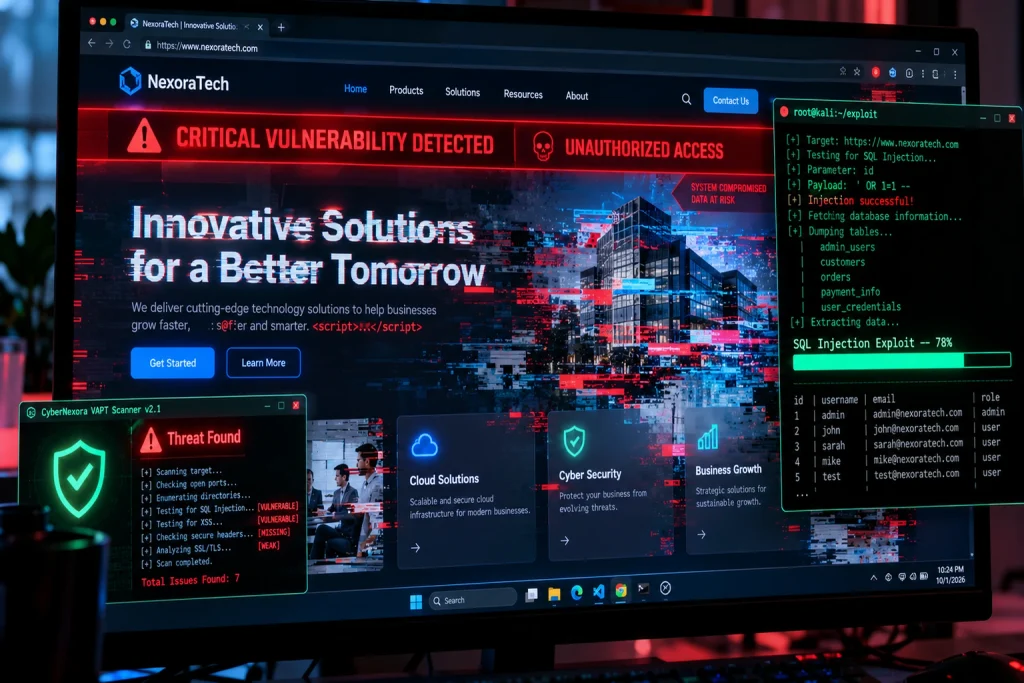
Cyber threats in 2026 are no longer a distant concern for enterprises with massive security budgets. They are a daily reality for businesses of every size. From AI-powered phishing campaigns to zero-day exploits sold on markets, attackers have more tools, more automation, and more patience than ever before. In this environment, guessing whether your systems are secure is not a strategy. It is a liability.
That is where VAPT services come in. Vulnerability Assessment and Penetration Testing-commonly shortened to VAPT—has become one of the most reliable ways to measure, understand, and improve an organization’s security posture. Whether you are a startup handling customer data or an established enterprise with a complex cloud infrastructure, VAPT gives you something no firewall or antivirus can: proof of where you are exposed and how an attacker would exploit it.
What Are VAPT Services?
VAPT services combine two distinct but complementary disciplines: vulnerability assessment and penetration testing.
A vulnerability assessment is a systematic review of your systems, applications, and networks to identify known weaknesses. It uses automated scanners and manual checks to find missing patches, misconfigurations, weak credentials, outdated software, and other low-hanging fruit that attackers love.
Penetration testing, on the other hand, goes further. A penetration tester—often called an ethical hacker—simulates a real attack against your environment. They do not just find vulnerabilities; they attempt to exploit them, chain them together, and determine how far an attacker could go. The result is a realistic picture of your actual risk, not just a list of theoretical issues.
When delivered together as VAPT services, these two approaches give you both breadth and depth. You learn what is broken, how it can be broken, and what it would cost an attacker to break it.
Vulnerability Assessment vs Penetration Testing: What’s the Difference?
Many people use the terms interchangeably, but they serve different purposes.
| Aspect | Vulnerability Assessment | Penetration Testing |
|---|---|---|
| Goal | Identify and list vulnerabilities | Exploit vulnerabilities to measure impact |
| Approach | Automated scanning + manual validation | Manual, creative, attacker-simulated |
| Frequency | Regular, often monthly or quarterly | Periodic, often annually or after major changes |
| Output | Prioritized vulnerability report | Detailed attack narrative with proof of concept |
| Skill Level | Security analyst | Experienced ethical hacker |
A vulnerability assessment tells you that a door is unlocked. A penetration test tells you whether someone can actually walk through that door, what they can steal once inside, and how long they can stay before anyone notices. Both are essential. Neither replaces the other.
Why VAPT Services Matter More Than Ever in 2026
The threat landscape in 2026 is defined by speed and scale. Attackers use AI to scan for vulnerabilities across thousands of targets simultaneously. Ransomware groups operate like businesses, with customer support and negotiation teams. Supply chain attacks have shown that even the most secure company can be breached through a trusted vendor.
At the same time, regulatory pressure is increasing. Governments and industry bodies are mandating stronger security controls, and customers are more aware of data privacy than ever. A breach does not just cost money—it costs reputation, trust, and sometimes the entire business.
VAPT services address this reality head-on. They provide evidence-based assurance that your defenses work. They help you prioritize spending on the risks that actually matter. And they give you a documented record of due diligence that can satisfy auditors, insurers, and partners.
Key Benefits of Professional VAPT Services
- Real-world risk visibility – You see your systems through the eyes of an attacker, not just a compliance checklist.
- Prioritized remediation – Not every vulnerability is equally dangerous. VAPT helps you fix the critical ones first.
- Compliance support – Many standards, including ISO 27001, PCI DSS, and SOC 2, require regular penetration testing.
- Reduced breach costs – Finding and fixing a flaw before an attacker does is dramatically cheaper than dealing with a breach.
- Customer confidence – Demonstrating proactive security builds trust with clients and partners.
How VAPT Fits Into a Modern Cybersecurity Strategy
VAPT is not a one-time project. It is a continuous cycle. The most mature organizations integrate VAPT into their development lifecycle, testing new applications before they go live and retesting after every significant change. They also combine VAPT with other practices such as security awareness training, endpoint detection and response, and incident response planning.
In 2026, the most effective cybersecurity strategies are layered. VAPT is the layer that validates whether all the other layers are actually working. Without it, you are trusting assumptions. With it, you are trusting evidence.
Common Mistakes Businesses Make With VAPT
- Treating VAPT as a checkbox for compliance rather than a genuine security improvement.
- Running only automated scans and calling it a penetration test.
- Ignoring the remediation phase after the report is delivered.
- Testing only external systems and forgetting internal networks, APIs, and cloud configurations.
- Choosing the cheapest provider instead of one with proven methodology and reporting.
Avoiding these mistakes can mean the difference between a useful security investment and a false sense of safety.
How CyberNexora Can Help
Cybersecurity is too important to rely only on incomplete YouTube tutorials or scattered blog posts. If your team needs proper, structured learning, or if your organization has already faced an attack and needs protection, CyberNexora provides professional VAPT services designed to find real weaknesses and help you fix them before attackers can exploit them. Their approach combines thorough vulnerability assessment with realistic penetration testing, giving you a clear roadmap for strengthening your security posture in 2026 and beyond.
Whether you are preparing for compliance, responding to an incident, or simply want to know where you stand, CyberNexora’s VAPT services can give you the clarity and confidence you need.
What is VAPT in cybersecurity?
VAPT stands for Vulnerability Assessment and Penetration Testing. It is a combined service that identifies security weaknesses and then attempts to exploit them to measure real-world risk.
How often should a business conduct VAPT?
Most organizations should conduct a vulnerability assessment quarterly and a full penetration test at least annually. You should also test after major infrastructure changes, new application deployments, or security incidents.
Is vulnerability assessment enough without penetration testing?
No. A vulnerability assessment finds potential issues, but only penetration testing confirms whether those issues can actually be exploited and what impact they would have.
Can small businesses benefit from VAPT services?
Absolutely. Small businesses are often targeted precisely because they have weaker defenses. VAPT helps them focus limited resources on the most critical risks.
How do I choose the right VAPT provider?
Look for a provider with certified testers, a clear methodology, sample reports, and a remediation support process. Experience in your industry and compliance requirements is also important.