
Introduction: SparroWocky Backdoor — Why It Matters
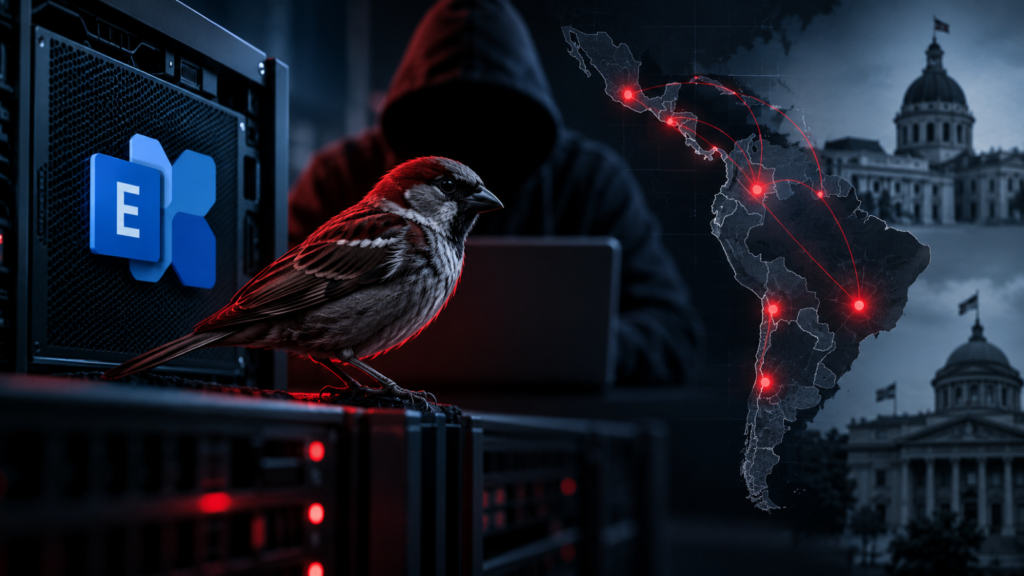
SparroWocky Backdoor is a newly reported malware campaign linked by ESET researchers to FamousSparrow, a cyberespionage group active since at least 2019. The activity has primarily focused on Latin America, with the backdoor observed at government entities in Argentina, Ecuador, Guatemala, Honduras, Panama, Peru, Puerto Rico, and Venezuela.
The campaign reportedly began using SparroWocky in August 2025. Researchers observed attackers exploiting internet-facing Microsoft Exchange servers for initial access before deploying the modular backdoor through techniques designed to keep malicious code hidden from conventional security controls.
Who Is FamousSparrow?
FamousSparrow is a China-aligned cyberespionage group that ESET has tracked since at least 2019. The group was initially associated with attacks against hotels but has also targeted governments, international organizations, engineering companies, trade groups, and law firms.
The group is particularly associated with SparrowDoor, its previously documented backdoor. ESET’s earlier research showed that FamousSparrow continued developing its malware despite a period with limited publicly documented activity.
SparroWocky Backdoor: Technical Breakdown
SparroWocky is a modular C++ backdoor designed to provide attackers with extensive control over compromised Windows systems. ESET researchers reported that the malware appears to have replaced SparrowDoor as a major implant used by the group.
Attack Chain and Timeline
The reported campaign follows a multi-stage intrusion process:
- Attackers reportedly gained initial access through publicly exposed Microsoft Exchange servers.
- A loader used DLL side-loading to execute malicious components through legitimate software.
- An encrypted payload was decrypted and mapped directly into memory.
- SparroWocky established communication with attacker-controlled infrastructure.
- The backdoor could then execute commands, manipulate files, collect information, and support further network access.
Earlier FamousSparrow activity in Latin America also involved DLL side-loading and Microsoft Exchange exploitation, showing continuity in the group’s use of exposed enterprise infrastructure.
What Can SparroWocky Do?
According to reporting on ESET’s findings, the backdoor can:
- Execute commands and arbitrary files.
- Collect system, network, user, domain, and Windows information.
- Enumerate drives, directories, files, displays, and active sessions.
- Upload, download, copy, move, and delete files.
- Capture periodic screenshots.
- Create processes in another logged-in user’s session.
- Operate as a TCP proxy to forward network connections.
- Remove persistence and delete malicious files.
These capabilities make the malware useful for both surveillance and continued access after an initial compromise.
Potential Risks & Impact
Espionage and Data Exposure
A backdoor capable of collecting system information, stealing files and taking screenshots can provide attackers with visibility into sensitive organizational activity. Government networks are particularly attractive targets because compromised systems may contain confidential communications, operational information, and internal documents.
Lateral Movement
The TCP proxy capability can potentially allow attackers to use a compromised machine as a bridge toward other systems. This increases the importance of investigating activity beyond the initially compromised Exchange server.
Persistence and Evasion
SparroWocky reportedly supports persistence through mechanisms such as services or Registry Run entries. Its use of encrypted communications, in-memory execution, DLL side-loading, dynamic API resolution, and other anti-analysis techniques can complicate detection.
Official Response / Research Findings
ESET is the principal research source behind the current findings. Its reporting identified SparroWocky activity across eight Latin American countries and described FamousSparrow as a China-aligned cyberespionage group. ESET also reported that approximately 90% of the FamousSparrow targets visible in its telemetry from mid-2025 into 2026 were located in Latin America.
Organizations can also review [Cyber Incidents coverage from CyberNexora News]Cyber Incidents for related threat activity.
Industry Context: Why Public-Facing Servers Remain a Target
Internet-facing enterprise systems continue to provide attractive entry points because they can expose attackers directly to critical organizational infrastructure. FamousSparrow has previously been observed exploiting Microsoft Exchange vulnerabilities, including ProxyLogon-related weaknesses, reinforcing the importance of timely patching and exposure management.
Organizations should therefore combine vulnerability management with continuous monitoring. Security teams can also review [CyberNexora’s Learn & Protect resources]Learn & Protect for broader defensive guidance.
How to Protect Your Organization
- Patch internet-facing Exchange servers: Apply current Microsoft security updates and verify that legacy vulnerabilities are no longer exploitable.
- Reduce unnecessary exposure: Remove direct internet access to administrative interfaces and restrict external services wherever possible.
- Hunt for DLL side-loading: Investigate unexpected DLL loading involving legitimate executable files.
- Monitor memory activity: Look for suspicious unsigned code, unusual memory mappings, and processes behaving differently from their normal function.
- Review persistence locations: Check Windows services and Registry Run keys for unauthorized modifications.
- Inspect Exchange and Windows logs: Look for unusual authentication, process creation, webshell activity, and unexpected administrative actions.
- Monitor outbound traffic: Investigate unexplained TLS connections, unusual destinations, and systems acting as unexpected TCP proxies.
- Prepare incident-response procedures: If compromise is suspected, isolate affected systems, preserve forensic evidence, rotate exposed credentials, and investigate possible lateral movement.
For additional defensive material, organizations can consult [CyberNexora’s security guidance]Resources.
Indicators of Compromise (IoCs)
The available reporting emphasizes behavioral indicators rather than a single universal IoC list. Security teams should particularly investigate:
- Suspicious DLL side-loading chains.
- Encrypted payloads loaded directly into memory.
- Unexpected modifications to service or Registry Run persistence.
- Unusual outbound TLS communications.
- Systems unexpectedly operating as TCP proxies.
- Repeated screenshot or file-transfer activity.
- Suspicious processes associated with internet-facing Exchange infrastructure.
ESET has published technical research and associated indicators for its investigation, which defenders should consult when conducting a targeted hunt.
Key Takeaways
- SparroWocky Backdoor is a newly reported modular malware family linked to FamousSparrow.
- The campaign has focused heavily on Latin American government organizations.
- Public-facing Microsoft Exchange servers were reportedly used for initial access.
- DLL side-loading and in-memory payload execution are important parts of the attack chain.
- Organizations should prioritize Exchange patching, exposure reduction, memory monitoring, and persistence hunting.
Conclusion: SparroWocky Backdoor and What Happens Next
The emergence of SparroWocky Backdoor demonstrates the continued evolution of FamousSparrow’s tooling and its focus on targeted cyberespionage. The combination of Exchange-based initial access, DLL side-loading, memory execution, file theft, screenshots, and proxy functionality gives defenders several areas to investigate.
Security teams should watch for additional SparroWocky samples, infrastructure changes, and related FamousSparrow activity. Continued monitoring of [CyberNexora’s Cyber Incidents reports]Cyber Incidents can help organizations track emerging campaigns.
Frequently Asked Questions(FAQs)
SparroWocky Backdoor is a modular backdoor linked to the FamousSparrow cyberespionage group. It can execute commands, manipulate files, capture screenshots, collect system information, and act as a TCP proxy.
The SparroWocky malware has been linked by ESET researchers to FamousSparrow, a China-aligned cyberespionage group active since at least 2019.
Reported targets include government organizations in Argentina, Ecuador, Guatemala, Honduras, Panama, Peru, Puerto Rico, and Venezuela.
The reported campaign used publicly exposed Microsoft Exchange servers for initial access. Attackers then used DLL side-loading and an encrypted payload loaded directly into memory to deploy the backdoor.
Organizations should patch internet-facing Exchange servers, reduce unnecessary public exposure, monitor for suspicious DLL side-loading and persistence, review authentication and network logs, and investigate unusual outbound connections.