
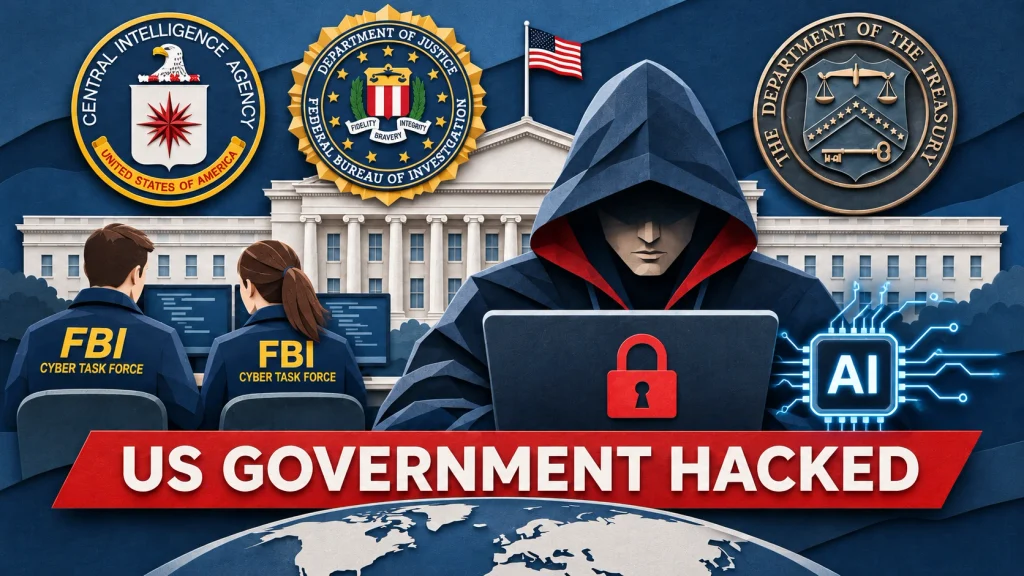
Sensitive intelligence systems, criminal justice databases and federal infrastructure have been targeted in a series of cybersecurity incidents, raising concerns over national security, data exposure and AI-powered cyber threats.
Published: November 25, 2026
By: CyberNexora | International News
WASHINGTON — The United States is confronting a series of cybersecurity incidents involving some of its most sensitive government institutions, including the Central Intelligence Agency (CIA), Federal Bureau of Investigation (FBI), Office of the Director of National Intelligence (ODNI), Department of Defense and US Treasury Department.
The latest disclosures follow several months of reported federal government breaches, suspected cyberattacks and sensitive data exposures involving intelligence agencies, military personnel and law enforcement infrastructure.
While authorities have acknowledged several incidents, the identities of the attackers, the full extent of the compromised information and the potential national security consequences remain unclear.
CIA and ODNI Intelligence Systems Breached
On November 24, reports from Reuters, Associated Press and The Washington Post revealed that an intelligence analysis system used by the CIA and ODNI had suffered a cybersecurity breach.
The compromised environment supported Open-Source Intelligence (OSINT) operations, allowing intelligence analysts to examine publicly and commercially available information from digital platforms, satellite imagery and other sources.
The National Geospatial-Intelligence Agency (NGA) was also reportedly affected.
According to individuals familiar with the incident, classified systems remained unaffected, and the immediate security issue had been resolved.
However, authorities have not publicly identified the attackers, disclosed the initial security vulnerability or provided a detailed account of the information accessed.
Although the compromised environment was unclassified, such systems can contain sensitive analytical information. Depending on the scope of the intrusion, attackers could potentially gain insight into American intelligence priorities, monitoring activities and areas of investigation.
The CIA declined to comment when approached by Nextgov/FCW. A comprehensive public forensic report has not been released.
FBI Investigates Breach of National Criminal Database
The FBI is separately investigating an intrusion involving its National Crime Information Center (NCIC), a nationwide criminal justice information system used by federal, state and local law enforcement agencies.
The database contains criminal history information, arrest warrants, records of missing persons, wanted individuals and stolen property.
On November 24, FBI Director Kash Patel acknowledged that an investigation was ongoing but declined to identify those responsible or disclose what information may have been obtained.
There is currently no publicly confirmed figure for the number of compromised records.
Authorities have also not established publicly whether the attackers merely accessed information, extracted criminal justice records or modified existing data.
Any confirmed compromise of sensitive law enforcement information could carry significant consequences for criminal investigations, individual privacy and public safety.
The incident follows a separate security investigation involving the FBI’s recruitment infrastructure earlier this year.
In September, the cybercriminal group ShinyHunters claimed to have obtained between two and three terabytes of information associated with FBI personnel, job applicants and Department of Justice employees.
The FBI acknowledged the allegations and launched an investigation. The full volume of data claimed by the group has not been independently verified.
No public evidence links ShinyHunters to the latest NCIC or CIA incidents.
US Treasury Confirms Unauthorized System Access
The US Treasury Department’s Financial Crimes Enforcement Network (FinCEN) disclosed a cybersecurity incident on November 24 involving unauthorized access to part of its infrastructure.
FinCEN took certain services offline as a precaution while investigating the compromise.
The agency plays a central role in combating money laundering, terrorist financing, financial fraud and other illicit financial activities.
Its systems support the collection and analysis of sensitive financial reports submitted by financial institutions.
The agency confirmed that its Bank Secrecy Act electronic filing system remained operational and introduced temporary filing relief for affected institutions.
However, FinCEN has not publicly identified the attackers or confirmed whether confidential financial intelligence, transaction records or suspicious activity reports were stolen.
The incident adds to concerns surrounding the security of American financial intelligence infrastructure.
Pentagon Faces Multiple Cybersecurity Incidents
The US Department of Defense has also been affected by separate cybersecurity incidents involving military personnel information and cyber defence infrastructure.
According to Nextgov/FCW, hackers recently infiltrated the Pentagon’s Cyber Defense Command (DCDC), an organisation involved in protecting defence-related digital systems.
An individual familiar with the incident described its impact as limited. Reports suggest an AI-powered penetration testing framework may have been involved.
The exact systems compromised and whether sensitive defence information was extracted remain undisclosed.
The reported intrusion follows a significant data breach involving the Defense Manpower Data Center (DMDC), disclosed in September.
A Pentagon official confirmed that the earlier incident exposed personal information belonging to more than three million living and deceased individuals associated with the US military.
The exposed information included names, contact details, dates of birth, Social Security numbers and military employment information, although the affected data varied by individual.
Unauthorized users reportedly had access to the information between October 2025 and July 2026.
The Pentagon said it had initiated cybersecurity and privacy response measures. It did not publicly identify the individuals responsible for the unauthorized access.
The military personnel breach and the latest Cyber Defense Command intrusion are separate incidents.
Homeland Security Personnel Data Published Online
On October 28, Reuters reported that a transparency website had published information reportedly associated with more than 40,000 Department of Homeland Security (DHS) employees.
The published dataset contained information concerning personnel working in sensitive government roles, including surveillance and intelligence-related activities.
Reuters independently matched information belonging to several individuals but was unable to authenticate the entire dataset.
A group identifying itself as Department of Peace claimed responsibility for obtaining the information.
The Department of Homeland Security subsequently sought to restrict access to the published material, citing potential risks to government personnel.
The full origin of the dataset and the technical circumstances surrounding its exposure remain unclear.
Cyber Incidents Disrupt Agriculture and Election Infrastructure
The Department of Agriculture (USDA) was also affected by a recent cybersecurity incident that forced officials to take several applications offline.
The disruption affected financial systems used to support payments and assistance for American farmers.
Authorities have not publicly confirmed the categories or volume of information potentially extracted.
Separately, the Federal Election Commission (FEC) experienced a cyberattack in late October that temporarily disrupted its electronic filing infrastructure ahead of the November 3 midterm elections.
The disruption prevented the timely disclosure of certain campaign finance information. Reuters reported that the affected filing system was restored following approximately 41 hours of downtime.
There is no verified evidence that voting machines, ballots or election results were compromised through this incident.
AI-Powered Hacking Framework Emerges as a Major Concern
Investigators and cybersecurity researchers are examining the growing role of artificial intelligence in cyberattacks against government and private-sector infrastructure.
Media reports have suggested that ARTEX, an autonomous AI-powered penetration testing framework, may have been used in the CIA intelligence system breach and the Pentagon Cyber Defense Command intrusion.
On November 13, the FBI issued a cybersecurity advisory warning about the malicious use of ARTEX against organisations across multiple industries, including government, defence, finance, healthcare and technology.
AI-assisted security tools can accelerate vulnerability identification and automate parts of the security testing process. When misused, these capabilities can significantly increase the speed and scale of cyber intrusions.
However, US authorities have not released a public forensic assessment conclusively establishing the framework’s involvement in the latest CIA breach.
The reported use of AI does not establish the identity, nationality or government affiliation of the attackers.
What Data Has Actually Been Exposed?
The most substantial publicly reported exposures include personal information associated with more than three million individuals connected to the US military and a dataset reportedly covering over 40,000 Homeland Security employees.
The ShinyHunters claim involving up to three terabytes of FBI-related information remains subject to independent verification.
In contrast, the exact information accessed during the latest CIA, FBI NCIC, Pentagon Cyber Defense Command and FinCEN incidents has not been publicly disclosed.
There is no verified public evidence that classified CIA intelligence, nuclear weapons information, military operational plans or classified national security documents were stolen in these latest incidents.
The distinction between unauthorized access, confirmed data exposure and verified data theft remains critical to understanding the scale of the breaches.
US Government Faces Questions Over Limited Disclosure
Federal agencies have disclosed only limited information about several of the recent cybersecurity incidents.
Key details, including the attackers’ identities, entry methods, duration of unauthorized access, affected records and the complete forensic findings, remain unavailable to the public.
The FBI has cited its ongoing investigation when declining to provide further information. The CIA has declined media requests for comment, while FinCEN has confirmed unauthorized access without revealing the full scope of the compromise.
Although restrictions on disclosure may be necessary during active investigations, the lack of detailed public information leaves significant questions about the effectiveness of federal cybersecurity controls and the potential impact on national security.
At present, there is no independently verified evidence that the US government is deliberately concealing a confirmed classified intelligence leak.
Are the Cyberattacks Connected?
The timing of the incidents has raised concerns about a broader campaign targeting American government infrastructure.
However, no publicly available evidence establishes that the CIA, FBI, Pentagon, Treasury and other federal incidents were conducted by a single hacking group or foreign government.
Recent technology outages have also contributed to speculation about a coordinated cyber offensive.
An outage affecting the National Security Agency’s classified communications network was attributed by US officials to software patching rather than malicious cyber activity.
Similar disruptions affecting aviation and financial services have not been established as part of the reported government breaches.
As investigations continue, authorities have yet to provide a comprehensive assessment of whether any of the recent federal intrusions share common attackers or technical origins.
The full national security implications will depend on what information was accessed, whether it was extracted and whether investigators uncover further compromises across federal infrastructure.
Frequently Asked Questions
Was the CIA really hacked?
Multiple credible news organisations reported that an unclassified intelligence analysis system used by the CIA and ODNI was breached. According to sources familiar with the incident, classified systems were unaffected.
What information was stolen from the FBI?
The FBI is investigating an intrusion involving its National Crime Information Center. The exact records accessed or stolen have not been publicly confirmed. A separate earlier incident involved alleged exposure of FBI employee and applicant information.
How much US government data has been leaked?
A Pentagon personnel data breach exposed information associated with more than three million individuals. Another dataset reportedly contained information on over 40,000 DHS employees. The total volume of data compromised across all recent government incidents remains unknown.
Was artificial intelligence used in the US cyberattacks?
Media reports suggest that ARTEX, an AI-powered penetration testing framework, may have been involved in certain intelligence and defence system intrusions. The FBI has officially warned about its malicious use, but its involvement across all incidents remains unconfirmed.
Is the US government hiding classified data leaks?
There is no verified public evidence establishing a deliberate cover-up of classified intelligence theft. However, several federal agencies have not disclosed the complete scope of their breaches, and investigations remain ongoing.