
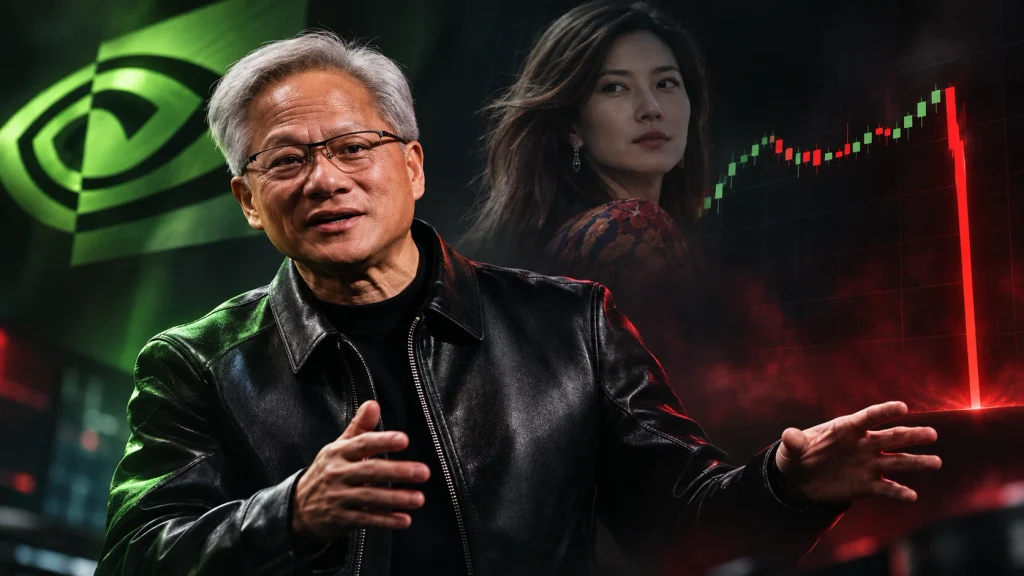
The Nvidia CEO Chinese spy allegations have raised serious questions about artificial intelligence security, foreign intelligence operations and the protection of sensitive U.S. semiconductor technology.
Nvidia founder and CEO Jensen Huang is facing scrutiny following reports about his relationship with Alice Huang, a Chinese businesswoman whom U.S. intelligence officials reportedly suspect of collecting information for Beijing.
The controversy has prompted an independent investigation by Nvidia’s board, attracted attention from U.S. lawmakers and renewed concerns over China’s access to advanced AI chips.
President Donald Trump has publicly defended Jensen Huang, saying the Nvidia chief executive told him he had no knowledge of the woman’s alleged intelligence activities.
However, no public finding has established that Nvidia’s confidential technology was stolen, that Jensen Huang knowingly assisted espionage or that a cyberattack occurred.
The case highlights an important challenge facing technology companies: protecting sensitive business information when commercial relationships, personal connections and international security interests intersect.
What Happened in the Nvidia CEO Chinese Spy Controversy?
The controversy intensified after The New York Times reported that U.S. intelligence officials believed Alice Huang, a business executive associated with Singapore-based Megaspeed International, had been collecting information for the Chinese government.
The reporting linked Alice Huang to Jensen Huang, Nvidia’s co-founder and longtime chief executive.
Jensen Huang subsequently acknowledged being unfaithful to his wife and apologized to his family and Nvidia employees.
Following the reports, Nvidia’s board announced an independent investigation to examine whether its CEO had been targeted by a foreign intelligence operation.
The company’s decision brought the matter beyond personal controversy and into discussions about corporate governance, information security and U.S. national security.
Nvidia is a major supplier of processors used in artificial intelligence, cloud computing and high-performance computing infrastructure. Consequently, allegations involving foreign intelligence interest in the company’s leadership have implications extending beyond Nvidia itself.
Who Is Alice Huang, the Businesswoman Named in the Reports?
Alice Huang, also identified in news reports as Huang Le, is a Chinese businesswoman and former executive associated with Megaspeed International, a Singapore-based company connected to AI computing infrastructure.
According to reporting by The New York Times, U.S. intelligence officials suspected that she was gathering information for Beijing.
Megaspeed has also faced scrutiny over allegations involving the movement of advanced Nvidia chips through international supply chains.
Alice Huang and Jensen Huang are not related, despite sharing the same surname.
The allegations surrounding Alice Huang remain contested. China’s Foreign Ministry has rejected the accusations, describing them as unsubstantiated.
The publicly available reporting does not establish that Alice Huang has been convicted of espionage or that the allegations have been proved in court.
This distinction is essential because intelligence assessments, investigative suspicions and legally established findings are not interchangeable.
Donald Trump Responds to Jensen Huang Spy Allegations
President Donald Trump addressed the controversy during a White House briefing on November 9.
Trump confirmed that he had spoken with Jensen Huang about the allegations and asked whether the Nvidia CEO knew the woman was allegedly connected to Chinese intelligence.
According to Trump, Huang said he had no idea she was a spy.
Trump publicly expressed confidence in Huang’s explanation and described him as an important figure in the American technology industry.
The president also acknowledged questions about when his administration first received intelligence concerning the alleged relationship.
Separate reporting by The New York Times described an intelligence-related memorandum prepared before Trump’s visit to Beijing, involving Secretary of State Marco Rubio.
Trump did not provide a definitive account of when he first became aware of the relevant intelligence.
The developments have generated questions about the relationship between government intelligence warnings, corporate executives and national security decision-making.
Is the FBI Investigating Nvidia CEO Jensen Huang?
Trump told reporters that the Federal Bureau of Investigation was looking into the matter.
Reuters and other news organizations reported his comments, but Trump’s statement should not be interpreted as confirmation that Jensen Huang has been charged with a crime.
The precise scope, status and potential conclusions of any federal investigation remain unclear from publicly available information.
Investigators examining possible foreign intelligence activity may seek to establish whether sensitive information was requested, shared or obtained.
They may also investigate whether individuals or businesses were involved in conduct that violated U.S. laws or export restrictions.
An investigation does not establish criminal wrongdoing.
At this stage, the public record does not support describing Jensen Huang as a convicted participant in an espionage operation.
Nvidia Board Launches Independent Investigation
Nvidia’s board initiated an independent investigation after reports raised concerns that its CEO might have been targeted by a foreign intelligence effort.
The company stated that it had no reason to believe national security information or Nvidia’s confidential secrets had been compromised.
Nevertheless, the board said the review would examine available information.
Jensen Huang remains Nvidia’s chief executive while the investigation continues and has committed to cooperating with the process.
The board’s response is significant from a corporate cybersecurity perspective.
Companies handling sensitive technology must assess potential risks to intellectual property, confidential communications, commercial relationships and executive access.
An independent review can help determine whether existing safeguards were sufficient and whether additional controls are required.
However, announcing an investigation is not the same as confirming that security defenses failed.
How Are Nvidia AI Chips Connected to the Allegations?
One of the most important aspects of the controversy concerns the international supply chain for Nvidia’s advanced AI processors.
Nvidia chips are widely used to train and operate large artificial intelligence models. Access to powerful computing hardware has consequently become an important factor in international technology competition.
The United States has imposed restrictions on the export of certain advanced semiconductor technologies to China, citing national security concerns.
Jensen Huang has publicly advocated allowing Nvidia to sell more chips in China under applicable government policies.
The allegations involving Alice Huang have brought fresh attention to the relationship between corporate sales, overseas intermediaries and export compliance.
On November 10, Reuters reported that The Information had published allegations concerning a network of businesses associated with Alice Huang and the movement of Nvidia chips to Chinese customers.
The Information’s report alleged that business relationships helped facilitate at least $7.5 billion in chip shipments. It also described approximately 240,000 Nvidia processors, including H100, H200 and A100 models, in connection with the reported network.
Reuters explicitly stated that it could not independently verify that report.
These figures therefore remain reported allegations rather than independently established findings.
Questions about whether specific shipments violated export restrictions require evidence concerning the relevant chips, transaction dates, destinations, applicable licenses and legal requirements.
The controversy does not establish that Nvidia itself knowingly authorized illegal shipments.
Why the Allegations Raise Cybersecurity and Espionage Concerns
The cybersecurity significance of this case extends beyond traditional hacking.
Foreign intelligence operations can potentially target companies through personal relationships, corporate partnerships, human intelligence and commercial intermediaries.
Unlike a conventional malware attack, an intelligence-gathering operation might seek information through ordinary conversations, legitimate meetings or trusted professional relationships.
Security professionals frequently describe the broader risk of trusted access being exploited as an insider threat.
A related concept is social engineering, in which individuals use deception or manipulation to obtain information or access.
These concepts help explain the possible security risks raised by the Nvidia controversy. They do not establish that Alice Huang used a particular technique or obtained protected Nvidia information.
Potential targets in an industrial espionage scenario could include product-development plans, customer relationships, supplier information, business strategy or confidential technical documentation.
For companies developing commercially valuable technology, understanding how information is shared and who can access it is an essential part of security governance.
CyberNexora previously examined related governance challenges in its article on AI security frameworks and cybersecurity policy.
The broader lesson is that protecting sensitive technology involves technical defenses and responsible management of human access.
Was Nvidia Hacked or Was Confidential Data Stolen?
There is an important distinction between an alleged intelligence operation and a confirmed cyber incident.
As of November 10, the public reporting reviewed for this article does not establish that Nvidia experienced a cyberattack connected to the allegations.
There is also no publicly confirmed finding that company source code, proprietary AI chip designs or confidential research were stolen through the reported relationship.
Nvidia’s board has specifically stated that it has no reason to believe company secrets or national security information were compromised.
That statement does not predetermine the outcome of its investigation, but it is important context.
The investigation could examine information security practices without ultimately finding evidence of unauthorized access or data theft.
Cybersecurity reporting should distinguish suspected exposure, reported espionage concerns and confirmed compromises.
CyberNexora has discussed the importance of separating verified incidents from emerging threat reports in its coverage of major cybersecurity incidents and security developments.
Accurate classification helps readers understand what is known without exaggerating the threat.
Why U.S. National Security Officials Are Concerned About AI Chips
Advanced semiconductors have become strategically important because they support powerful artificial intelligence systems.
AI computing infrastructure is used across scientific research, commercial applications, cybersecurity operations and advanced technological development.
Governments therefore view access to certain semiconductor capabilities as a matter of economic competitiveness and national security.
U.S. export controls are intended to restrict access to specified technologies and equipment under applicable regulations.
However, the rules are complex. Restrictions may vary depending on the processor model, performance characteristics, destination, end user and authorization requirements.
The Nvidia controversy has intensified scrutiny of whether existing oversight can adequately address security risks associated with international chip supply chains.
Some lawmakers have requested additional information about Nvidia’s security procedures and interactions involving Alice Huang.
According to Reuters, senior Republican lawmakers requested a closed-door briefing from Jensen Huang for November 18.
The request concerned national security risks and Nvidia’s safeguards against foreign espionage.
A request for congressional scrutiny should not be confused with a finding that the company violated the law.
Nvidia Faces Shareholder and Corporate Governance Questions
The controversy has also affected Nvidia’s financial and corporate environment.
Reuters reported that Nvidia and Jensen Huang were named in a proposed shareholder class-action lawsuit alleging that investors had been misled about the executive’s ties to a suspected Chinese intelligence operative.
The allegations in that lawsuit remain unproven.
Nvidia’s share price fell more than 4% on November 9 amid the developments.
For investors, the situation raises questions about leadership continuity, risk management and the handling of potentially sensitive intelligence-related concerns.
For cybersecurity professionals, it illustrates how a security investigation involving a senior executive can affect corporate governance even without a confirmed technical breach.
An effective response requires appropriate oversight, evidence preservation, legal review and clear communication.
How Technology Companies Can Reduce Corporate Espionage Risks
The Nvidia controversy offers a broader opportunity to examine how organizations protect their intellectual property and sensitive business relationships.
Technology companies frequently interact with suppliers, distributors, international partners, research institutions and government agencies.
Such relationships are necessary for ordinary business operations, but organizations should understand what information can be shared and under which conditions.
Access to confidential systems should follow the principle of least privilege, meaning individuals receive only the permissions needed for their responsibilities.
Companies should also establish clear classification policies for confidential technical and commercial information.
Sensitive documents, internal research, supplier agreements and product roadmaps may require enhanced monitoring and access restrictions.
Security awareness programs can help executives and employees recognize suspicious requests for information, unexpected contact attempts and efforts to bypass established procedures.
Organizations should also maintain practical methods for confidentially reporting potential security concerns.
Technical assessments remain important because foreign intelligence threats can overlap with conventional cyber risks.
CyberNexora explains these defensive practices in its guide to vulnerability assessment and penetration testing.
Vulnerability testing cannot prevent every intelligence-related risk, but it can help identify weaknesses that attackers might exploit to gain unauthorized technical access.
The strongest approach combines security controls, employee awareness, vendor oversight and independent governance.
How AI Technology and Intellectual Property Protection Are Connected
Artificial intelligence companies often possess valuable information beyond the physical chips they manufacture.
Sensitive assets may include proprietary software, optimization techniques, research data, hardware specifications and confidential engineering documentation.
The misuse of confidential information is different from legitimate independent research or lawful competitive development.
Understanding that distinction is particularly important as AI tools make software analysis and technical investigation more accessible.
For a related discussion, see CyberNexora’s coverage of AI reverse engineering and intellectual property concerns.
The Nvidia allegations have not established that such technologies were used to compromise the company. The connection is relevant as a broader information-security consideration.
What Happens Next in the Nvidia Investigation?
Several developments will determine how the situation evolves.
Nvidia’s independent investigation may produce additional findings concerning the reported relationship and any associated information-security risks.
U.S. authorities may provide further clarification about the scope of their inquiries.
Congressional scrutiny may also lead to additional questions about semiconductor exports, corporate security procedures and access to sensitive technologies.
Any future legal proceedings will need to be assessed separately from media allegations.
Until credible findings become public, it would be premature to conclude that Jensen Huang knowingly assisted a foreign intelligence operation or that Nvidia’s technology was compromised.
Frequently Asked Questions
Is Nvidia CEO Jensen Huang accused of being a Chinese spy?
Reports concern Jensen Huang’s relationship with a woman suspected by U.S. intelligence officials of gathering information for China. Public reporting does not establish that Jensen Huang himself was a Chinese spy or knowingly participated in espionage.
Who is Alice Huang?
Alice Huang, also known as Huang Le, is a Chinese businesswoman and former executive associated with Singapore-based Megaspeed International. U.S. intelligence officials reportedly suspect her of sharing information with Beijing. China disputes the allegation.
What did Donald Trump say about Jensen Huang?
Trump said he questioned Huang about whether he knew of the alleged intelligence connection. According to Trump, Huang denied having such knowledge, and the president expressed confidence in his explanation.
Has Nvidia confirmed a cybersecurity breach?
No. Nvidia has not publicly confirmed a cybersecurity breach connected to these allegations. Its board has stated that it has no reason to believe company secrets or national security information were compromised.
Why does the controversy matter for AI security?
Nvidia develops advanced processors used in AI computing. Concerns about potential foreign intelligence activity involving its leadership raise broader questions about intellectual property protection, semiconductor exports and corporate security governance.
Is the FBI investigating Jensen Huang?
Trump said the FBI was looking into the matter. However, the publicly reported comments do not establish that Jensen Huang has been criminally charged or that investigators have concluded he committed wrongdoing.
For continuing coverage of cybersecurity policy, AI security and global technology developments, visit CyberNexora News.