
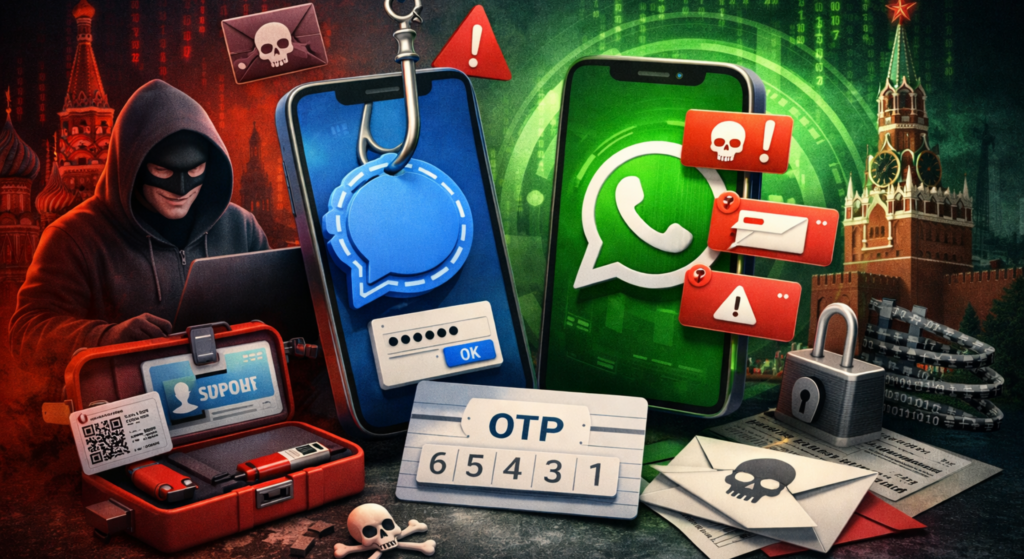
In a serious cybersecurity alert issued on March 21, 2026, the Federal Bureau of Investigation (FBI) and the Cybersecurity and Infrastructure Security Agency (CISA) warned about an ongoing phishing campaign targeting users of popular messaging applications like Signal and WhatsApp. The campaign is believed to be linked to threat actors associated with Russian intelligence services and has already resulted in the compromise of thousands of accounts worldwide.
Unlike traditional cyberattacks that exploit software vulnerabilities, this campaign relies entirely on social engineering techniques. Instead of breaking encryption or hacking the platform itself, attackers manipulate users into giving away access to their accounts. This makes the attack particularly dangerous, as even highly secure platforms can be compromised through human error.
The primary targets of this campaign include individuals with high intelligence value such as current and former government officials, military personnel, journalists, and political figures. However, the methods used are scalable, meaning regular users could also become victims if they are not cautious.
The attack typically begins with a phishing message where the attacker impersonates a trusted entity, such as “Signal Support” or a known contact. Victims are then asked to share their verification code (OTP) or PIN. In another variation, users are tricked into clicking malicious links or scanning QR codes. These actions allow attackers to link their own devices to the victim’s account or take full control of it.
There are two main outcomes depending on how the victim is tricked. If a user shares their verification code or PIN, the attacker can take over the account, locking the victim out and gaining access to future messages. On the other hand, if the victim scans a QR code or clicks a malicious link, the attacker may gain access to both past and current messages while the victim remains unaware of the breach.
Once access is obtained, attackers can read private conversations, access contact lists, and impersonate the victim to send messages to others. This enables further phishing attacks, creating a chain reaction that expands the reach of the campaign. Because the messages appear to come from a trusted source, the chances of success are significantly higher.
Cybersecurity agencies have emphasized that the encryption of platforms like Signal and WhatsApp remains intact. The attack does not exploit any weakness in the apps themselves but instead targets user behavior. This highlights a critical reality in modern cybersecurity: the human element is often the weakest link.
To protect against such attacks, users are strongly advised to never share their verification codes or PINs with anyone, regardless of how legitimate the request may appear. It is also important to avoid clicking on suspicious links or scanning QR codes from unknown sources. Regularly reviewing linked devices in app settings and removing any unrecognized devices can help prevent unauthorized access.
This incident reflects a growing trend in cyber warfare where nation-state actors are increasingly using social engineering to bypass technical defenses. As digital communication continues to expand, awareness and user education have become just as important as technological security measures.
In conclusion, the latest FBI warning serves as a reminder that even the most secure platforms can be compromised if users are not vigilant. Staying informed, cautious, and aware is the key to defending against modern cyber threats.