
Mobile applications have become a major part of modern life. People use Android and iOS apps for banking, healthcare, shopping, communication, education, and business operations. Because these applications process large amounts of sensitive personal and financial data, cybercriminals increasingly target insecure mobile applications to steal credentials, access private information, bypass authentication systems, and exploit vulnerable APIs.
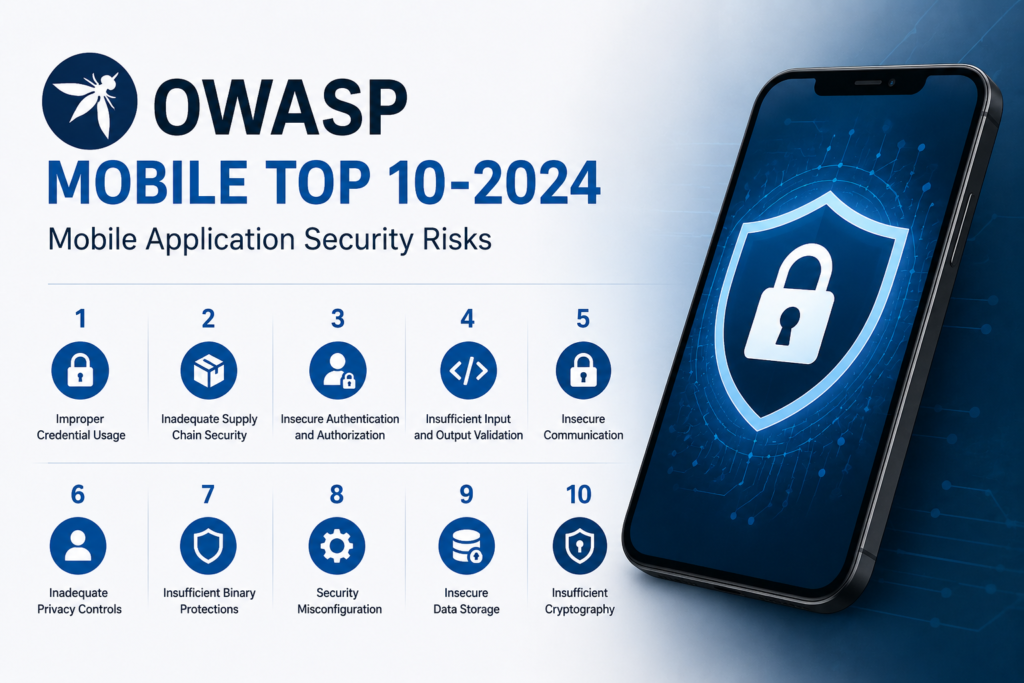
The OWASP Mobile Top 10-2024 highlights the most critical mobile application security risks affecting Android and iOS applications today. Cybersecurity professionals, mobile developers, penetration testers, and enterprise security teams use the OWASP Mobile Top 10 framework to identify dangerous vulnerabilities and improve overall mobile app security.
As mobile technology continues to evolve rapidly, mobile application security has become one of the most important areas in modern cybersecurity.
What is OWASP Mobile Top 10-2024?
OWASP is a globally recognized non-profit organization focused on improving software and application security. OWASP publishes security frameworks, awareness projects, Mobile Penetration Testing guides, and best practices used by cybersecurity professionals worldwide.
The OWASP Mobile Top 10 is a security framework designed to identify the most serious vulnerabilities commonly found in mobile applications.
The project mainly focuses on:
- Android application security
- iOS application security
- Mobile authentication systems
- Mobile API security
- Secure mobile development practices
- Mobile Penetration Testing
The primary goal of OWASP Mobile Top 10-2024 is simple:
Help organizations build secure mobile applications and reduce cyber attack risks.
Today, many organizations integrate OWASP Mobile standards into:
- Mobile penetration testing
- Security audits
- DevSecOps pipelines
- Application security programs
- Enterprise compliance requirements
Because mobile applications often store sensitive user information, even a small security weakness can lead to serious data breaches, account compromise, or unauthorized backend access.
Why OWASP Mobile Top 10-2024 Matters
Modern mobile applications process highly sensitive information every day, including:
- Banking and payment information
- Authentication tokens
- Usernames and passwords
- Personal identity data
- Business information
- Healthcare records
- Device and location data
If mobile applications are not properly secured, attackers may exploit vulnerabilities to:
- Steal sensitive information
- Hijack user accounts
- Access backend systems
- Intercept network communications
- Bypass authentication controls
- Exploit insecure APIs
This is why mobile application security is now a major priority for organizations worldwide.
The OWASP Mobile Top 10-2024 helps companies identify dangerous mobile security risks and strengthen their overall mobile security posture.
OWASP Mobile Top 10-2024 Security Risks
1. Improper Credential Usage
Many mobile applications insecurely store sensitive credentials such as passwords, API keys, and authentication tokens.
Common security issues include:
- Hardcoded credentials inside applications
- Weak password storage mechanisms
- Exposed API secrets
- Unsafe token management
Attackers can reverse engineer mobile apps and extract sensitive credentials to gain unauthorized access.
2. Inadequate Supply Chain Security
Modern mobile apps rely heavily on third-party SDKs, libraries, and frameworks.
If these components contain vulnerabilities or malicious code, the entire application becomes vulnerable.
Examples include:
- Vulnerable third-party SDKs
- Outdated dependencies
- Malicious software packages
- Compromised mobile frameworks
Supply-chain attacks continue to increase across the cybersecurity landscape.
3. Insecure Authentication and Authorization
Weak authentication systems can allow attackers to bypass login protections and compromise user accounts.
Common examples include:
- Weak password policies
- Missing multi-factor authentication
- Broken session management
- Improper access controls
These vulnerabilities often result in unauthorized account access and identity compromise.
4. Insufficient Input and Output Validation
Mobile applications frequently process user-controlled input through APIs and forms.
If validation mechanisms are weak, attackers may inject malicious payloads into backend systems.
Examples include:
- SQL Injection
- Command Injection
- API manipulation
- Unsafe deserialization
Proper input validation is critical for preventing backend compromise and sensitive data exposure.
5. Insecure Communication
Mobile applications constantly exchange data between devices and backend servers.
If communication channels are not properly secured, attackers may intercept or manipulate network traffic.
Common issues include:
- Missing HTTPS protection
- Weak TLS configurations
- Unencrypted API traffic
- Exposure to man-in-the-middle attacks
Secure communication is essential for protecting user privacy and sensitive business information.
6. Inadequate Privacy Controls
Weak privacy protections can expose sensitive user information without proper authorization.
Examples include:
- Excessive data collection
- Weak permission management
- Exposure of personal information
- Insecure location data handling
Privacy-related security failures may damage user trust and create legal compliance issues.
7. Insufficient Binary Protections
Mobile applications are frequently targeted through reverse engineering attacks.
Without strong binary protections, attackers may:
- Modify application behavior
- Bypass security controls
- Analyze source code
- Extract sensitive business logic
Common weaknesses include:
- Missing code obfuscation
- Lack of anti-tampering protection
- Weak runtime defenses
- Missing root or jailbreak detection
Strong binary protection reduces mobile application manipulation risks.
8. Security Misconfiguration
Incorrect security configurations remain one of the most common causes of mobile application vulnerabilities.
Examples include:
- Debug mode enabled in production
- Misconfigured cloud storage
- Unsafe default settings
- Exposed administrative interfaces
Even small configuration mistakes can expose sensitive systems to attackers.
9. Insecure Data Storage
Many mobile applications improperly store sensitive information on user devices.
Common examples include:
- Plain-text credential storage
- Insecure local databases
- Sensitive data stored in logs
- Weak encryption mechanisms
If a mobile device becomes compromised, attackers may easily extract stored data.
10. Insufficient Cryptography
Weak cryptographic implementations can expose highly sensitive information to attackers.
Examples include:
- Weak encryption algorithms
- Poor cryptographic key management
- Predictable encryption keys
- Broken encryption implementations
Strong cryptographic practices are essential for protecting sensitive user and business information.
OWASP Mobile Top 10-2024 for Mobile Penetration Testing
Mobile security is now one of the fastest-growing fields in cybersecurity. Many bug bounty programs, enterprise security assessments, and Mobile Penetration Testing projects heavily focus on Android and iOS applications.
Learning the OWASP Mobile Top 10-2024 helps cybersecurity students and professionals:
- Understand mobile attack techniques
- Learn Android and iOS security testing
- Practice API security testing
- Identify insecure authentication systems
- Analyze real-world mobile vulnerabilities
- Improve Mobile Penetration Testing skills
Many cybersecurity labs and training platforms also include mobile hacking challenges based on OWASP Mobile vulnerabilities.
Why Security Professionals Use OWASP Mobile Top 10-2024
Security professionals trust OWASP Mobile standards because they provide a globally recognized framework for mobile application security testing and risk management.
Organizations use OWASP Mobile Top 10-2024 to:
- Improve mobile application security
- Protect customer information
- Reduce cyber attack risks
- Perform security audits
- Train development teams
- Build secure Android and iOS applications
- Strengthen enterprise security posture
Because the framework is widely recognized across the cybersecurity industry, it helps organizations maintain consistent mobile security practices across different platforms and environments.
Final Thoughts
The OWASP Mobile Top 10-2024 remains one of the most important security frameworks for identifying and preventing mobile application vulnerabilities. As cyber threats targeting Android and iOS applications continue to grow, organizations must prioritize secure mobile development, Mobile Penetration Testing, API security, and strong authentication controls.
Understanding OWASP Mobile Top 10-2024 helps developers, cybersecurity students, penetration testers, and enterprise security teams reduce security risks, protect sensitive data, and build more secure mobile applications for modern users.
Frequently Asked Questions(FAQs)
The OWASP Mobile Top 10-2024 is a globally recognized security framework that identifies the most critical vulnerabilities affecting Android and iOS mobile applications. It helps developers, security teams, and penetration testers improve mobile app security and reduce cyber risks.
The framework highlights common mobile security weaknesses such as insecure authentication, insecure data storage, weak cryptography, and insecure communication. Organizations use it to identify vulnerabilities, strengthen defenses, and protect sensitive user data.
Mobile app developers, cybersecurity students, penetration testers, security researchers, DevSecOps engineers, and enterprise security teams can benefit from understanding the OWASP Mobile Top 10 to build and assess secure mobile applications.
Some of the most common risks include improper credential usage, insecure authentication and authorization, insecure data storage, inadequate supply chain security, insecure communication, security misconfigurations, and insufficient cryptography.
The framework provides a structured approach for identifying and testing mobile application vulnerabilities. Security professionals use it during Mobile Penetration Testing to evaluate authentication mechanisms, API security, data protection controls, and overall application resilience against cyberattacks.Accordion Content