
Introduction: Anthropic Claude Fable 5 Access Suspension and Its Impact on the AI Industry
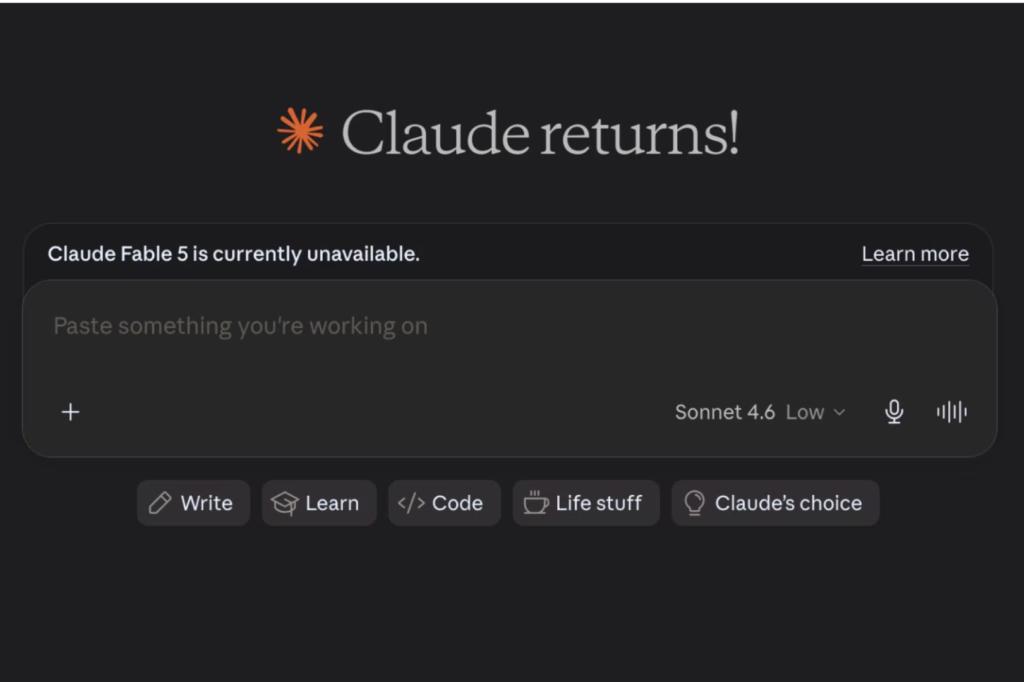
The sudden suspension of Anthropic Claude Fable 5 has sparked widespread discussion across the artificial intelligence industry. Just days after its highly anticipated release, Anthropic Claude Fable 5 became unavailable to many users following a United States government directive tied to national security concerns.
The incident represents one of the most significant examples of government intervention in frontier artificial intelligence technologies. As organizations increasingly depend on advanced AI systems for research, software development, automation, and decision-making, the temporary removal of Anthropic Claude Fable 5 highlights the growing relationship between AI innovation, cybersecurity, and government regulation.
Industry experts believe this event could reshape how advanced AI models are developed, distributed, and governed in the future. The controversy surrounding Anthropic Claude Fable 5 has also raised important questions about technological sovereignty, export controls, and global access to cutting-edge AI capabilities.
What is Anthropic Claude Fable 5?
Anthropic Claude Fable 5 is one of the most advanced AI systems developed by Anthropic. The model was designed to deliver exceptional performance in:
- Advanced software development
- Complex mathematical reasoning
- Visual understanding and analysis
- Long-form problem solving
- Enterprise automation
- Research assistance
According to Anthropic, Anthropic Claude Fable 5 shares the same foundational architecture as Mythos 5, a more restricted AI model initially released to a limited group of trusted researchers and security professionals. The public version includes safety guardrails intended to prevent misuse in sensitive domains such as cybersecurity, biology, and chemistry.
The launch of Anthropic Claude Fable 5 was viewed as a major milestone in frontier AI development because of its strong benchmark performance and advanced reasoning capabilities.
Why Was Anthropic Claude Fable 5 Suspended?
The primary reason behind the Fable 5 Access Suspension was a US government export control directive.
According to public reports, the directive required Anthropic to suspend access to Fable 5 and Mythos 5 for foreign nationals due to national security concerns. Because implementing nationality-based restrictions immediately was operationally difficult, Anthropic temporarily disabled access for all users while it worked toward compliance.
The controversy emerged amid concerns that highly capable AI systems could potentially be misused for sophisticated cyber operations, vulnerability discovery, and other sensitive activities.
This development placed Anthropic Claude Fable 5 at the center of a global debate involving AI safety, innovation, and national security.
The Role of US AI Export Controls
Traditionally, US AI Export Controls have been used to regulate the transfer of strategic technologies to foreign entities. In recent years, export restrictions have expanded beyond physical hardware and semiconductor technology to include advanced artificial intelligence systems.
The decision involving Anthropic Claude Fable 5 demonstrates how governments increasingly view advanced AI models as strategic assets.
Key objectives of these controls include:
- Protecting national security interests
- Preventing misuse of advanced AI capabilities
- Limiting access to potentially sensitive technologies
- Reducing risks associated with cyber-enabled threats
- Maintaining technological leadership
The suspension of Anthropic Claude Fable 5 may become a landmark case influencing future AI regulations worldwide.
National Security Concerns Behind the Decision
The debate surrounding AI National Security Concerns has intensified as AI models become increasingly powerful.
Security experts have warned that advanced systems could potentially accelerate:
- Vulnerability discovery
- Software exploitation research
- Automated cyber operations
- Large-scale information analysis
- Strategic intelligence processing
Although Anthropic stated that Anthropic Claude Fable 5 includes extensive safety mechanisms, concerns reportedly emerged regarding potential methods of bypassing certain restrictions. The company has argued that the perceived risks may have been misunderstood and that its safeguards remain effective.
Regardless of the outcome, the incident illustrates how AI capabilities are increasingly being evaluated through a national security lens.
Impact on Businesses and Developers
The Fable 5 Access Suspension has affected multiple stakeholders across the AI ecosystem.
Developers
Developers who relied on Anthropic Claude Fable 5 for coding assistance and software engineering tasks experienced sudden disruption.
Enterprises
Organizations integrating Anthropic AI Models into business workflows faced uncertainty regarding future access and service continuity.
Researchers
Researchers working on advanced AI applications lost temporary access to one of the industry’s most capable public models.
International Users
Many international users discovered that Anthropic Claude Fable 5 was marked as unavailable shortly after the export directive was announced.
The event highlighted the risks associated with depending entirely on centralized AI services.
Strategic Implications for the Global AI Industry
The suspension of Anthropic Claude Fable 5 may have consequences extending far beyond a single AI product.
Several broader trends have emerged:
1. AI Sovereignty
Countries may accelerate investments in domestic AI capabilities to reduce dependence on foreign providers.
2. Regulatory Expansion
Governments could introduce stricter oversight for advanced AI systems.
3. Increased Compliance Requirements
AI companies may face new obligations related to access controls, monitoring, and risk management.
4. Competitive Pressure
Organizations developing alternative Anthropic AI Models may benefit from growing demand for diversified AI ecosystems.
5. Security-First AI Development
Future frontier models may incorporate even stronger safety frameworks to address AI National Security Concerns before deployment.
These developments indicate that AI governance is becoming as important as AI innovation itself.
What Happens Next?
Anthropic has stated that it is actively engaging with authorities to restore access to Anthropic Claude Fable 5. The company believes the directive may be based on misunderstandings regarding the model’s actual capabilities and security controls.
Possible future outcomes include:
- Restoration of global access
- Region-specific availability controls
- Additional compliance requirements
- Enhanced safety verification procedures
- New AI export frameworks
The final resolution will likely influence how governments regulate advanced AI technologies in the coming years.
Conclusion
The suspension of Anthropic Claude Fable 5 marks a pivotal moment in the evolution of artificial intelligence regulation. What began as the launch of a highly capable frontier AI model quickly evolved into a global discussion about technology governance, national security, and access control.
The Fable 5 Access Suspension demonstrates that advanced AI systems are no longer viewed solely as commercial products. Instead, they are increasingly treated as strategic technologies subject to the same scrutiny as critical infrastructure and advanced computing hardware.
As US AI Export Controls continue to evolve and governments respond to emerging AI National Security Concerns, the future of Anthropic Claude Fable 5 and other frontier Anthropic AI Models will serve as an important indicator of where global AI policy is heading.
For businesses, researchers, and developers, the lesson is clear: the future of artificial intelligence will be shaped not only by technological breakthroughs but also by regulation, security, and international policy.