
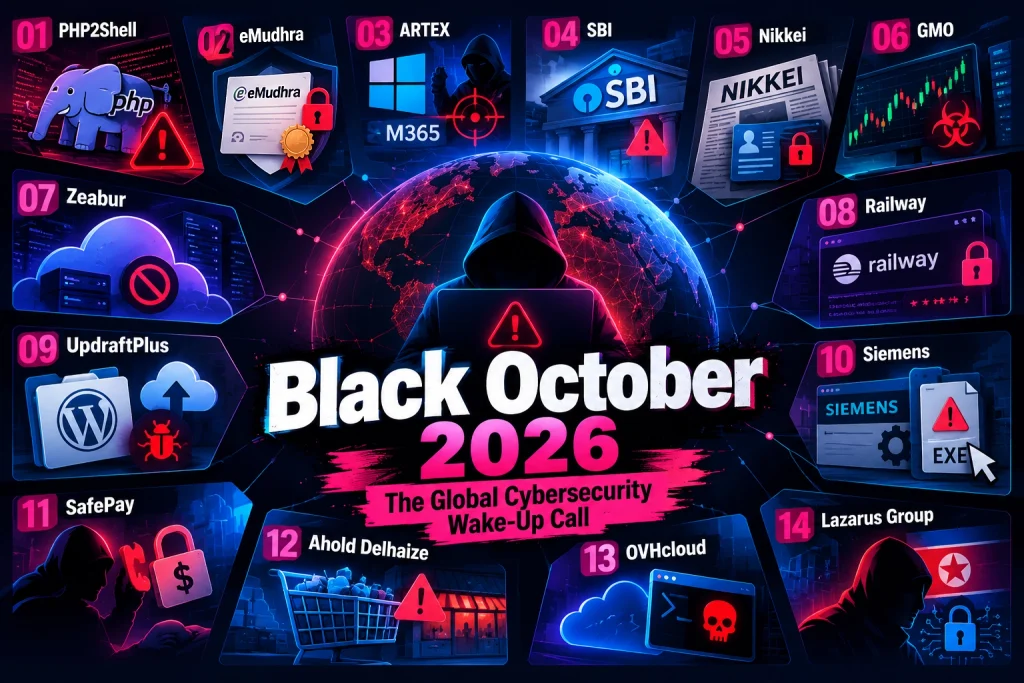
October 2026 has brought a dense series of cybersecurity disclosures, software vulnerabilities, data exposures and infrastructure incidents into public view. From critical PHP vulnerabilities and compromised certificate authority keys to cloud-platform security incidents, ransomware warnings and software supply-chain attacks, these developments highlight how a weakness in one trusted component can create risks across an entire digital ecosystem.
The term “Black October” is being used to describe this concentration of cybersecurity events. It should not be interpreted as the name of one confirmed, coordinated global cyberattack. The incidents discussed below have different causes, timelines, affected systems and levels of confirmation.
Some involve confirmed unauthorized access. Others involve potentially exposed data, security vulnerabilities or campaigns that began before October. Distinguishing these categories is essential to understanding the actual risk.
Here are 14 incidents and security developments that deserve attention from business leaders, technology teams and cybersecurity professionals.
1. PHP2Shell: Critical PHP Vulnerabilities Require Immediate Patching
Two critical PHP vulnerabilities, CVE-2026-109618 and CVE-2026-109619, were disclosed on October 21, 2026, under the name PHP2Shell. According to the PHP development team, successful exploitation could allow unauthenticated remote code execution. The vulnerabilities may also create risks involving memory access and service availability.
PHP powers websites and applications across a wide range of hosting environments, making vulnerable installations an important concern for website owners, hosting providers and development teams.
Security telemetry reported rapid scanning and exploitation attempts following disclosure. However, reports of attempted exploitation should not automatically be treated as confirmation that attackers successfully compromised vulnerable websites.
The response is clear: identify affected PHP installations, apply the official security updates and verify that the updated runtime is actually running. The released fixes include PHP 8.5.12, 8.4.27, 8.3.36 and 8.2.35. Systems using older or unsupported branches should consult their hosting provider or vendor for the appropriate security update.
The European cybersecurity agencies also urged organizations to prioritize internet-facing systems in their joint statement on the PHP vulnerabilities.
Key lesson: A patch is only effective when it is applied to the affected system and the updated service is running.
2. eMudhra: Weak Certificate Authority Keys Trigger Trust Concerns
A security disclosure involving eMudhra raised concerns about the cryptographic integrity of digital certificates trusted by browsers and other software.
On October 17, a researcher reported that private keys associated with eight eMudhra intermediate Certificate Authorities had been generated with insufficient cryptographic randomness. Such weak keys could potentially allow someone to recover private keys and create fraudulent certificates capable of impersonating websites or services.
eMudhra said it revoked the affected intermediate authorities and reported that no end-entity certificates had been issued from the affected intermediates. The company also said it had found no evidence of infrastructure compromise or a data breach.
Google’s security update describes the blocking measures applied to protect Chrome and Android users. Other browser and operating-system trust-store operators also took action.
This incident is primarily a digital trust and certificate-security issue, not evidence that eight websites were hacked or that customer databases were stolen.
Key lesson: Digital certificates are only as trustworthy as the cryptographic processes and controls behind them.
3. ARTEX: AI-Assisted Activity Targets Microsoft 365 Environments
Microsoft reported activity involving ARTEX, an agentic AI penetration-testing framework used by the China-state-aligned threat actor Storm-0940 to accelerate reconnaissance and attacks against downstream organizations.
According to Microsoft Security, the activity reached more than 2,250 Microsoft 365 tenants. A detailed subset involved password-spraying activity targeting 327 accounts across eight organizations.
The distinction matters: reaching or targeting a tenant does not mean every tenant was compromised. Microsoft also notes that the presence of affected applications or successful authentication does not by itself prove that customer data was accessed or exfiltrated.
The campaign illustrates how automated tools can accelerate reconnaissance, password attacks and the abuse of applications that already have access to cloud environments. In some investigated environments, attackers obtained privileged access rapidly.
Organizations should review unusual application sign-ins, unexpected OAuth credential changes, service-principal activity and suspicious privilege modifications. Strong, phishing-resistant multifactor authentication and tightly controlled application permissions remain important safeguards.
Key lesson: AI can accelerate an attack, but weak identity controls and excessive application permissions can determine how far it goes.
4. SBI: 3,897 Customer Records Identified in Dark-Web Data Review
India’s State Bank of India investigated a suspected customer-data exposure after receiving alerts on October 16 from its threat-intelligence service provider, the Defence Cyber Agency and CERT-In.
SBI’s preliminary analysis reviewed approximately 375,000 records reportedly available on the dark web and identified 3,897 customer records containing personally identifiable information. Reported information included names, registered mobile numbers, dates of birth, email addresses, residential addresses, customer identifiers and loan-related details.
The figures must be interpreted carefully. The 375,000 figure describes the dataset reviewed; it does not mean 375,000 confirmed SBI customers were affected. The investigation is intended to establish the authenticity, source and full extent of the records.
SBI activated its incident-response procedures and engaged an independent cybersecurity agency. The bank stated that its core operations, financial performance and business continuity remained unaffected.
The incident highlights how personal information can increase the risk of targeted phishing and impersonation, even when there is no public confirmation that banking passwords, PINs or transaction credentials were exposed.
See the Reuters report on SBI’s investigation.
Key lesson: A suspected data exposure requires investigation and clear communication-not assumptions about the number of affected customers.
5. Nikkei: Stolen Credentials Expose 1.83 Million Records
Japanese media company Nikkei disclosed unauthorized access to a cloud service used for system development. According to the company, attackers used previously compromised credentials to access the service on October 7.
The incident involved approximately 1.83 million records. However, not all records contained personally identifying information. About 1.68 million reportedly contained information that could not identify individuals. Approximately 150,000 records contained personal information such as names, addresses, email addresses, telephone numbers or dates of birth, while about 120,000 included email addresses.
Nikkei said credit-card information was not involved. As of October 16, it had found no evidence that the personal information had been misused, and it reported no service disruption or data tampering from the incident.
The case demonstrates how stolen credentials can provide access to cloud systems without requiring attackers to exploit a new software vulnerability.
Organizations should use multifactor authentication, restrict access to development environments, monitor unusual cloud logins and revoke credentials as soon as compromise is suspected.
Read more in SecurityWeek’s report on the Nikkei incident.
Key lesson: Identity security is a critical part of cloud security. A stolen login can undermine otherwise well-protected infrastructure.
6. GMO Internet: Malware Found on Customer Cloud Servers
GMO Internet confirmed unauthorized access involving its Onamae.com Desktop Cloud service in Japan. The company reported that malicious programs had been installed in some customer server environments.
GMO identified 26,739 servers as potentially affected. This is the potential scope, not a confirmed count of servers successfully compromised. Information stored on the servers may have been viewed, and a subsequent company update warned that trading-account credentials saved in trading tools might have been exposed.
As a precaution, GMO suspended the affected service while investigating with external cybersecurity specialists. Customers were advised to change potentially exposed credentials, disconnect trading sessions and remain alert for phishing or fraudulent communications.
The incident highlights the risks associated with hosting sensitive credentials on remote servers. A compromise of a cloud environment can affect credentials used to access other services, even when those other services have not themselves been breached.
See GMO Internet’s incident notice and its follow-up update.
Key lesson: Do not assume that credentials stored on a cloud server are safe simply because they belong to a separate application.
7. Zeabur: Security Incidents Followed by a Shutdown Announcement
Cloud deployment platform Zeabur disclosed unauthorized access to its internal systems and some customer services on October 14. The company said this second security incident affected a broader scope than an earlier incident in August, while noting that its investigation remained ongoing.
On October 17, Zeabur announced that it would wind down its services. According to its official announcement, some services would begin shutting down on December 1, 2026, with all dedicated servers and shared clusters scheduled to stop operating by December 31.
The company said that migration assistance and data-export arrangements were being addressed, with certain final deadlines still to be announced.
The announcement is especially significant for developers and businesses that host production applications, databases or customer-facing services on the platform. They should not wait until the shutdown dates to begin preparing a migration.
Organizations using Zeabur should inventory their deployed applications, databases, domains, environment variables, storage and external integrations. Before migrating, they should also review credentials and rotate any secrets that may have been exposed.
Key lesson: Security incidents and service shutdowns require a continuity plan that protects both data and business operations.
8. Railway: Customer Environment Variables Potentially Exposed
Developer platform Railway disclosed suspicious activity involving systems that store customer environment variables on October 21.
Railway’s initial investigation indicated that an unauthorized third party may have accessed encrypted environment variables and obtained the decrypted contents of some of them. Environment variables can contain sensitive information such as API keys, database credentials and private registry credentials.
The company said the initial analysis suggested that the impact might be limited to a subset of users, but it recommended that all users take precautionary action while the investigation continued.
Railway advised users to rotate environment variables and related secrets, review service logs for unusual activity and check connected systems for unauthorized use. Its notice also said the incident might be part of a series of attacks targeting platform companies and AI inference providers; this was the company’s assessment, not proof that every related platform had been compromised.
Read Railway’s official security disclosure.
Key lesson: Secrets should be protected, monitored and rotated-not treated as permanently safe merely because they are stored in a managed platform.
9. UpdraftPlus: Compromised Management Keys Used Against WordPress Sites
The company behind UpdraftPlus, a widely used WordPress backup plugin, disclosed unauthorized access to its website over the October 17–18 weekend.
According to TeamUpdraft’s incident report, the attacker used a compromised key to access the company’s site. Investigators also reported that stolen UpdraftCentral connection keys were used to send commands to connected WordPress installations, including commands to create unexpected users or install malicious plugins.
This was not proof that every WordPress website using UpdraftPlus had been compromised. The risk was particularly relevant to sites connected through the affected remote-management system, although the company advised users to check their sites for suspicious activity.
TeamUpdraft released updates to revoke affected UpdraftCentral connection keys. Website administrators should ensure they are running the current version, review unexpected users and plugins, inspect logs and investigate any unfamiliar connected site or administrative activity.
Key lesson: Trusted remote-management features can become an attack path when their credentials are compromised.
10. Siemens Software Center: Attackers Abused a Genuine Signed Application
Siemens confirmed active exploitation of CVE-2026-110936, a DLL side-loading vulnerability in Siemens Software Center.
In the reported attack, criminals used a genuine, digitally signed copy of Siemens Software Center alongside malicious files. The vulnerable application could load a DLL from its local folder without adequately validating it, allowing the malicious code to execute while the legitimate application remained unmodified.
Siemens stated that it had no evidence that its own systems, products or update channel had been breached. The vendor fixed the vulnerability in Siemens Software Center version 4.0.9.8.
Some security reporting linked the wider activity to ClickFix-style lures, which deceive users with fake verification prompts. The core vendor-confirmed Siemens issue, however, was the application’s unsafe DLL-loading behaviour.
Organizations using the software should update to the fixed version and investigate unexpected installations or suspicious endpoint activity.
See Siemens ProductCERT’s advisory.
Key lesson: A valid digital signature establishes the identity of signed software; it does not guarantee that every file loaded by that software is safe.
11. SafePay: Ransomware Threat Remains a Serious Business Risk
On October 20, CISA, the FBI, the U.S. Secret Service and international partners issued a joint advisory concerning SafePay ransomware.
The advisory states that SafePay has affected at least 600 organizations since August 2024 across multiple critical-infrastructure sectors and regions. This is a cumulative figure covering a longer period, not 600 new victims in October 2026.
The agencies describe several ways attackers gain initial access, including exposed credentials, brute-force password attacks and exploitation of VPN access. The advisory provides defensive recommendations, indicators of compromise and incident-response guidance.
Businesses should prioritize timely security updates for internet-facing systems, phishing-resistant MFA where supported, restricted remote access, endpoint monitoring and tested offline or immutable backups. Organizations should also prepare a response process for suspected ransomware incidents rather than waiting until operations are disrupted.
Read the joint CISA/FBI SafePay advisory.
Key lesson: Ransomware resilience depends on preventing initial access, detecting suspicious activity early and being able to restore systems safely.
12. Ahold Delhaize: Retail Websites and Apps Taken Offline
Retail group Ahold Delhaize disclosed a cybersecurity incident on October 12 after detecting suspicious activity in its IT infrastructure. The company took certain systems offline as a precaution, affecting websites and apps for many of its brands across Europe and the United States.
In its October 19 update, the company said its investigation had confirmed malicious actions by others. Its physical stores remained open, although digital services and online operations experienced disruption. In an earlier update, the company said it had no evidence at that time that customer, associate or partner data had been taken.
The public updates did not establish a confirmed attacker identity or prove that customer data had been stolen. The impact was primarily visible in service availability and the work required to restore affected systems safely.
The incident illustrates the operational consequences of a cyber event at a company that depends on interconnected IT systems, retail operations and digital services.
See Ahold Delhaize’s incident update.
Key lesson: Taking systems offline can be a necessary containment measure. Businesses need plans that protect infrastructure while keeping essential services running where possible.
13. OVHcloud CLI: Malicious Binaries Replaced Legitimate Releases
OVHcloud disclosed a software supply-chain incident involving its command-line interface (CLI). According to the project’s official GitHub security advisory, a compromised developer account was used to replace released binaries with malicious versions.
The affected release assets were available during a window of approximately 94 minutes on October 19, 2026, between 14:47 and 16:21 UTC+2. The affected assets were associated with versions v0.11.0 through v0.15.0, but the advisory specifies that users who downloaded those releases before the incident window were not affected by this particular replacement.
The project stated that its source code and build chain were not affected and that release v0.16.0 was unaffected.
This incident shows that software supply-chain risk extends beyond vulnerable source code. Attackers may target the distribution process so that users unknowingly download malicious files from a normally trusted project.
Users who downloaded the CLI during the specified window should follow the official advisory to assess the installation and replace potentially compromised binaries. If the malicious binary was executed, exposed secrets should be reviewed and rotated.
Key lesson: Verify the origin and integrity of downloaded software, especially when a vendor reports that release assets were replaced.
14. Lazarus: Post-Quantum Cryptography Appears in Malware Communications
On October 21, Kaspersky published findings about Operation FlashHole, a cyberespionage campaign attributed to the Lazarus group. Researchers reported that the campaign had been active since at least July 2025 and had affected at least three organizations in South Korea across several sectors.
The activity involved spear-phishing, abuse of legitimate software and updated malware. One notable finding was the use of ML-KEM-1024, a post-quantum cryptographic mechanism, to establish an encrypted connection between malware and attacker-controlled infrastructure before additional payloads were downloaded.
This detail is important, but it should not be misinterpreted. The reporting describes post-quantum cryptography being used to protect malware communications. It does not establish that the malware used quantum computing to break encryption or that it was a ransomware campaign locking victims’ files with post-quantum encryption.
The case demonstrates how advanced cryptographic standards can be used by both defenders and threat actors. Detection must therefore consider suspicious processes, persistence, unusual outbound connections and malicious behaviour-not just whether a connection is encrypted.
Read Kaspersky’s research announcement.
Key lesson: Encryption is a technology, not a guarantee of good intent. Security monitoring must evaluate what is communicating, where it is communicating and why.
What Connects These 14 Cybersecurity Developments?
These incidents are not evidence of one common attacker or a single coordinated campaign. Together, however, they reveal several recurring security challenges.
1. Credentials remain a critical weakness
The Railway, Nikkei and ARTEX cases highlight how access tokens, environment variables, stolen credentials and overly powerful applications can create opportunities for attackers.
Organizations should enforce MFA, reduce unnecessary privileges, rotate exposed secrets and monitor identity activity continuously.
2. Software supply chains need stronger protection
The OVHcloud CLI and UpdraftPlus cases show how trusted distribution or remote-management mechanisms can become attack paths.
Businesses should protect developer accounts, restrict release permissions, verify artifacts and monitor privileged software-management operations.
3. Patching must be timely and verified
PHP2Shell and Siemens demonstrate why security updates cannot be postponed indefinitely. Organizations need an accurate inventory of externally accessible systems, a documented patching process and verification that fixes are active.
4. Trust must be continuously validated
The eMudhra incident demonstrates that certificates and cryptographic systems can develop weaknesses even when they are part of established trust infrastructure.
Trust decisions should be supported by sound cryptography, effective revocation, system monitoring and reliable incident-response processes.
5. Cybersecurity must protect business continuity
The Ahold Delhaize, GMO and Zeabur incidents show that cybersecurity can affect availability, customer experience, vendor dependency and the ability to operate.
Backups, tested recovery procedures, supplier-risk assessments and clear communication plans are essential parts of resilience.
What Should Businesses Do Now?
Organizations do not need to react to every headline in the same way. They need to determine which systems, services and credentials they actually use and then apply the relevant controls.
- Review exposure: Inventory internet-facing websites, PHP deployments, cloud services, WordPress installations and development tools.
- Patch relevant systems: Apply official fixes for affected PHP and Siemens software versions, along with other security updates relevant to the organization’s technology stack.
- Rotate exposed secrets: Replace potentially affected API keys, environment variables, access tokens and credentials. Review related accounts and services for misuse.
- Strengthen identity security: Enable phishing-resistant MFA where available, review cloud application permissions and investigate unfamiliar sign-ins or privilege changes.
- Check software integrity: Follow vendor advisories for potentially affected downloads, plugins, management connections and digital certificates.
- Improve detection: Review authentication, application, endpoint and cloud audit logs for unusual activity. Investigate unexpected users, plugins, processes and configuration changes.
- Test recovery: Maintain protected backups, validate that restoration works and define how critical services can continue during an incident.
Where a specific vendor or authority provides an incident-response advisory, follow that guidance rather than applying a generic fix that may not address the actual exposure.
Conclusion: Cybersecurity Cannot Depend on Trust Alone
Black October 2026 is a reminder that cybersecurity risk can emerge from a vulnerable software component, a compromised credential, a weak cryptographic key or a trusted application used in an unexpected way.
The incidents do not all share the same cause, and their consequences should not be exaggerated. Their collective lesson is nevertheless clear: organizations need visibility into their systems, timely patching, strong identity controls, protected secrets, verified software and tested recovery plans.
Security is not a one-time implementation. It is an ongoing process that must evolve alongside the technology businesses depend on.
How CyberNexora Helps Businesses Build More Secure Digital Systems
CyberNexora focuses on cybersecurity, application security and secure development practices that help businesses understand and reduce technical risk.
Through services such as Vulnerability Assessment and Penetration Testing (VAPT), organizations can identify weaknesses in their authorized testing scope and prioritize remediation.
Build securely. Test regularly. Protect what matters.
Explore cybersecurity resources and services at CyberNexora.
Frequently Asked Questions (FAQs)
What does “Black October 2026” mean?
“Black October” is an informal label used to describe a concentration of cybersecurity incidents, vulnerability disclosures and security responses reported during October 2026. It is not the official name of one confirmed, coordinated global attack.
Were all 14 incidents confirmed cyberattacks?
No. The list includes confirmed unauthorized access, security vulnerabilities, potential data exposure, a ransomware advisory and a cyberespionage campaign. The status and evidence differ by incident, so each claim must be assessed separately.
Did the SBI incident expose 375,000 customer records?
The approximately 375,000 figure refers to records reviewed in a reported dark-web dataset. SBI’s preliminary analysis identified 3,897 customer records containing personally identifiable information. The source and full scope were still under investigation in the reporting reviewed for this article.
Does PHP2Shell mean every PHP website was hacked?
No. PHP2Shell refers to two serious PHP vulnerabilities that could allow remote code execution under affected conditions. Vulnerability does not automatically mean compromise. Website owners should identify their PHP versions, apply the correct security updates and review logs for suspicious activity.
What is the most important cybersecurity lesson for businesses?
Do not rely on a single security measure. Combine timely patching, strong authentication, careful secret management, least-privilege access, continuous monitoring and tested recovery procedures. Regular security assessments can help identify weaknesses before they become incidents.