
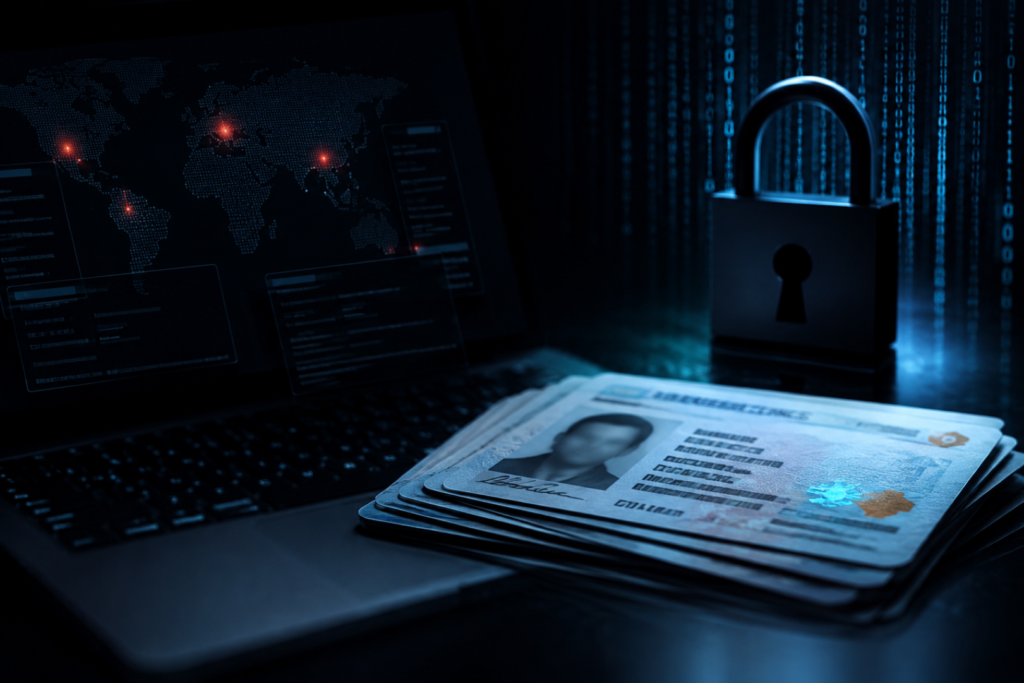
Introduction: Drivers License Data Breach — Why It Matters
Drivers License Data Breach reports have raised concerns after a dark web identity service called Nexus allegedly offered scans of more than 153 million U.S. and Canadian driver’s licenses. The FBI’s New Orleans field office is reportedly investigating the suspected source, while IDScan.net is investigating whether unauthorized access occurred.
The Drivers License Data Breach allegedly involves driver’s licenses, identification cards, travel documents and medical cards. Such records could support identity theft and fraud.
What Is IDScan.net?
IDScan.net is an identity-verification technology provider. Researchers reportedly found evidence linking some Nexus records to the company.
That link does not confirm an IDScan.net breach. The company is reportedly investigating whether unauthorized access occurred.
What Caused the Incident?
The cause has not been publicly established. Nexus reportedly claimed access to a large collection of identity-document scans, while researchers examined samples and identified possible links to IDScan.net.
Drivers License Data Breach: Factual Breakdown
Timeline of Events
- Before disclosure: Nexus reportedly claimed it had been obtaining identity data, although the method and duration remain unconfirmed.
- Late August 2026: Researchers examined sample records advertised by the service.
- September 1, 2026: Investigative reporting brought the alleged exposure to wider attention.
- After disclosure: Nexus reportedly disappeared from the dark web.
- September 2026: The FBI investigation and IDScan.net review were underway.
Reuters reported that the FBI was investigating the exposure and that the source had not been confirmed.
What Data Was Allegedly Affected?
The dataset allegedly includes:
- Front-and-back driver’s-license scans
- Identification cards
- Travel and international identity documents
- Medical cards
- Infrared and ultraviolet document images
Drivers License Data Breach: What You Need to Know
Identity and Financial Risk
Detailed identity documents can help criminals impersonate victims or conduct convincing social-engineering attacks. If combined with other personal information, the records could potentially support fraudulent account recovery, new-account fraud, SIM-swapping or financial scams.
Business and Reputational Risk
Organizations may face customer distrust, incident-response costs and regulatory scrutiny after unauthorized exposure.
Regulatory and Compliance Risk
NIST recommends safeguards against inappropriate access, use and disclosure of personally identifiable information, including access controls and monitoring.
Official Response / Statement
The FBI’s New Orleans field office is reportedly investigating the suspected source. No public finding has established the origin or scope of the records.
IDScan.net has not confirmed that it suffered a breach and is reportedly investigating whether unauthorized access occurred. Therefore, the 153 million figure should be treated as a claimed database size, not a confirmed count of affected individuals.
Nexus reportedly went offline after the Drivers License Data Breach became public. That does not establish that copies were deleted, because data offered on criminal marketplaces may already have been copied or redistributed.
Industry Context: Why Identity Data Is a High-Value Target
Identity-verification systems can hold highly sensitive documents used to establish a person’s identity. Identity records can be especially valuable when criminals combine them with information stolen from other sources.
The incident reinforces the need for data minimization, limited retention and strict access controls. Readers can follow CyberNexora’s cyber incidents coverage and learn-and-protect resources.
NIST guidance supports limiting PII access and using encryption and monitoring.
How to Protect Yourself or Your Organization
- Monitor financial accounts for unfamiliar transactions or account changes.
- Enable multi-factor authentication and use unique passwords for important accounts.
- Verify unexpected requests for identity documents through official channels.
- Watch for account-recovery or SIM-change activity that was not authorized.
- Review identity-theft protections such as fraud alerts or monitoring where available.
- Minimize data retention by deleting identity scans when legitimate retention requirements end.
- Apply least-privilege access and strong authentication to identity repositories.
- Encrypt sensitive records in storage and transit, while securely managing encryption keys.
Organizations can review CyberNexora’s Learn & Protect section for practical guidance.
Indicators of Compromise (IoCs)
No technical IoCs, such as malware hashes, IP addresses or malicious domains, have been publicly established for this incident.
Instead, individuals should watch for:
- Unexpected identity-verification requests
- Unrequested password resets
- Unfamiliar SIM or mobile-number changes
- Suspicious financial activity
- Messages using unusually accurate personal information
Key Takeaways
- Nexus reportedly advertised more than 153 million U.S. and Canadian driver’s-license scans.
- The FBI’s New Orleans field office is reportedly investigating the suspected source.
- IDScan.net has not confirmed a breach and is investigating the allegations.
- Strong access controls, encryption, monitoring and limited retention remain essential.
Conclusion: Drivers License Data Breach and What Happens Next
The Drivers License Data Breach remains an evolving investigation, not a confirmed finding about the source or total number of affected people.
Readers should watch for verified findings and formal notifications. Businesses should review access permissions, retention, encryption and monitoring now. Related developments can be followed through CyberNexora’s cyber incidents category.
Frequently Asked Questions(FAQs)
It refers to reports that Nexus offered more than 153 million U.S. and Canadian driver’s-license scans. The FBI is reportedly investigating the suspected source.
No. IDScan.net has not confirmed a breach and has reportedly said it is investigating whether unauthorized access occurred.
The reported dataset allegedly includes driver’s licenses, identification cards, travel documents, medical cards and detailed document images.
Yes. Genuine identity documents could potentially support impersonation, fraud, social engineering, account takeover and SIM-swapping.
Organizations should review access controls, encryption, retention, logging and incident-response procedures. Sensitive records should be limited to legitimate business needs.
There is no confirmed evidence that all copies were deleted after the service reportedly disappeared. Data shared on criminal marketplaces may already have been copied or redistributed.