
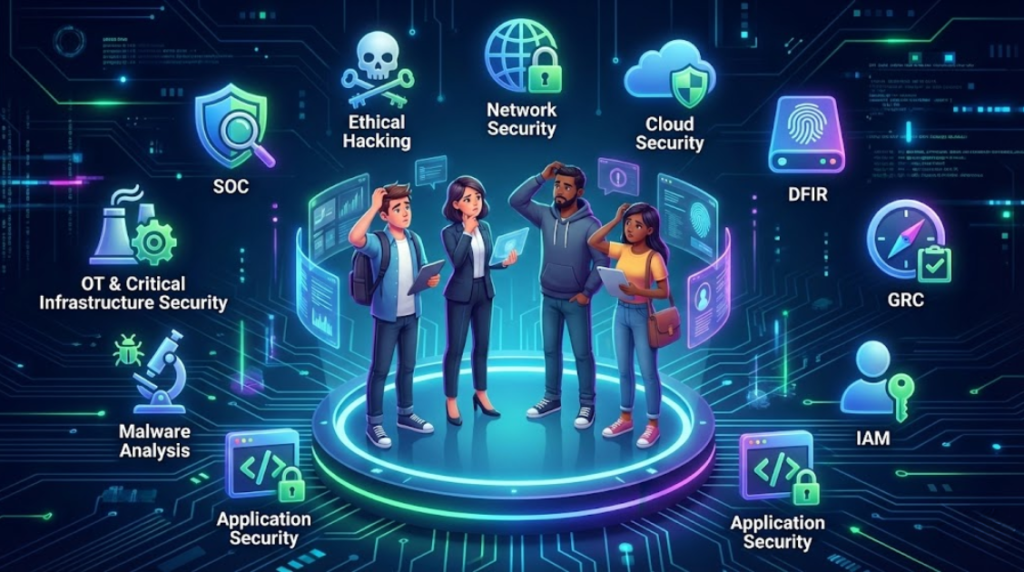
Cybersecurity is one of the most misunderstood fields in technology. Many people think it only means hacking, but in reality, cybersecurity is a large ecosystem of specialized domains, each with a unique role in protecting digital systems, users, and data.
This guide explains all major and currently relevant cybersecurity domains in a clear and structured way, so students can finally understand:
- what each domain actually does
- how domains differ from each other
- which domain matches their interests and skills
The aim is simple: no confusion, no hype, only clarity.
1. Security Operations Center (SOC)

A Security Operations Center (SOC) is the core monitoring hub of cybersecurity.
SOC teams work continuously to detect, analyze, and respond to security threats before they cause damage.
What happens inside a SOC:
- Continuous monitoring of logs and alerts
- Detection of suspicious or malicious activity
- Initial investigation of incidents
- Coordinating response actions
SOC professionals do not “hack.” They observe, analyze, and protect.
Who should choose SOC:
Students who like analysis, alerts, dashboards, and real-time security operations.
2. Ethical Hacking & Penetration Testing
Ethical hacking focuses on thinking like an attacker, but working legally.
The goal is to find weaknesses before criminals do.
Key responsibilities:
- Testing websites, networks, and applications
- Simulating real-world attacks with permission
- Identifying vulnerabilities
- Writing clear security reports
Ethical hackers do not break systems — they strengthen them.
Who should choose this domain:
Students who enjoy hands-on technical work, tools, and problem-solving.
3. Network Security
Network security protects how data moves between devices and systems.
This domain focuses on:
- Firewalls and network segmentation
- Secure routing and switching
- VPNs and encrypted communication
- Preventing unauthorized access
Without network security, even secure systems become exposed.
Who should choose this domain:
Students interested in networking concepts and infrastructure security.
4. Cloud Security
Modern organizations rely heavily on cloud platforms. Cloud security ensures that data and services in the cloud are correctly configured and protected.
Key areas include:
- Preventing misconfigurations
- Managing access permissions
- Protecting cloud workloads and storage
- Monitoring cloud activity
Most cloud breaches happen due to human misconfiguration, not hacking.
Who should choose this domain:
Students looking for high-demand, future-ready cybersecurity roles.
5. Digital Forensics & Incident Response (DFIR)

DFIR focuses on what happens after an attack.
This domain involves:
- Investigating security incidents
- Finding how an attack occurred
- Preserving digital evidence
- Supporting legal and internal investigations
DFIR professionals answer the question: “What really happened?”
Who should choose this domain:
Students who like investigation, analysis, and structured problem-solving.
6. Governance, Risk & Compliance (GRC)
GRC ensures that organizations follow security rules, standards, and laws.
This domain includes:
- Creating security policies
- Risk assessments
- Compliance with regulations and frameworks
- Security audits
GRC is essential for trust and legal safety.
Who should choose this domain:
Students who prefer policy, documentation, and organizational security.
7. Identity & Access Management (IAM)
IAM controls who can access what inside an organization.
Core responsibilities:
- Managing user identities
- Authentication systems
- Access permissions and roles
- Preventing unauthorized access
Most major breaches begin with identity misuse.
Who should choose this domain:
Students interested in enterprise systems and access control logic.
8. Application Security (AppSec)
Application security focuses on building security into software, not adding it later.
This domain includes:
- Secure coding practices
- Code reviews
- Security testing during development
- Fixing vulnerabilities early
AppSec helps prevent vulnerabilities before software goes live.
Who should choose this domain:
Students who enjoy coding and want to build secure applications
9. Malware Analysis & Threat Research
This domain studies how malicious software works.
Key activities:
- Analyzing malware behavior
- Understanding attack techniques
- Researching emerging threats
- Supporting threat intelligence
This is one of the most technically advanced domains.
Who should choose this domain:
Students interested in deep technical research and analysis.
10. OT & Critical Infrastructure Security
This domain protects industrial and essential systems.
Examples include:
- Power plants
- Manufacturing systems
- Transportation and healthcare infrastructure
Attacks here affect real lives, not just data.
Who should choose this domain:
Students interested in large-scale and national-level security systems.
How Should Students Choose a Domain?
There is no “best” domain in cybersecurity — only the right fit.
- Prefer monitoring and alerts → SOC
- Prefer testing and tools → Ethical Hacking
- Prefer investigation → DFIR
- Prefer rules and audits → GRC
- Prefer building systems → AppSec / Cloud Security
Cybersecurity careers are paths, not shortcuts
Final Conclusion
Cybersecurity is a field built on skills, responsibility, and continuous learning. Understanding the domains early helps students avoid confusion, wasted time, and wrong career choices.
This guide was written to educate, not impress — and to help students worldwide make informed decisions in a fast-changing digital world.