
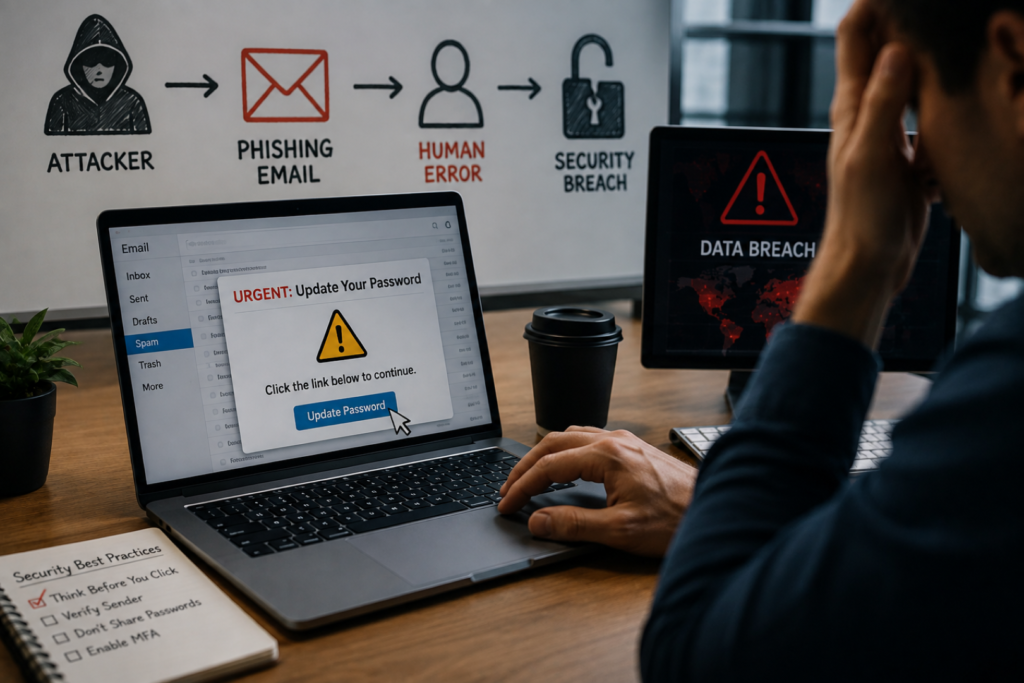
Introduction: Security Awareness — Why It Matters
Despite rapid advances in cybersecurity technologies, Security Awareness remains one of the strongest defenses against cybercrime. Security researchers continue to report that human error is responsible for a significant share of successful cyberattacks, allowing attackers to bypass even advanced technical safeguards.
Recent studies reveal that 71% of organizations experienced at least one identity-related security breach during the past year, while the SANS Security Awareness Report found that 80% of organizations consider social engineering their greatest human-related cyber risk. As AI-powered phishing, voice scams, and SMS-based attacks become increasingly sophisticated, organizations are recognizing that cybersecurity is no longer just an IT responsibility—it requires active participation from every employee.
What is Security Awareness?
Security awareness is the ongoing process of educating employees and users to recognize, avoid, and respond to cyber threats. Rather than relying solely on technical controls such as firewalls or antivirus software, organizations combine technology with employee education to reduce the likelihood of successful attacks.
A strong security awareness program typically includes:
- Phishing awareness training
- Password security best practices
- Multi-factor authentication (MFA)
- Safe email and web browsing habits
- Data protection guidelines
- Incident reporting procedures
Modern awareness programs focus on changing employee behavior instead of simply delivering annual compliance training.
Why Human Error Still Causes Most Cyberattacks
Cybercriminals understand that people are often easier to exploit than technology. Instead of attempting to break through sophisticated security systems, attackers frequently manipulate employees into revealing credentials, downloading malicious files, or approving fraudulent requests.
Some of the most common human-related security mistakes include:
- Clicking phishing emails
- Using weak or reused passwords
- Sharing sensitive information unintentionally
- Misconfiguring cloud services
- Falling for voice phishing (vishing)
- Responding to SMS phishing (smishing)
- Granting unnecessary user permissions
Artificial intelligence has made these attacks even more convincing. AI-generated emails now closely imitate legitimate business communications, making it increasingly difficult for users to distinguish genuine messages from fraudulent ones.
Security Awareness: Current Statistics & Industry Trends
Recent industry findings demonstrate why organizations are increasing investment in security awareness initiatives.
According to recent research:
- 71% of organizations experienced at least one identity-related breach during the past year.
- 80% of organizations identify social engineering as their leading human-related cybersecurity risk.
- AI-powered phishing campaigns are becoming more personalized and difficult to detect.
- Businesses are replacing annual awareness sessions with continuous, behavior-based security education.
- Identity management and least-privilege access controls are becoming standard cybersecurity practices.
Security leaders are also combining awareness training with phishing simulations, role-based education, and regular testing to improve employee readiness. These practical exercises help organizations identify risky behaviors before attackers can exploit them.
As cyber threats continue to evolve, organizations are increasingly adopting defense strategies that combine employee education with technical safeguards such as identity verification, zero-trust security models, and multi-factor authentication.
Potential Risks & Impact
Identity and Financial Risk
Successful phishing attacks can expose login credentials, financial information, and sensitive corporate data. Stolen identities may also be used for unauthorized access, business email compromise (BEC), or further cyberattacks.
Business and Operational Risk
Human errors can result in data breaches, operational disruptions, financial losses, and reputational damage. Even a single employee mistake may provide attackers with access to critical systems.
Regulatory and Compliance Risk
Organizations that fail to implement effective cybersecurity awareness programs may face compliance challenges under data protection regulations and industry security standards, particularly if preventable breaches occur.
Official Response
Cybersecurity experts and industry organizations continue to stress that awareness training must become an ongoing process rather than a once-a-year compliance exercise. Security leaders increasingly recommend combining employee education with phishing simulations, multi-factor authentication (MFA), identity verification, and least-privilege access to reduce human-related cyber risks.
Industry Context: Why Human Error Remains a Growing Cybersecurity Challenge
The rapid adoption of artificial intelligence has transformed how cybercriminals conduct phishing and social engineering attacks. AI-generated emails, cloned voices, and personalized SMS messages are making scams more convincing than ever before.
Organizations are therefore investing in continuous employee education alongside technical controls. Readers interested in similar cybersecurity trends can also explore CyberNexora’s Learn & Protect, Cyber Incidents, and Resources sections.
How to Protect Yourself and Your Organization
- Conduct regular cybersecurity awareness training for all employees.
- Enable Multi-Factor Authentication (MFA) on every critical account.
- Use strong, unique passwords with a password manager.
- Verify suspicious emails, phone calls, and text messages before responding.
- Apply the principle of least privilege to user accounts.
- Perform regular phishing simulations to improve employee readiness.
- Encourage immediate reporting of suspicious activities to the IT or security team.
Key Takeaways
- Human error continues to be one of the leading causes of cyberattacks.
- AI-powered phishing and social engineering attacks are becoming increasingly sophisticated.
- Continuous security awareness training is more effective than annual compliance sessions.
- Identity protection, MFA, and least-privilege access significantly reduce cyber risks.
- Every employee plays an important role in organizational cybersecurity.
Conclusion: Security Awareness and What Happens Next
As Security Awareness continues to evolve, organizations must recognize that cybersecurity depends as much on people as on technology. Employee education, identity protection, and continuous security awareness programs have become essential components of modern cyber defense.
Organizations that combine ongoing awareness training with technical safeguards such as MFA, phishing simulations, and access controls will be better prepared to defend against increasingly sophisticated AI-assisted cyber threats. For more cybersecurity awareness guides, visit CyberNexora’s Learn & Protect section.
Frequently Asked Questions(FAQs)
Security Awareness refers to modern cybersecurity education that helps employees recognize and prevent cyber threats such as phishing, social engineering, and identity attacks. It focuses on continuous learning rather than annual training sessions.
Employees can unintentionally click phishing links, use weak passwords, or expose sensitive information. Attackers often target people because exploiting human behavior is easier than bypassing technical security controls.
The most common threats include phishing emails, vishing, smishing, credential theft, weak passwords, accidental data exposure, and misconfigured systems.
Organizations should implement continuous security awareness training, enable MFA, conduct phishing simulations, apply least-privilege access, and encourage prompt incident reporting.
No. Cybersecurity awareness is a shared responsibility across the entire organization. Every employee plays a role in protecting business data and preventing cyber incidents.