
Introduction: Apple AI Security Updates — Why It Matters
Apple AI Security Updates mark a significant shift in how one of the world’s largest technology companies intends to defend its ecosystem against rapidly evolving cyber threats driven by artificial intelligence.
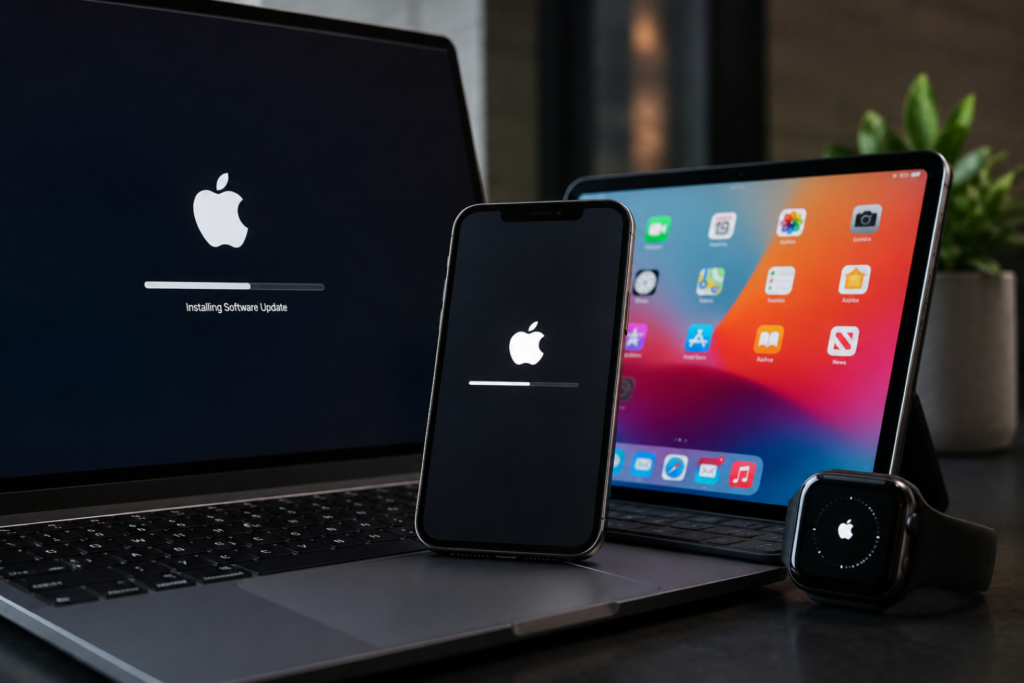
Apple has announced plans to deliver security patches much faster than before, reducing the time users must wait for critical fixes instead of bundling them primarily with major software releases. The decision comes as cybercriminals increasingly leverage artificial intelligence to discover vulnerabilities, automate attacks, and create sophisticated malware capable of exploiting newly discovered flaws within hours. Apple AI Security Updates represent a proactive approach to protecting users against rapidly evolving AI-powered cyber threats.
The Apple AI Security Updates initiative is expected to strengthen protection across iPhones, iPads, Macs, Apple Watches, and other Apple devices.
The announcement also arrives amid reports that the World Leaks ransomware group has claimed to have breached Tata Electronics and stolen approximately 200,000 confidential files, allegedly including information related to Apple’s upcoming iPhone 18 Pro. However, neither Apple nor Tata Electronics has confirmed these claims, and the alleged breach remains unverified.
As AI continues transforming both cybersecurity and cybercrime, organizations are increasingly recognizing that rapid patch management is becoming just as important as developing secure software.
What is Apple?
Apple is one of the world’s leading technology companies, developing a wide range of consumer devices and operating systems including:
- iPhone
- iPad
- Mac
- Apple Watch
- Apple TV
- visionOS devices
- iOS
- iPadOS
- macOS
- watchOS
For years, Apple has maintained a structured software release schedule consisting of feature updates, performance improvements, and security patches. While emergency updates have occasionally been released outside this schedule for actively exploited vulnerabilities, most security fixes traditionally arrived alongside larger operating system updates. Through its Apple AI Security Updates strategy, the company aims to deliver critical security fixes more efficiently across its ecosystem.
The company’s latest strategy signals a shift toward a more agile security model, enabling critical fixes to reach users much sooner after vulnerabilities are identified.
What Caused the Shift Toward Faster Security Updates?
Artificial intelligence has fundamentally changed the cybersecurity landscape. The Apple AI Security Updates initiative reflects Apple’s commitment to minimizing the exploitation window for newly discovered vulnerabilities.
Previously, attackers often relied on manual vulnerability research and handcrafted exploits that required considerable time and expertise. Today, AI-powered tools enable cybercriminals to accelerate nearly every stage of an attack.
Modern AI can assist attackers in:
- Identifying vulnerable software at scale
- Automating vulnerability discovery
- Generating exploit code more rapidly
- Creating sophisticated phishing campaigns
- Producing highly convincing social engineering content
- Deploying malware variants that continuously evolve
- Increasing the speed of ransomware operations
Because attackers can now move significantly faster than before, organizations have much less time to respond once a vulnerability becomes public.
Industry experts increasingly describe this period as the “exploitation window”—the time between public disclosure of a vulnerability and the installation of security updates by affected users. Reducing this window has become one of the most effective ways to limit successful cyberattacks.
Apple AI Security Updates: Full Technical Breakdown
The Apple AI Security Updates strategy focuses on reducing delays between vulnerability discovery and patch deployment.
Timeline of Events
- Apple announced plans to accelerate the release of critical software security updates.
- The new approach prioritizes delivering important patches without waiting for major operating system releases.
- The strategy is designed to counter the growing speed of AI-powered cyberattacks.
- The announcement follows increasing concern across the cybersecurity industry regarding AI-assisted vulnerability exploitation.
- Reports also surfaced alleging that the World Leaks ransomware group had breached Tata Electronics, although these claims remain unverified.
How the New Update Strategy Works
Under the Apple AI Security Updates strategy, Apple plans to release critical patches independently whenever necessary instead of waiting for scheduled operating system updates.
This approach offers several security advantages:
- Faster remediation of newly discovered vulnerabilities.
- Reduced exposure to zero-day exploitation.
- Improved protection against AI-assisted attack campaigns.
- Greater flexibility for responding to emerging threats.
- Better security coverage across Apple’s ecosystem.
The strategy aligns with a broader trend among major technology companies that are moving toward continuous security delivery instead of relying solely on traditional monthly or quarterly patch cycles.
Security teams have increasingly emphasized that the speed of patch deployment is becoming nearly as important as the quality of the security fix itself.
Apple Devices Expected to Benefit
The accelerated security update strategy is expected to enhance protection across Apple’s ecosystem, including:
- iPhone
- iPad
- Mac computers
- Apple Watch
- Apple TV
- Vision Pro and future Apple platforms
- Core Apple services supporting these devices
By reducing delays in patch distribution, Apple aims to provide more consistent protection regardless of device category.
The Role of AI in Modern Cyber Threats
Artificial intelligence has become a double-edged sword in cybersecurity.
While defenders increasingly rely on AI for threat detection, anomaly identification, and automated incident response, attackers are using the same technologies to improve offensive capabilities.
Some emerging AI-driven attack techniques include:
- Automated vulnerability scanning
- AI-generated phishing emails
- Deepfake-enabled social engineering
- Malware capable of modifying its behavior
- Intelligent credential stuffing attacks
- Automated reconnaissance against enterprise infrastructure
These capabilities significantly reduce the time required for attackers to launch sophisticated campaigns, increasing pressure on software vendors to deliver security updates more rapidly than ever before.
Alleged Tata Electronics Supply Chain Incident
The announcement regarding Apple’s accelerated security updates coincides with reports involving Tata Electronics, one of Apple’s major manufacturing partners.
According to unverified claims made by the World Leaks ransomware group, approximately 200,000 confidential files were allegedly stolen from Tata Electronics. The threat actor further claimed that some of the purportedly stolen information relates to Apple’s upcoming iPhone 18 Pro.
At the time of writing, Apple has not confirmed the alleged breach, and Tata Electronics has also not publicly verified the claims. Consequently, the reported incident should be treated as an allegation until official confirmation becomes available.
Regardless of the outcome of the investigation, the reports highlight the growing importance of supply chain cybersecurity, particularly for global technology manufacturers that depend on extensive networks of suppliers, contractors, and production partners.
Potential Risks & Impact
Apple’s decision to accelerate security updates reflects a broader reality: the pace of cyber threats is increasing dramatically due to artificial intelligence. Organizations can no longer rely solely on traditional update cycles, as attackers may exploit newly disclosed vulnerabilities within hours rather than weeks.
Identity and Privacy Risks
For individual users, delayed security updates can expose sensitive personal information to attackers. If vulnerabilities remain unpatched, cybercriminals may attempt to gain unauthorized access to devices or user accounts.
Potential risks include:
- Theft of personal information
- Credential compromise
- Financial fraud
- Unauthorized access to cloud accounts
- Spyware infections
- Identity theft
Rapid patch deployment helps reduce these risks by closing known security gaps before they can be widely exploited.
Business and Operational Risks
Organizations operating Apple devices across corporate environments also benefit from faster security releases. The Apple AI Security Updates approach helps enterprises reduce exposure to newly discovered vulnerabilities by enabling faster patch deployment.
Delayed patching can result in:
- Business disruptions
- Ransomware infections
- Unauthorized network access
- Data theft
- Increased recovery costs
- Productivity losses
Enterprises increasingly follow vulnerability management programs that prioritize critical updates immediately after release. Apple’s new strategy aligns well with modern cybersecurity practices that emphasize rapid risk reduction.
Supply Chain Cybersecurity Risks
The unverified claims involving Tata Electronics serve as another reminder that cybersecurity extends far beyond a company’s own infrastructure.
Large technology manufacturers depend on complex supply chains involving:
- Hardware manufacturers
- Software vendors
- Logistics providers
- Component suppliers
- Cloud service providers
- Third-party contractors
A compromise affecting any partner can potentially impact the broader ecosystem.
Although there is no official confirmation that Apple-related information was exposed, the reported claims demonstrate why organizations must continuously assess supply chain risks and strengthen vendor security requirements.
Readers interested in similar cybersecurity incidents can explore CyberNexora News for additional case studies.
Regulatory and Compliance Considerations
Governments and regulators worldwide continue emphasizing rapid vulnerability management as part of broader cybersecurity compliance.
Many cybersecurity frameworks—including those developed by standards organizations and regulatory agencies—recommend:
- Timely security updates
- Continuous vulnerability monitoring
- Risk assessments
- Secure software development
- Incident response planning
- Vendor security reviews
Organizations that delay security updates may face increased operational risk and, depending on applicable regulations, potential compliance challenges.
Read more about cybersecurity laws and government regulations affecting organizations worldwide.
Official Response / Statement
Apple announced its intention to accelerate the delivery of software security updates in response to increasingly sophisticated AI-powered cyber threats. According to Apple, Apple AI Security Updates are intended to provide users with faster protection against emerging cyber threats.
The company indicated that critical security fixes will be distributed more quickly rather than waiting for broader operating system release schedules, helping users receive protection sooner against newly discovered vulnerabilities.
Regarding the reported Tata Electronics incident, there has been no official confirmation from either Apple or Tata Electronics that a breach occurred or that Apple-related information was compromised.
The claims originate from the World Leaks ransomware group and therefore should be treated as unverified allegations until supported by official investigation findings or public statements.
As investigations continue, organizations should avoid drawing conclusions based solely on threat actor claims, as ransomware groups have historically exaggerated or misrepresented stolen data to increase pressure on victims.
Industry Context: Why AI-Powered Cyber Threats Are Increasing
Artificial intelligence is rapidly changing both defensive and offensive cybersecurity capabilities. The Apple AI Security Updates strategy reflects this industry-wide shift toward continuous vulnerability management.
Security vendors now use AI to:
- Detect anomalies
- Identify malware
- Automate threat hunting
- Improve incident response
- Reduce alert fatigue
Unfortunately, attackers are leveraging similar technologies.
Modern cybercriminal groups increasingly use AI to:
- Generate convincing phishing emails
- Discover software vulnerabilities
- Automate exploitation
- Improve malware evasion
- Analyze stolen information
- Scale cyberattacks across multiple targets
This technological shift significantly reduces the time between vulnerability disclosure and active exploitation.
Security experts increasingly refer to this trend as the “race against time,” where organizations must patch systems before attackers can weaponize newly discovered weaknesses. Governments and regulators worldwide, including the Cybersecurity and Infrastructure Security Agency (CISA), continue emphasizing rapid vulnerability management. Security experts believe Apple AI Security Updates align with the industry’s growing emphasis on continuous vulnerability management and rapid patching.
Discover more cybersecurity awareness and protection tips to strengthen your security posture.
How to Protect Yourself and Your Organization
Apple’s announcement highlights several best practices that organizations and individual users should follow to improve cybersecurity resilience. Installing Apple AI Security Updates as soon as they become available significantly reduces the risk of exploitation.
1. Install Security Updates Immediately
Enable automatic updates whenever possible and apply critical security patches as soon as they become available.
2. Monitor Security Advisories
Regularly review security bulletins from software vendors to stay informed about newly discovered vulnerabilities and recommended mitigations.
3. Enable Multi-Factor Authentication (MFA)
Protect Apple IDs and business accounts using MFA to reduce the risk of credential theft.
4. Strengthen Supply Chain Security
Organizations should:
- Evaluate vendor cybersecurity practices.
- Conduct regular third-party risk assessments.
- Require timely patch management from suppliers.
- Monitor for unusual activity across partner networks.
5. Deploy Continuous Threat Monitoring
Implement endpoint detection and response (EDR), security information and event management (SIEM), and network monitoring solutions to identify suspicious behavior before it escalates.
6. Train Employees on AI-Driven Threats
Security awareness programs should include education on:
- AI-generated phishing emails
- Deepfake scams
- Social engineering
- Credential protection
- Safe software update practices
Human awareness remains one of the strongest defenses against evolving cyber threats.
7. Maintain Regular Backups
Organizations should maintain encrypted, offline, and regularly tested backups to ensure rapid recovery from ransomware or other cyber incidents.
Indicators of Compromise (IoCs)
At the time of publication, Apple has not disclosed any specific Indicators of Compromise (IoCs) related to its accelerated security update initiative. Additionally, the alleged Tata Electronics incident remains unconfirmed, and no verified forensic indicators have been released.
Organizations should nevertheless monitor for common signs of compromise, including:
- Unusual login attempts from unfamiliar locations
- Unexpected privilege escalation or account changes
- Suspicious outbound network connections
- Unknown applications or processes running on endpoints
- Unauthorized modifications to system files
- Alerts related to known vulnerabilities affecting Apple devices
Security teams should follow official advisories from Apple and trusted cybersecurity authorities for any future IoCs or mitigation guidance.
Key Takeaways
- Apple is accelerating the release of critical security updates to reduce the time attackers have to exploit newly discovered vulnerabilities.
- AI-powered cyber threats are enabling attackers to automate reconnaissance, vulnerability discovery, phishing, and malware deployment at unprecedented speed.
- Faster patch deployment is expected to improve protection across iPhones, iPads, Macs, Apple Watches, and other Apple devices.
- Claims by the World Leaks ransomware group regarding an alleged breach of Tata Electronics remain unverified, with no confirmation from Apple or Tata Electronics.
- The developments highlight the growing importance of continuous vulnerability management, rapid patching, and supply chain cybersecurity.
Conclusion: Apple AI Security Updates and What Happens Next
Apple AI Security Updates demonstrate how major technology companies are adapting their security strategies to counter the rapidly evolving threat landscape shaped by artificial intelligence. As attackers increasingly automate cyberattacks and shorten the time required to exploit vulnerabilities, traditional software release cycles are becoming less effective for protecting users.
Although the reported Tata Electronics incident remains unconfirmed, it underscores the importance of strong supply chain security and cautious handling of third-party cybersecurity risks. Organizations and individual users alike should prioritize installing Apple AI Security Updates, timely software updates, continuous monitoring, and proactive cybersecurity practices.
Explore additional cybersecurity resources and practical security guidance for professionals and businesses.
Frequently Asked Questions(FAQs)
Apple AI Security Updates refer to Apple’s new approach of releasing critical security patches more quickly instead of waiting for major operating system updates. The goal is to reduce the time attackers have to exploit newly discovered vulnerabilities.
Apple is responding to the growing threat posed by AI-powered cyberattacks. Artificial intelligence allows attackers to identify vulnerabilities and automate attacks much faster than traditional methods, making rapid patch deployment increasingly important.
The accelerated update strategy is expected to protect a wide range of Apple products, including iPhones, iPads, Macs, Apple Watches, Apple TV, and future Apple platforms by delivering critical security fixes more promptly.
At the time of writing, there is no official confirmation that Tata Electronics was breached. Reports stem from claims made by the World Leaks ransomware group, and both Apple and Tata Electronics have not publicly verified the alleged incident.
Rapid security patches reduce the “exploitation window” between vulnerability disclosure and remediation. This makes it more difficult for cybercriminals to exploit known flaws before users install the necessary updates.
Organizations should implement timely patch management, enable multi-factor authentication, conduct regular security assessments, monitor third-party vendors, deploy continuous threat detection solutions, and train employees to recognize AI-assisted phishing and social engineering attacks.