
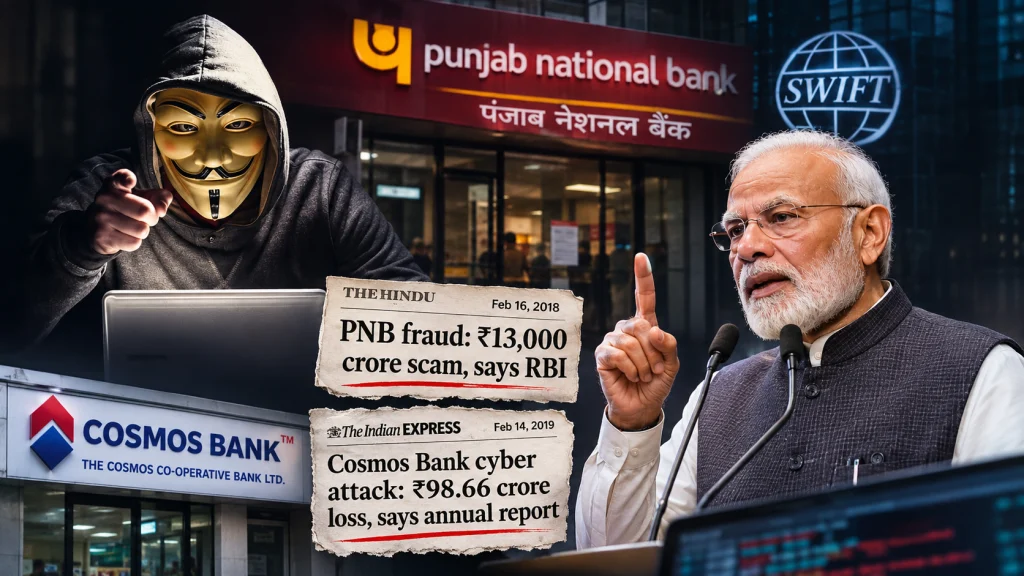
india’s banking infrastructure is becoming an increasingly important target for cybersecurity protection as the country rapidly expands its digital financial ecosystem. Prime Minister Narendra Modi has issued a serious warning about the growing threat of cybercriminals and cyberterrorists, highlighting how modern warfare can target a nation’s economy without conventional weapons.
The warning came on October 25, 2026, when PM Modi inaugurated the Reserve Bank of India’s (RBI) newly established Data Centre and Cybersecurity Training Institute at Info Valley-II in Jatni, near Bhubaneswar, Odisha.
Addressing senior government officials, financial sector representatives and banking professionals, the Prime Minister emphasised that protecting India’s banking system is essential as the country becomes economically stronger and increasingly dependent on digital financial services.
“Nowadays, wars are not fought with weapons alone. A nation can also be weakened by attacking its economy.”
PM Modi further stressed the need to protect India’s banking infrastructure from cyber looters and cyber terrorists, calling for modern technology, advanced infrastructure and specialised cybersecurity professionals.
His warning comes against the backdrop of increasing digital financial fraud, previous banking security incidents and the growing complexity of cyber threats targeting financial institutions worldwide.
The inauguration of the RBI’s new ₹169 crore facility is an important development in India’s efforts to strengthen financial infrastructure and improve cybersecurity capabilities.
PM Modi’s Full Cybersecurity Warning: What Did He Say?
During his October 25 address in Bhubaneswar, PM Modi connected India’s economic development with the need for stronger financial security.
He explained that the previous decade focused on expanding banking access to people who had previously been excluded from the formal banking system. The coming decade, he said, must focus on making banking more efficient and reliable.
However, the expansion of digital banking also creates new security responsibilities.
The Prime Minister highlighted three important requirements:
- Modern infrastructure to protect critical banking systems.
- Updated cybersecurity training and advanced security technologies.
- Skilled professionals capable of responding to rapidly evolving cyber threats.
He also emphasised that traditional security tools and outdated training methods are insufficient to address the changing nature of cyberattacks.
His message was particularly important because India’s financial ecosystem now supports millions of individuals, businesses and institutions through interconnected digital services.
The Prime Minister did not announce a specific upcoming cyberattack. Instead, he called for stronger preparedness against threats that could affect India’s financial and economic security.
Why Is India’s Banking System a Target for Cybercriminals?
India’s banking infrastructure has undergone a major digital transformation.
Customers can now transfer money, access bank accounts, make payments and manage financial activities through digital platforms without visiting physical bank branches.
This convenience depends on several interconnected technologies:
- Unified Payments Interface (UPI).
- Real-Time Gross Settlement (RTGS).
- National Electronic Funds Transfer (NEFT).
- Internet and mobile banking.
- ATM networks and payment gateways.
- Banking databases and core banking systems.
- Financial APIs and third-party service providers.
- Cloud infrastructure and enterprise applications.
These systems are essential to India’s financial operations.
However, cybercriminals can exploit weaknesses in digital applications, user authentication, internal controls, third-party integrations and financial processes.
A serious incident involving a critical financial institution could potentially cause service disruptions, expose sensitive information, facilitate fraudulent transactions or affect customer confidence.
The risk becomes even more significant when multiple institutions depend on shared technology providers and interconnected financial infrastructure.
This is why banking cybersecurity is increasingly considered a matter of national economic security rather than simply an IT management responsibility.
India’s Financial Cybercrime Statistics: 28 Lakh Complaints Reported in 2025
The RBI’s warning about financial security comes at a time when digital financial fraud has become a significant challenge for India.
According to the Reserve Bank of India’s discussion paper, “Exploring Safeguards in Digital Payments to Curb Frauds”, published on April 9, 2026, digital payment transaction volumes increased approximately 38 times over the preceding decade.
The same paper cited the following figures from the National Cyber Crime Reporting Portal (NCRP):
| Year | Reported complaints | Reported amount |
|---|---|---|
| 2021 | 2.6 lakh | ₹551 crore |
| 2022 | 6.9 lakh | ₹2,290 crore |
| 2023 | 13.1 lakh | ₹7,465 crore |
| 2024 | 24 lakh | ₹22,848 crore |
| 2025 | 28 lakh | ₹22,931 crore |
The reported amount associated with complaints reached approximately ₹22,931 crore in 2025.
These figures demonstrate the scale of India’s digital financial fraud problem.
Importantly, these are reported complaints and associated amounts, not confirmed cyber intrusions into bank servers or final verified financial losses.
The RBI also highlighted the increasing use of bogus call centres, deepfake-driven impersonation scams and money mule networks.
What Is Making Financial Fraud More Dangerous?
One important finding in the RBI discussion paper is that many digital payment frauds do not involve criminals directly breaking into a bank’s systems.
Instead, criminals manipulate customers into authorising payments themselves.
This is known as Authorised Push Payment (APP) fraud.
Common techniques include:
- Fake bank customer-care calls.
- Fraudulent KYC update messages.
- Fake investment and trading platforms.
- UPI payment request manipulation.
- Deepfake voice and video impersonation.
- Digital arrest scams.
- Phishing websites stealing banking credentials.
- Mule accounts used to receive and transfer fraudulent funds.
This creates a challenge for financial institutions because even a technically secure banking platform can be misused when customers are manipulated into authorising fraudulent transactions.
Previous Banking Incidents: PNB and Cosmos Bank Show the Financial Risks
India has already experienced major financial security incidents that demonstrate the importance of protecting banking infrastructure.
Two particularly important cases are the Punjab National Bank fraud and the Cosmos Cooperative Bank cyberattack.
1. Punjab National Bank Fraud – 2018
In 2018, one of India’s largest banking fraud cases came to light at Punjab National Bank (PNB).
The case involved fraudulent Letters of Undertaking (LoUs) and foreign letters of credit used in connection with import transactions.
According to the Ministry of Finance’s response in Parliament, PNB reported fraudulent transactions amounting to approximately ₹12,967.86 crore to the RBI.
The Reserve Bank clarified that the PNB incident involved operational risk arising from employee misconduct and failures in internal controls.
The case highlighted serious weaknesses in financial messaging processes, internal banking supervision and transaction authorisation controls.
Cybersecurity significance: The incident demonstrated why banks must strengthen access management, internal monitoring, transaction verification and security controls around financial messaging infrastructure.
An important distinction: the PNB case is primarily documented as a financial fraud and internal-control failure involving SWIFT-related processes, not as a confirmed external cyberattack on the bank’s core systems.
2. Cosmos Cooperative Bank Cyberattack – 2018
The Cosmos Cooperative Bank cyberattack in Pune was a genuine and significant banking cybersecurity incident.
During August 2018, hackers compromised the bank’s ATM payment gateway switch and SWIFT payment gateway.
According to the bank’s FY 2018–19 Annual Report, the attacks took place on August 11 and August 13, 2018.
The incident involved unauthorised transactions through international payment infrastructure and ATM-related operations.
The bank reported a net loss of ₹98.66 crore associated with the cyberattack.
The incident also affected day-to-day operations and payment systems until the security infrastructure was analysed and restored.
Cybersecurity significance: The Cosmos Bank incident demonstrated how a successful attack against payment infrastructure can result in financial losses and operational disruption.
It remains an important Indian banking cybersecurity case study.
3. International SWIFT Attacks and Financial Infrastructure Risks
The international financial sector has also experienced serious cyber incidents involving financial messaging systems.
The 2016 Bangladesh Bank cyber heist is one of the most widely discussed examples.
Attackers compromised the bank’s environment and used fraudulent SWIFT payment instructions to attempt the transfer of nearly US$1 billion.
Approximately US$81 million was successfully transferred before the fraudulent activity was detected and stopped.
The incident demonstrated that cybercriminals can target the technology and operational processes connecting financial institutions rather than simply attempting to steal customer passwords.
Why it matters for India: Financial institutions must secure their payment infrastructure, messaging environments, authentication systems and internal transaction approval processes.
These historical cases are examples of the risks that financial institutions must prepare for. They have not been identified as the direct cause of PM Modi’s October 2026 warning.
RBI Inaugurates ₹169 Crore Data Centre in Bhubaneswar
One of the most important developments behind PM Modi’s warning is the inauguration of the RBI’s new Data Centre in Odisha.
On October 25, 2026, the Prime Minister inaugurated the facility at Info Valley-II in Jatni, near Bhubaneswar.
According to reports, the project involved an investment of approximately ₹169 crore and covers an area of 18.55 acres.
The facility is intended to strengthen the technological foundation and resilience of India’s financial infrastructure.
Which Banking Systems Will the New Data Centre Support?
According to the RBI’s official announcement, the new Data Centre will house mission-critical systems, including:
Real-Time Gross Settlement (RTGS):
RTGS enables real-time settlement of high-value financial transactions between banks.
National Electronic Funds Transfer (NEFT):
NEFT provides an electronic mechanism for transferring funds between bank accounts across India.
Other Critical RBI Systems:
The facility will support important RBI applications and financial infrastructure.
The new facility is intended to improve the reach, efficiency and reliability of digital financial services.
It is important to note that UPI is operated by NPCI, not directly by the RBI Data Centre. The new facility supports critical RBI systems and the wider financial ecosystem rather than replacing NPCI’s UPI infrastructure.
Why Is a New Data Centre Important?
A modern financial data centre plays an essential role in:
- Protecting critical financial information.
- Supporting continuous banking operations.
- Improving infrastructure resilience.
- Strengthening business continuity.
- Supporting disaster recovery.
- Maintaining the availability of mission-critical applications.
Geographical separation between critical infrastructure facilities can also reduce the impact of localised disruptions.
The RBI’s new facility represents an important investment in the long-term resilience of India’s financial infrastructure.
RBI’s New Cybersecurity Training Institute: Building India’s Cyber Defence Workforce
Alongside the Data Centre, the RBI has established a dedicated Cybersecurity Training Institute.
The institute is expected to strengthen specialised knowledge and promote training and research in emerging technology fields.
Its focus areas include:
- Cybersecurity.
- Artificial Intelligence.
- Big Data Analytics.
- Enterprise Computing.
- Quantum Computing.
- Advanced financial technologies.
PM Modi specifically highlighted the need for updated cybersecurity training methods and skilled professionals.
The reason is straightforward: cyber threats are constantly changing.
Financial institutions require professionals who can identify security weaknesses, analyse suspicious activities, investigate cyber incidents and improve their security infrastructure.
The new institute is therefore important not only for technological development but also for building specialised cybersecurity capabilities.
RBI’s Other Cybersecurity Initiatives: AI, Cyber Range and Digital Fraud Prevention
The new Bhubaneswar facilities are not the only cybersecurity initiatives being undertaken by the Reserve Bank.
The RBI’s 2025–26 Annual Report describes several initiatives aimed at improving the resilience of the financial sector.
1. Cyber Range Initiative
The RBI has implemented a Cyber Range initiative to enhance cyber resilience across the banking sector.
Cyber Range platforms provide controlled environments for simulated cyber exercises and incident-response training.
These exercises can help financial institutions evaluate their preparedness for different cyber incident scenarios.
2. MuleHunter.AI
The RBI Innovation Hub has developed MuleHunter.AI to help identify suspicious money mule accounts.
Money mule accounts are bank accounts used to receive or transfer money obtained through fraudulent activities.
AI-based detection can help financial institutions identify suspicious account patterns and improve fraud prevention.
3. Digital Payment Intelligence Platform
The RBI has been developing a Digital Payment Intelligence Platform using AI and machine learning.
The proposed system aims to assess beneficiary risk through transaction-related information before a payment is executed.
This can support banks in identifying potentially suspicious transactions.
4. Digital Forensic Readiness
The RBI has also been working on digital forensic readiness requirements.
Digital forensic readiness helps organisations prepare to collect, preserve and analyse digital evidence when cybersecurity incidents occur.
This is important for incident investigation, regulatory compliance and potential legal proceedings.
5. AI-Related Cybersecurity Risk Assessment
As financial institutions increasingly adopt AI-based technologies, new risks can emerge involving data security, privacy, access controls and system reliability.
The RBI’s 2026–27 agenda includes assessing cybersecurity risks associated with the use of AI tools and systems by supervised financial entities.
Together, these initiatives indicate that India’s financial cybersecurity strategy is increasingly focused on prevention, detection, investigation and resilience.
What Types of Cyberattacks Could Threaten India’s Banking Infrastructure?
Financial institutions must prepare for different categories of cyber threats.
| Cyber threat | Potential impact |
|---|---|
| Ransomware | Disruption of critical systems and data availability |
| DDoS attacks | Banking websites and services becoming unavailable |
| Phishing | Theft of banking credentials |
| Business Email Compromise | Fraudulent financial instructions |
| API vulnerabilities | Unauthorised access to connected applications |
| Supply chain attacks | Compromise through third-party providers |
| Insider threats | Misuse of authorised access |
| AI-powered impersonation | Sophisticated identity and payment fraud |
| Data breaches | Exposure of sensitive customer information |
| Payment infrastructure attacks | Disruption of financial transaction services |
Why Are API and Third-Party Security Becoming Important?
Modern banks do not operate in isolation.
They depend on technology providers, payment gateways, software applications, cloud infrastructure and external service providers.
These connections create additional security responsibilities.
A weakness in a third-party application or an exposed API could potentially create security risks for connected financial services.
This makes regular security assessments, access-control reviews and third-party risk management increasingly important.
Could a Cyberattack Disrupt India’s Banking System?
A large-scale cyber incident could potentially affect the availability or reliability of financial services.
For example, a serious incident involving a critical payment service could temporarily disrupt transactions or delay access to banking facilities.
A data breach could expose sensitive customer or institutional information.
Ransomware could affect the availability of business applications, while compromised financial processes could facilitate fraudulent transactions.
However, it is important to distinguish between a possible threat scenario and a confirmed incident.
There is no verified official announcement in PM Modi’s October 25 speech confirming a planned nationwide attack against Indian banks.
His statement is a warning about the growing importance of preparedness, modern infrastructure and skilled cybersecurity professionals.
What Should Indian Banks and Financial Institutions Do Now?
The evolving threat landscape makes continuous cybersecurity assessment essential for financial institutions.
Banks and financial service providers should strengthen their security programmes across multiple areas.
1. Regular Vulnerability Assessment and Penetration Testing (VAPT)
Identify and assess security weaknesses in web applications, mobile applications, APIs, networks and critical systems.
2. API Security Assessment
Evaluate authentication, authorisation, access control, data exposure and security configurations across interconnected financial applications.
3. Network Security Monitoring
Monitor network infrastructure for suspicious activities and unauthorised access attempts.
4. Cloud Security Assessment
Review cloud configurations, identity permissions, data protection and security controls.
5. Security Operations Centre (SOC)
Establish continuous security monitoring and incident detection capabilities.
6. Incident Response Planning
Maintain documented procedures for investigating, containing and recovering from cybersecurity incidents.
7. Employee Cybersecurity Awareness
Train employees to recognise phishing, impersonation, suspicious communications and social engineering.
8. Third-Party Risk Management
Regularly assess technology providers, vendors and external service integrations.
For financial institutions, cybersecurity must be a continuous process rather than a one-time security assessment.
What Should Indian Banking Customers Do to Protect Their Money?
Cybersecurity is not only the responsibility of banks. Customers also need to follow essential security practices.
- Never share your OTP, UPI PIN, ATM PIN or banking password.
- Never install remote-access applications at the request of unknown callers.
- Avoid clicking suspicious banking links.
- Verify payment requests before approving transactions.
- Never scan a QR code simply to receive money.
- Enable transaction notifications.
- Regularly review your bank statements.
- Never allow unknown individuals to use your bank account for receiving or transferring money.
Where Should You Report Online Banking Fraud?
If you become a victim of financial cyber fraud in India:
National Cyber Crime Helpline: 1930
Official Reporting Portal: https://cybercrime.gov.in/
Contact your bank immediately and report the transaction as soon as possible. Prompt reporting may help authorities and financial institutions take action to prevent further losses.
What Does PM Modi’s Warning Mean for India’s Cybersecurity Industry?
PM Modi’s warning highlights the growing importance of cybersecurity across India’s financial and technology sectors.
As businesses and institutions become increasingly dependent on digital infrastructure, the demand for specialised security expertise is expected to remain important.
Several areas deserve particular attention:
- Banking and Financial Services cybersecurity.
- Application Security and VAPT.
- API Security Testing.
- Cloud Security.
- Digital Forensics.
- Threat Intelligence.
- Security Operations and Incident Response.
- AI Security and Risk Assessment.
- Third-Party Security Assessments.
The RBI’s new training institute also highlights the importance of developing skilled cybersecurity professionals.
For cybersecurity companies, security researchers and technology professionals, the financial sector represents an important area of expertise and responsibility.
Frequently Asked Question
What did PM Modi say about cyber terrorism in India?
On October 25, 2026, PM Modi warned that modern wars are not fought with weapons alone and that a country can also be weakened by attacks on its economy. He stressed the importance of protecting India’s banking system from cybercriminals and cyberterrorists.
Why did PM Modi warn about India’s banking system?
The warning highlighted the growing dependence of India’s economy on digital banking and financial infrastructure. The Prime Minister emphasised the need for modern data centres, advanced cybersecurity training and skilled professionals to counter evolving cyber threats.
What is the new RBI Data Centre in Bhubaneswar?
It is an RBI facility inaugurated by PM Modi on October 25, 2026, at Info Valley-II in Jatni, Odisha. Developed at an estimated cost of ₹169 crore, it will support critical financial systems, including RTGS and NEFT, and strengthen the resilience of India’s financial infrastructure.
Have Indian banks experienced major cyberattacks before?
Yes. Cosmos Cooperative Bank experienced a major cyberattack in August 2018 involving its ATM payment gateway and SWIFT payment gateway. India also experienced the major PNB financial fraud in 2018, involving fraudulent Letters of Undertaking and failures in internal controls. These incidents demonstrate different types of risks facing financial institutions.
Is India expecting a major banking cyberattack on November 17, 2026?
There is no verified official announcement confirming a nationwide cyberattack or banking shutdown scheduled for November 17, 2026. PM Modi’s October 25 warning focused on strengthening long-term financial cybersecurity and preparing against evolving threats, not predicting an attack on a specific date.