
Introduction: Vidar Malware Campaign Targets Businesses and Individual Users
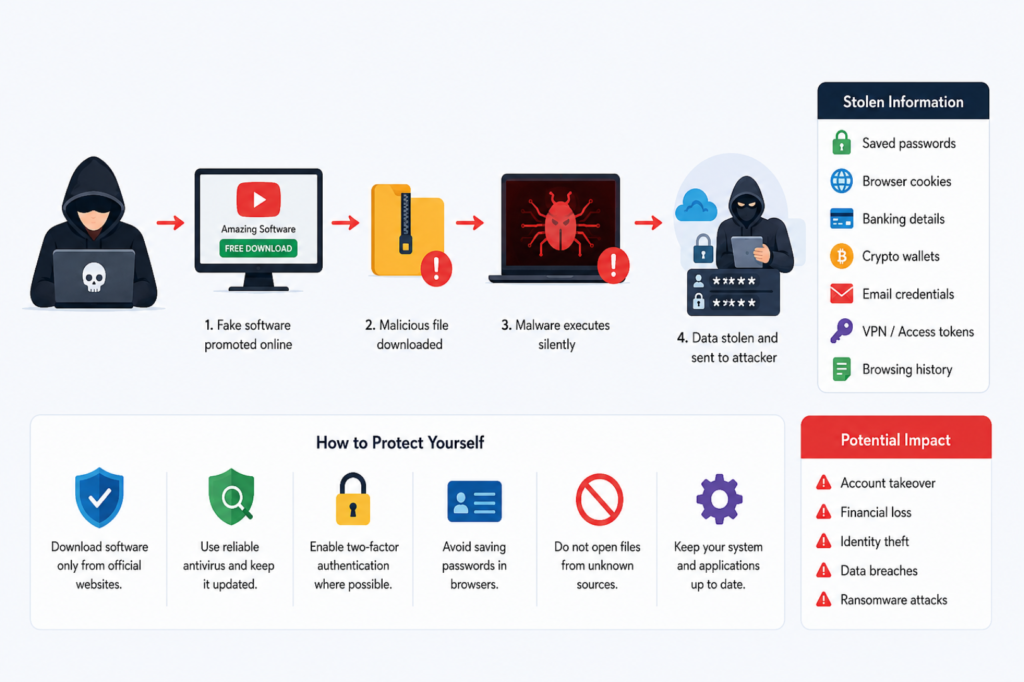
The Vidar Malware Campaign 2026 continues to target businesses through fake software downloads and credential theft operations.The latest Vidar Malware Campaign 2026 has become one of the most dangerous credential-stealing operations currently active in the cyber threat landscape. Cybercriminal groups are distributing the Vidar infostealer through fake software installers promoted across YouTube videos, malicious download pages, and deceptive file-sharing websites.
Security researchers observed attackers using social engineering techniques t o trick users into downloading infected applications disguised as legitimate software tools. Once executed, the malware silently steals login credentials, browser cookies, financial data, cryptocurrency wallet information, and corporate access tokens from infected systems.
Unlike traditional ransomware attacks that immediately disrupt systems, Vidar operates quietly in the background. This makes the threat particularly dangerous because organizations may remain compromised for long periods before detecting unauthorized access.
What is Vidar Malware?
Vidar Malware is a sophisticated information-stealing malware family first identified in 2018. Over time, the Credential Stealing Malware evolved into a highly advanced Malware-as-a-Service (MaaS) platform widely used by cybercriminal groups worldwide.
The primary objective of Vidar is to collect sensitive user and enterprise data from compromised Windows devices.
Vidar Malware Capabilities
The malware can steal:
- Saved browser passwords
- Session cookies
- Banking information
- Cryptocurrency wallet files
- Browser autofill data
- FTP and email credentials
- Corporate VPN access credentials
- Authentication tokens
- Browser history and downloaded files
Researchers also confirmed that modern variants of Vidar include advanced stealth and evasion mechanisms that help bypass traditional antivirus detection systems.
How the Vidar Malware Campaign Works
1. Fake Software Promotion Through YouTube
Threat actors upload videos promoting cracked software, productivity tools, gaming utilities, or fake corporate applications. Users are redirected to malicious download links hosted on third-party file-sharing platforms.
These campaigns heavily rely on trust manipulation and realistic branding.
2. Malicious Archive Delivery
Victims download compressed archives containing files that appear legitimate. In many cases, researchers identified a fake executable such as:
NeoHub.exe- Fake installers
- Modified browser-related files
The visible application appears harmless while hidden malicious components execute silently in the background.
3. Payload Execution
Once launched, the Credential Stealing Credential Stealing Malware loads hidden DLL files and establishes persistence within the infected environment. Some variants use:
- PowerShell execution
- DLL sideloading
- Fileless execution methods
- Memory injection techniques
Modern Vidar campaigns also abuse trusted Windows binaries to avoid detection.
4. Data Theft and Exfiltration
The Credential Stealing Malware collects sensitive information from browsers and local applications before transmitting the stolen data to attacker-controlled infrastructure.
Researchers observed the malware targeting browsers including:
- Google Chrome
- Microsoft Edge
- Mozilla Firefox
- Opera
- Vivaldi
- Waterfox
- Pale Moon
The stolen information is often sold on underground cybercrime marketplaces or used in follow-up ransomware and phishing attacks.
Technical Analysis of the Vidar Infostealer
Recent investigations show that Vidar 2.0 introduced major improvements in stealth and operational efficiency. Security researchers warn that the Vidar Credential Stealing Malware Campaign 2026 uses advanced evasion techniques to bypass traditional security tools.
Key Technical Features
Advanced Evasion Techniques
Vidar variants use:
- Obfuscated payloads
- Polymorphic builds
- Inflated executable sizes
- Anti-debugging functionality
- Virtual machine detection
These techniques reduce detection rates during security scanning.
API-Level Credential Interception
Newer variants reportedly intercept credentials before encryption occurs by targeting Windows cryptographic APIs directly.
This enables attackers to steal:
- Plaintext credentials
- Session tokens
- Browser authentication data
before traditional protection mechanisms activate.
Multi-Stage Infection Chains
Modern campaigns frequently use:
- Fake CAPTCHA pages
- Compromised WordPress sites
- GitHub repositories
- Discord and Reddit lures
- Fake software repositories
to distribute the malware at scale.
Potential Risks of Vidar Malware Infections
Credential Theft
The primary danger is unauthorized access to:
- Corporate accounts
- Cloud services
- VPN infrastructure
- Email systems
- Banking platforms
Session Hijacking
Stolen browser cookies may allow attackers to bypass multi-factor authentication in some cases.
Financial Losses
Attackers target cryptocurrency wallets and financial information, creating direct monetary risks for victims.
Secondary Cyber Attacks
Compromised credentials can later be used for:
- Business email compromise
- Ransomware deployment
- Data breaches
- Corporate espionage
- Supply chain attacks
Indicators of Compromise (IoCs)
Organizations should monitor for:
- Suspicious browser activity
- Unknown DLL execution
- Unusual PowerShell commands
- Unauthorized outbound connections
- Browser session hijacking attempts
- Fake software downloads from unofficial sources
- Unexpected credential access alerts
Security teams should also investigate systems showing abnormal authentication behavior after users download unofficial software tools.
Why Vidar Malware is Growing Rapidly
Researchers believe Vidar gained popularity after law enforcement disruptions affected competing infostealer operations such as Lumma and Rhadamanthys. Cybercriminal groups quickly shifted toward Vidar due to its reliability and flexibility.
The malware’s continued evolution demonstrates how cybercriminal ecosystems rapidly adapt after major takedowns.
Security Recommendations for Organizations
1. Restrict Unauthorized Software Downloads
Employees should avoid downloading:
- Cracked applications
- Unverified installers
- Software shared through YouTube descriptions
- Unknown file-sharing platform downloads
2. Deploy Endpoint Detection and Response (EDR)
Modern EDR solutions can help identify:
- Suspicious DLL sideloading
- Credential dumping behavior
- Fileless malware execution
- Browser data exfiltration
3. Enable Multi-Factor Authentication
Although cookie theft remains dangerous, MFA still significantly reduces risk exposure for most attacks.
4. Monitor Browser Credential Storage
Organizations should minimize browser-based credential storage policies for sensitive systems.
5. Conduct Employee Awareness Training
Users should be trained to recognize:
- Fake software installers
- Social engineering attempts
- Malicious download links
- Suspicious YouTube promotions
User Protection Guidelines
Individual users can reduce risk by:
- Downloading software only from official vendor websites
- Avoiding pirated or cracked applications
- Keeping operating systems updated
- Using reputable security software
- Monitoring account login activity regularly
- Clearing stored browser passwords when unnecessary
Conclusion: Vidar Malware Campaign 2026 Highlights Growing Infostealer Threats
The Vidar Malware Campaign 2026 highlights the growing risks of modern infostealer malware targeting corporate credentials. The Vidar Malware Campaign 2026 demonstrates how modern cybercriminal groups increasingly rely on stealth-based credential theft instead of highly visible attacks. By abusing trusted platforms, fake software downloads, and social engineering techniques, attackers can silently compromise users and enterprise environments at scale.
The campaign also highlights the growing importance of browser security, secure credential management, and user awareness in defending against modern infostealer malware.
As cyber threats continue evolving, organizations and individuals must adopt proactive cybersecurity strategies to detect and prevent credential-focused malware attacks before they escalate into larger breaches or ransomware incidents.