
Introduction
The growing number of GraphQL API security risks identified in 2026 has raised serious concerns across the cybersecurity industry. Security researchers continue discovering vulnerable GraphQL implementations exposing sensitive user information, internal application structures, authentication systems, and backend infrastructure details. As more enterprises adopt GraphQL for modern applications and cloud services, attackers are increasingly targeting insecure API environments.
The rise in GraphQL API security risks highlights how API security has become one of the most critical areas of modern cybersecurity. Organizations using GraphQL often prioritize flexibility and development speed, but weak security controls can create severe exposure risks if APIs are not properly configured.
Cybersecurity analysts warn that insecure GraphQL deployments may enable attackers to abuse introspection queries, bypass authorization controls, manipulate nested requests, and extract excessive amounts of sensitive data. Because GraphQL APIs often sit at the center of cloud applications, mobile services, SaaS platforms, and AI-driven systems, exploitation can have significant operational and business consequences.
Why GraphQL APIs Are Becoming High-Value Attack Targets
The increase in GraphQL API security risks is directly connected to the rapid growth of API-driven architectures. GraphQL allows developers to request highly customized data responses, making applications faster and more flexible compared to traditional REST APIs.
However, this flexibility also increases security complexity.
Common Reasons Attackers Target GraphQL APIs
- Centralized access to sensitive data
- Flexible query structures
- Weak access control implementations
- Excessive data exposure risks
- Insecure development configurations
Researchers report that many organizations deploy GraphQL services without implementing advanced security controls, creating opportunities for attackers to exploit misconfigured environments.
Major GraphQL API Security Risks Identified by Researchers
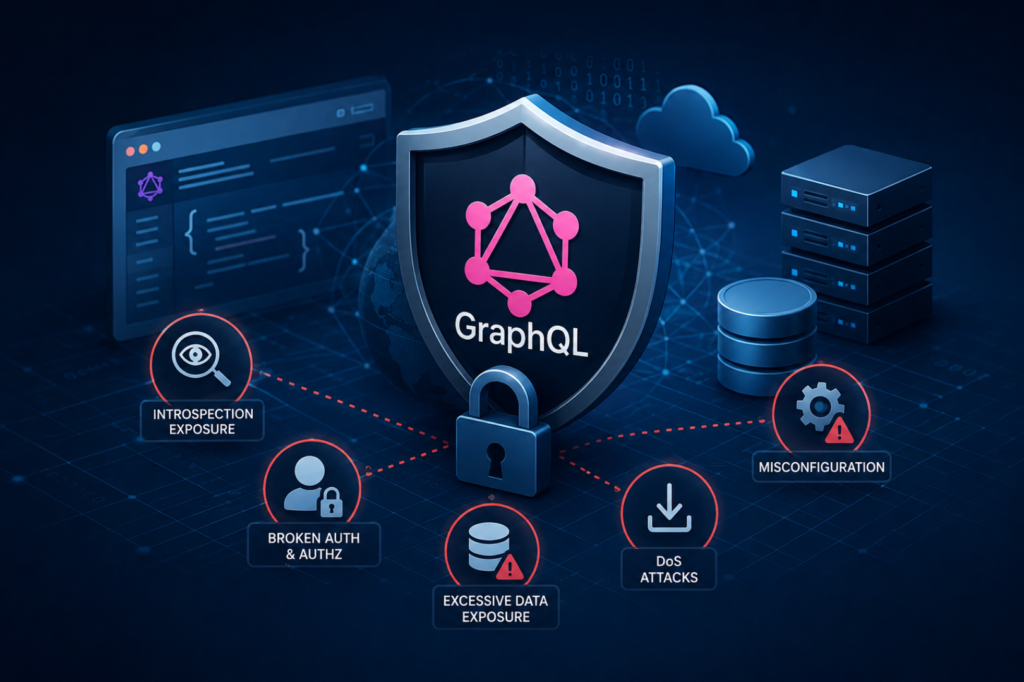
1. GraphQL Introspection Exposure
One of the most common GraphQL API security risks involves leaving introspection enabled in production environments.
Why It Matters
Introspection allows attackers to:
- Discover API schemas
- Identify backend objects
- Analyze application logic
- Map administrative functions
Attackers frequently use introspection to gather intelligence before launching targeted exploitation attempts.
Security Recommendation
- Disable introspection in production
- Restrict schema visibility
- Limit debugging features
2. Broken Authentication and Authorization
Weak authentication remains one of the most dangerous GraphQL API security risks affecting enterprise environments.
Potential Consequences
- Unauthorized data access
- Exposure of private records
- Account takeover opportunities
- Administrative privilege abuse
Researchers found that many GraphQL applications validate permissions only at the API endpoint level rather than enforcing object-level security controls.
Protection Measures
- Implement role-based access control
- Enforce token validation
- Use multi-factor authentication
- Apply object-level authorization checks
3. Excessive Data Exposure Risks
Excessive data exposure continues to be a major concern linked to GraphQL API security risks.
Because GraphQL allows highly customized queries, poorly secured APIs may expose:
- Email addresses
- Financial records
- Internal identifiers
- User profile information
- Backend configuration details
Without strict query restrictions, attackers can retrieve more data than intended through a single request.
4. Denial-of-Service Attacks Through Query Abuse
Another growing issue involving GraphQL API security risks is abuse of nested or recursive queries.
Attackers may intentionally send resource-intensive requests designed to:
- Exhaust server resources
- Increase CPU usage
- Trigger application slowdowns
- Cause API downtime
Recommended Protections
- Implement rate limiting
- Restrict query depth
- Apply query complexity analysis
- Configure execution timeouts
5. API Misconfiguration and Security Gaps
Many recent incidents involving GraphQL API security risks were caused by insecure default configurations and poor API governance.
Common Misconfigurations
- Publicly exposed endpoints
- Missing authentication enforcement
- Weak input validation
- Insecure development testing environments
- Lack of API monitoring
Misconfigured APIs can unintentionally expose sensitive business logic and customer information.
Business Impact of GraphQL API Security Risks
The consequences of insecure GraphQL environments extend beyond technical vulnerabilities.
Operational Risks
- Service disruptions
- Increased attack surface
- API abuse campaigns
- Infrastructure instability
Financial Risks
- Regulatory penalties
- Incident response costs
- Data breach expenses
- Legal liabilities
Reputational Risks
- Loss of customer trust
- Negative cybersecurity publicity
- Investor concerns
- Brand reputation damage
Organizations operating in healthcare, fintech, SaaS, and cloud services face particularly high risks because APIs often process large amounts of sensitive data.
Best Practices to Reduce GraphQL API Security Risks
Cybersecurity professionals recommend implementing layered security strategies to reduce exposure.
Disable Introspection in Production
Disabling introspection significantly reduces schema visibility for attackers.
Implement Rate Limiting
Rate limiting helps prevent:
- Automated attacks
- API scraping
- Resource abuse
- Denial-of-service attempts
Use Strong Authentication and Authorization
Organizations should:
- Validate every request
- Apply least-privilege access
- Restrict administrative functions
- Monitor suspicious API activity
Monitor and Audit API Traffic
Continuous monitoring helps identify:
- Abnormal query behavior
- Unauthorized access attempts
- Excessive request patterns
- Potential exploitation indicators
Future Outlook for GraphQL API Security
The increasing adoption of cloud-native applications, AI systems, and microservices architectures means GraphQL API security risks will continue growing in importance.
Security experts expect:
- Increased API-targeted attacks
- More regulatory focus on API protection
- Stronger API governance frameworks
- Greater investment in API security tools
As organizations continue relying on interconnected digital services, API security will remain a critical part of enterprise cybersecurity strategies.
Conclusion
The rise in GraphQL API security risks demonstrates how modern APIs have become one of the most attractive targets for cybercriminals. While GraphQL provides powerful flexibility and performance benefits, insecure implementations can expose organizations to serious threats involving data leakage, unauthorized access, and service disruption.
Security researchers continue warning that GraphQL API misconfigurations remain widespread across enterprise environments. Organizations must prioritize secure authentication, query limitation, access control enforcement, and proactive monitoring to reduce evolving API threats.
As digital ecosystems become increasingly API-driven, strengthening GraphQL security practices will be essential for protecting sensitive data and maintaining operational resilience.
What are GraphQL API security risks?
GraphQL API security risks involve vulnerabilities or insecure configurations that may expose sensitive data, enable unauthorized access, or allow abuse of API functionality.
Why are attackers targeting GraphQL APIs?
Attackers target GraphQL APIs because they often provide centralized access to large amounts of application data and backend functionality.
How can organizations reduce GraphQL API security risks?
Organizations should disable introspection, implement rate limiting, enforce strong authentication, restrict query complexity, and continuously monitor API activity.
What is GraphQL introspection abuse?
Introspection abuse occurs when attackers use schema discovery features to map backend structures and identify attack opportunities.
Can GraphQL APIs expose sensitive data?
Yes. Poorly secured GraphQL APIs may unintentionally expose customer records, authentication details, internal objects, or configuration information.